Enterprise
34 articles tagged "Enterprise"
Enterprise AI adoption requires infrastructure that balances innovation speed with security, compliance, and cost controls. These articles address the organizational, technical, and governance challenges that large organizations face when scaling AI across teams.
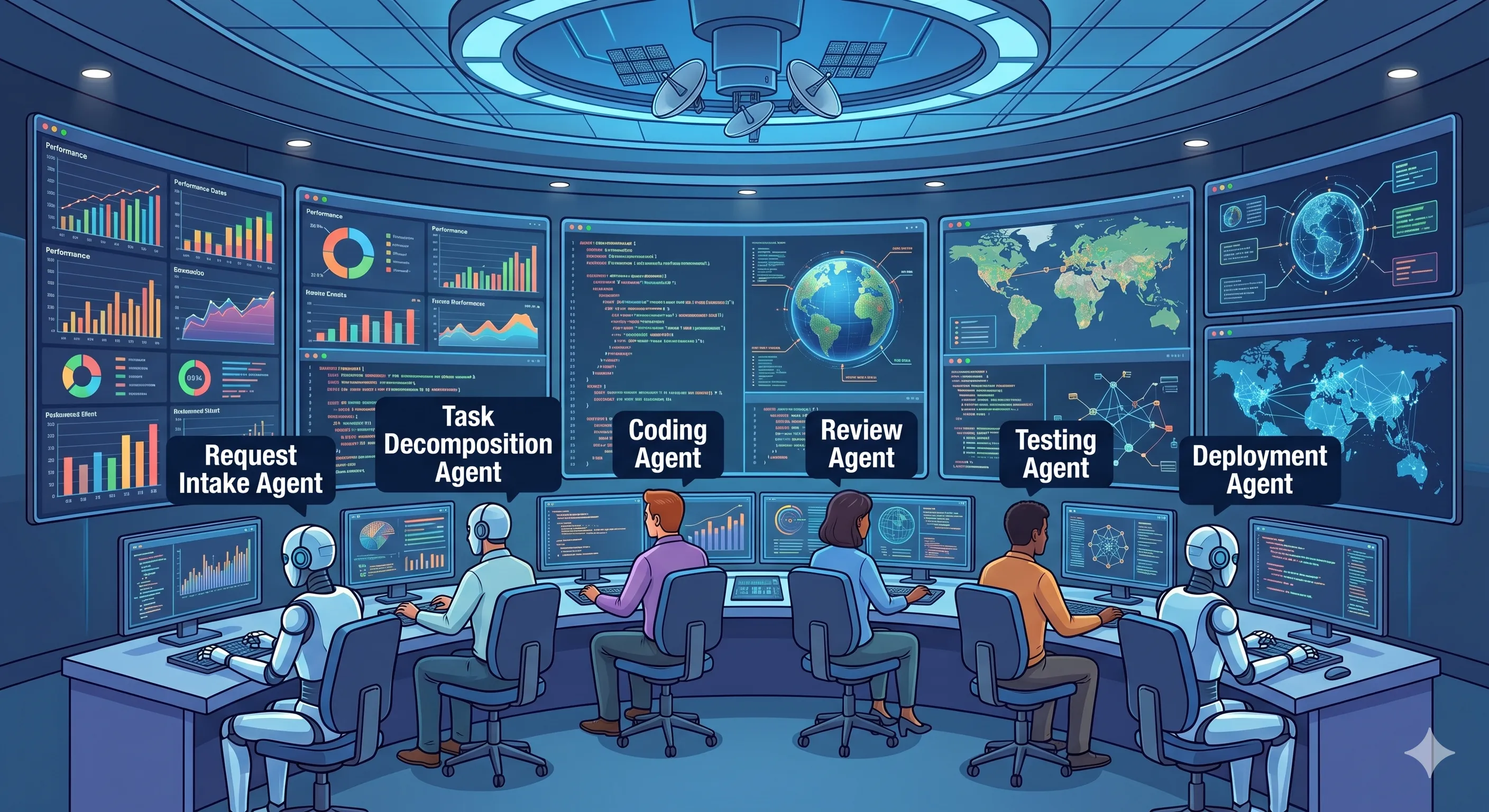
Agent Workflows in Enterprise Software Development
Single-agent prompting got you a productive autocomplete. Multi-agent workflows turn coding agents into a coordinated team — and that's a different engineering problem.
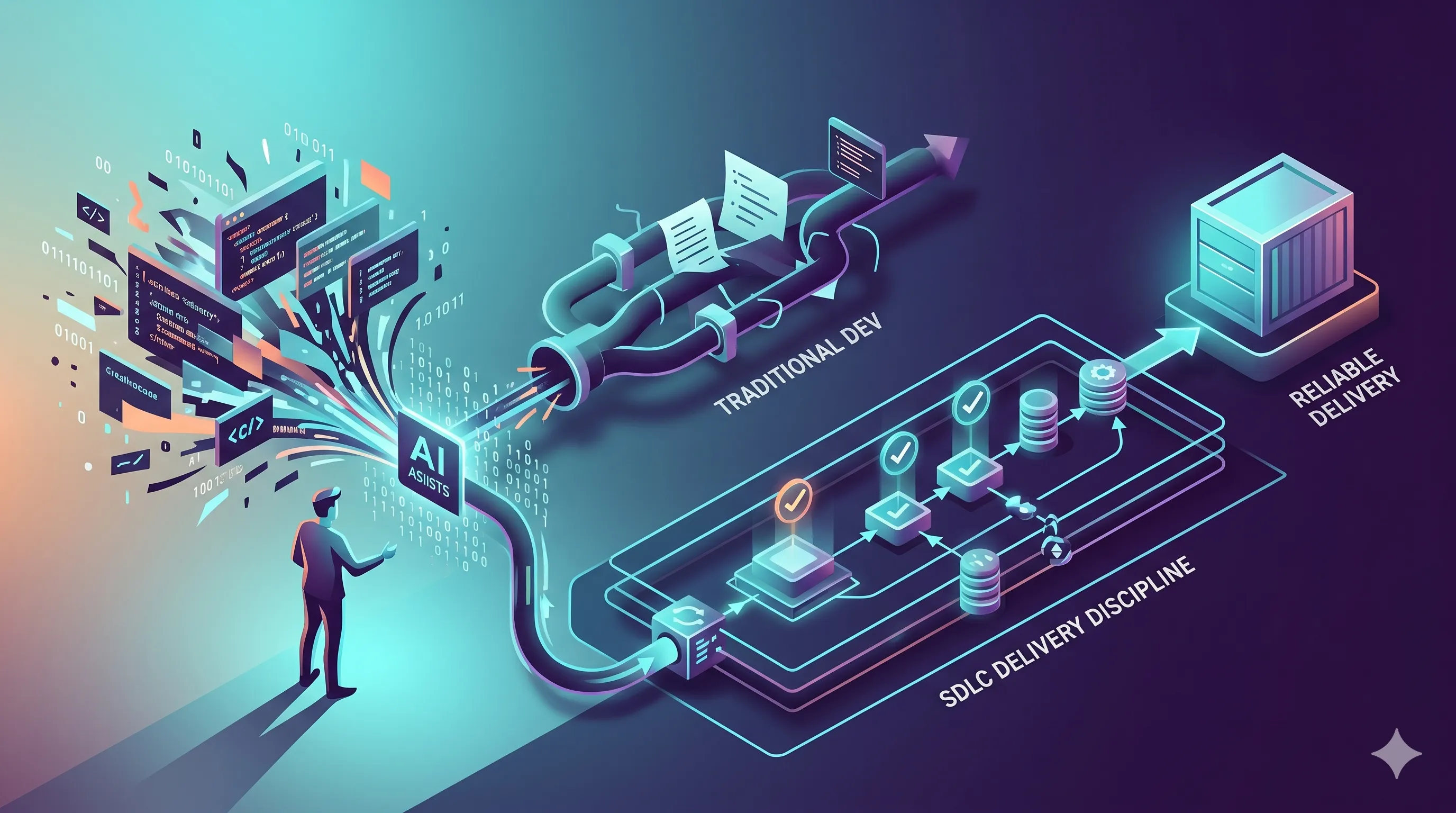
From AI Software Developer to AI Software Delivery: SDLC Discipline as the Real Differentiator
The right procurement question isn't whose AI engineer is best. It's whose delivery process is most defensible. Five disciplines + an RFP question bank for buyers.
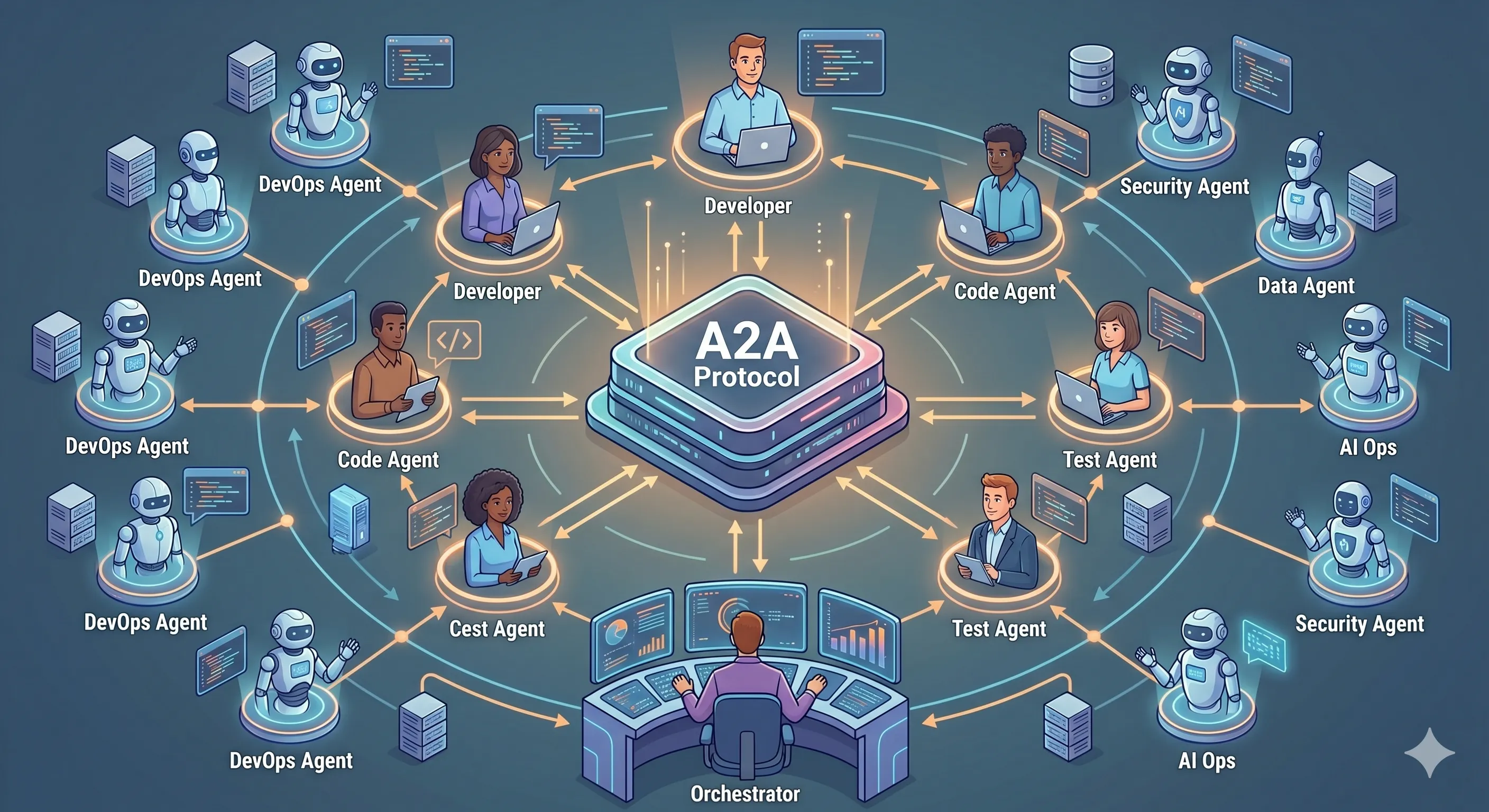
The A2A Protocol: Multi-Agent Orchestration for Software Teams
Agents have a tools protocol (MCP) and a teamwork protocol (A2A). Here's how A2A makes specialized AI agents from different vendors and teams actually cooperate on software work.
VibeFlow vs Devin vs Linear: AI-Native Software Development Platform Comparison
Three different bets on AI-native software development: a multi-agent SDLC platform, an autonomous coding agent, and an AI-augmented PM tool. Here's how to compare them.

Weekly AI Command: The Tech Launchpad (Week Ending April 4, 2026)
The first week of April 2026 has marked a definitive shift in the equilibrium of the AI industry. The tension between open-source accessibility and proprietary dominance has reached a boiling point. We are seeing a divergence: high-performance multimodal models are becoming available for local ex...

AI Coding at Scale: Governance Challenges Solo Tools Can't Solve
AI coding tools boost individual velocity but create organizational friction at scale. Here are the 5 challenges and the platform approach that solves them.
AI Governance Maturity Model: From Ad Hoc to Automated in 5 Levels
Most organizations are at Level 1 and don't know it. Here's a 5-level AI governance maturity model with a self-assessment checklist.
From Individual Copilots to Team-Wide AI Orchestration
Every technology follows the same arc: individual adoption, team coordination, organizational governance. AI coding is at the inflection point.
MCP Architecture: The Enterprise Integration Pattern for AI Coding
Every AI coding tool speaks its own language. MCP is the protocol that unifies them. Here's how it works and why enterprises need a gateway.

Why Enterprise Teams Outgrow Cursor and Devin
Solo AI coding tools boost individual velocity. But at scale, the governance gaps they create become bigger than the productivity gains.

CISO Guide to AI Agent Security: Threat Models for Code Agents
AI coding agents are autonomous actors in your codebase. Here are the 5 threat categories CISOs must address and the defense-in-depth controls that actually work.
Building an AI Audit Trail: From Model Selection to Production
A practical guide to implementing AI audit trails. Learn the 5 layers of traceability every enterprise needs for AI-generated code.
Enterprise AI Risk Management: Beyond Checkbox Compliance
Move from reactive AI compliance to proactive risk management. A CISO's guide to the 4 AI risk categories and a 90-day governance playbook.
Weekly AI Command: The Recap (March 15-20, 2026)
The middle of March 2026 has brought the industry to a definitive crossroads. We are moving past the era of "move fast and break things" into a period defined by high-stakes friction between federal oversight, state-level legislation, and the Pentagon's demand for unrestricted access to frontier AI.
Weekly AI Command: The Tech Launchpad (March 15-20, 2026)
This was the week the AI industry stopped debating model intelligence and started fighting over who controls the desktop. Between a transformative open-source architecture release, Meta's aggressive move into local AI agents, and OpenAI's internal reckoning with product sprawl, March 15-20 made o...
What is OpenClaw? An Executive Overview & Governance Guide
OpenClaw is the fastest-growing open-source AI agent runtime, surpassing 250K GitHub stars. This executive guide covers its architecture, shadow AI risks, and how enterprises can govern local autonomous agents.
Weekly AI Command: The Recap (March 15, 2026)
The pace of AI development is no longer measured in months or quarters. It is measured in days. This week alone, we witnessed the release of two frontier-grade models, a geopolitical standoff involving the world’s most advanced LLMs, and a hardware pivot that signals a shift in the global compute...
Weekly AI Command: The Tech Launchpad (March 15, 2026)
The era of AI experimentation has officially closed. We have entered the era of execution.
The Hidden Risks of Vibecoding: Why Your Enterprise Operations Need Verifiable AI Governance
Vibecoding is the latest shift in software development. It feels like magic: prompting an LLM, watching code appear, and seeing a feature go live in minutes. It’s the ultimate "move fast" strategy. But for the modern enterprise, moving fast without a map is just a faster way to hit a wall.
From Vibes to Verifiable: The New Standard for AI Production Readiness with VibeFlow
Most enterprise AI initiatives today aren't failing because the models are unintelligent. They are failing because the execution is built on a foundation of "vibes."
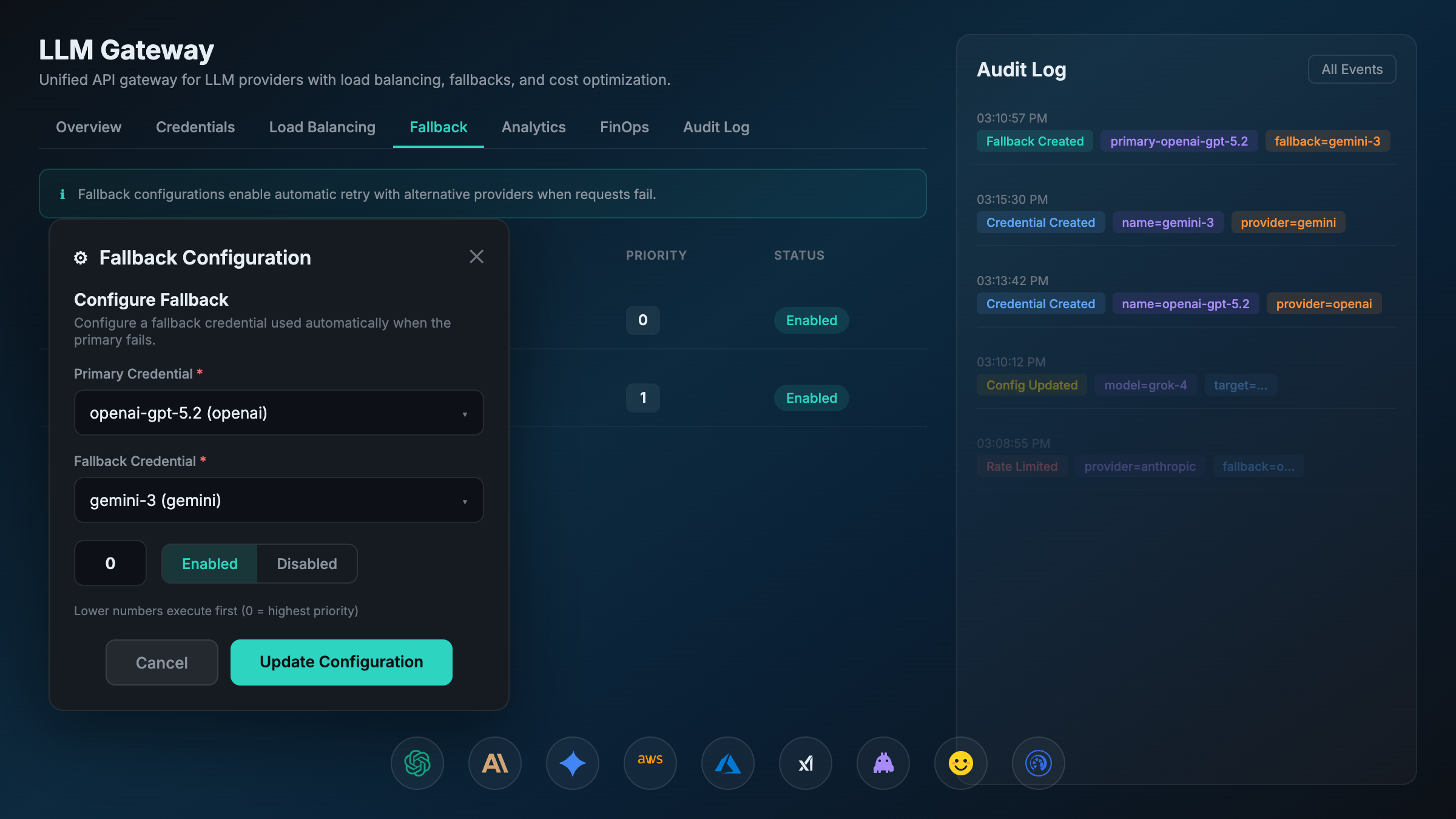
VibeFlow CLI with LLM Gateways: Technical Guide
VibeFlow CLI (vibeflow-cli) is a session orchestrator for AI-powered development agents. It manages tmux sessions, git worktrees, and provider lifecycles — launching agents like Claude Code, OpenAI Codex CLI, and Google Gemini CLI against your codebase. By default, each provider connects directly...
The DNA of Modern AI: Text Encoding and Vector Databases Explained
Every AI application starts with a translation problem.
Coding Agents and Shadow AI in Your SDLC: What to Measure
Your developers are shipping faster than ever. That's the good news.

From Cursor to Copilot: The Enterprise Guide to Governing Agentic Coding Tools
Your developers are shipping code written by agents. Not suggested by AI: written, tested, and committed by autonomous systems that navigate your codebase, execute terminal commands, and fix their own bugs.
VibeFlow Framework: Turn Vibe Checks into Verifiable Enterprise AI
We’ve all seen the demos. A developer sits down, types a few sentences into a chat interface, and: magic: a functional dashboard appears. The industry has dubbed this "Vibe Coding." It’s exhilarating, fast, and feels like the future.
DIY is Dead: Why You Need an AI Governance Platform
DIY AI governance breaks at scale. Learn why enterprises need a dedicated platform for centralized visibility, automated policy enforcement, and audit-ready compliance.
AI Governance Platform Vs DIY Policies: Which Is Better For Your Enterprise?
Your enterprise is deploying AI. Fast. The question isn't whether you need governance: it's how you're going to enforce it.
Check Your AI IQ: Part 3 - The Agentic Frontier
Agentic AI is the most powerful and dangerous layer of the modern AI stack. Learn how autonomous agents work, why governance is critical, and how enterprises can control them.
AI Pilots Don't Fail on Intelligence. They Fail on Execution.
95% of enterprise generative AI projects fail to reach production. The technology works. What fails is the governance, integration, and operational infrastructure that turns a demo into a production system.
Check Your AI IQ: Part 2 - The Predictive AI Powerhouse
Predictive AI demands clean, structured, historical data. Without data sovereignty, enterprises get noise, false confidence, and expensive mistakes. Learn where predictive AI delivers real value.
Context: The Secret Life of LLMs
Every conversation with an LLM starts from scratch. Understanding context windows, stateless architecture, memory systems, and context graphs is the key to getting real enterprise value from AI.
Check Your AI IQ: Part 1 - Decoding the Modern AI Stack
Machine learning, generative AI, predictive AI, and agentic AI form the modern enterprise AI stack. Understanding each pillar is the first step to governing them effectively.
Why Enterprises Need AI Governance Now More Than Ever
As AI adoption accelerates, organizations face increasing risks without proper governance frameworks. Learn why AI governance is essential for success.
Building Complete AI Visibility Across Your Enterprise
Shadow AI is a growing problem. Learn how to gain visibility into all AI usage across your organization and why it matters.
Weekly governance insights for engineering leaders
Read the patterns behind governed AI delivery, then turn them into tracked workflows with Axiom Studio.
Explore VibeFlow