VibeFlow vs Devin vs Linear: AI-Native Software Development Platform Comparison
Three different bets on AI-native software development: a multi-agent SDLC platform, an autonomous coding agent, and an AI-augmented PM tool. Here's how to compare them.
 AXIOM Team May 3, 2026 9 min read
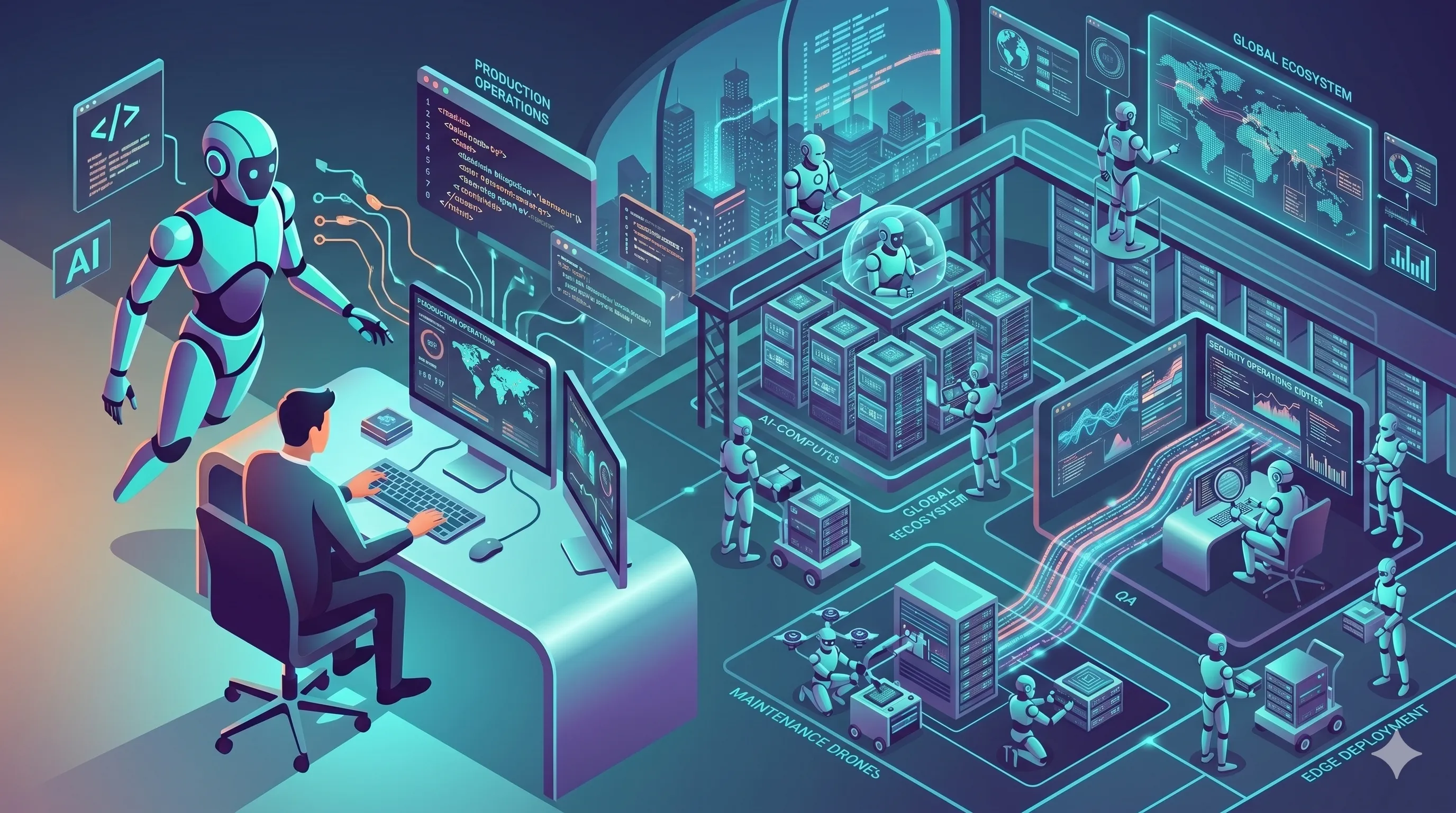
The phrase “AI-native software development” hides a category dispute. Three of the loudest products in the space mean three different things by it. VibeFlow calls a coordinated team of specialised agents — PM, architect, developer, QA, security — running a real SDLC on every change. Devin calls a single autonomous coding agent that takes a ticket and produces a pull request. Linear calls a PM-first tool that adds AI to triage, summary, and project hygiene around the work humans still do. Treat them as alternatives in the same category and you will pick badly. Treat them as different bets on what software development looks like with AI in it, and the choice clarifies fast.
This article opens a three-part series. Article 1B goes deeper on compliance and review-gate posture. Article 1C goes deeper on integrations and branch management. This piece sets the criteria.
The Criteria for an AI-Native Platform
There are five questions a buyer should ask of any product calling itself AI-native. Pose them once, and the platform-vs-tool distinction stops being marketing.
- Scope of automation. Is the AI a single agent, a coordinated team of agents, or an augmentation around humans?
- SDLC coverage. Which of planning, design, implementation, review, QA, security, deploy, and observe does the product own as first-class flow — versus leave to the buyer?
- Compliance and governance posture. When the auditor asks who built it and how, what evidence record drops out of normal use?
- Integration depth. Where does the product fit relative to existing source control, issue tracker, design tool, and documentation surfaces?
- Branch and change-management model. When two agents work on the same area in parallel, what happens?
Articles 1B and 1C take 3 and 4 apart in detail. The other three are the framing decisions; this article walks them.
VibeFlow’s Bet — Multi-Agent SDLC Platform
VibeFlow’s framing is that software development has roles, and each role should be its own agent. The product ships a default workflow with named personas: Aria the PM, an Architect, a Developer (Kai when the Principal Engineer override is active), Quinn the QA Lead, Sophie the Security Lead, plus PM and platform-facing personas. Every change moves through the explicit pipeline planning → implementing → done → security_review → qa_verified, with each stage owned by a different agent and each stage emitting a typed artifact the next stage consumes.
The bet behind the bet is that role separation is the product. A single agent that “writes code” cannot also adversarially review it; a single agent that “reviews” cannot honestly attest to compliance evidence on its own work. We made the case for that role-team model in Agent Workflows in Enterprise Software Development, and the gate-pipeline that sits underneath it is laid out in Quality Gates for AI-Generated Code.
flowchart LR
    P[PM Agent] --> A[Architect Agent]
    A --> D[Developer Agent]
    D --> Q[QA Agent]
    Q --> S[Security Agent]
    S --> H[Human Approver]
    H --> M[Merge / Deploy]
Underneath, the LLM Gateway, MCP Gateway, and A2A Gateway handle model routing, tool brokering, and inter-agent calls — protocol-level governance on open protocols. The shape is closer to a Kubernetes-for-agents than to a chatbot.
Devin’s Bet — Single Autonomous Coding Engineer
Devin’s framing — captured in Cognition Labs’ introducing Devin launch — is that the right unit of automation is a software engineer. Give it a ticket and it produces a pull request, browsing the web, running the code, and iterating on tests as needed. The product packages that loop into a hosted environment, exposes a chat interface for steering, and integrates with GitHub for the eventual PR.
The bet here is that autonomy at the task level is what scales. If one agent can ship a feature end-to-end, a team’s velocity is roughly its number of agents. Cognition is upfront about the loop being non-deterministic and about the value of human steering; the public emphasis is on what the agent can do alone.
The trade-off is structural. A single autonomous agent cannot represent a separation of concerns it does not have. The PR it produces is the artifact a human reviewer must inspect — there is no architect-agent design doc, no QA-agent test plan, no security-agent threat model attached. Whether that’s a feature or a bug depends on what the buyer’s organisation already has around it.
Linear’s Bet — AI-Augmented Project Management
Linear’s framing is the most modest of the three, and the most defensible: the place AI helps most is in PM hygiene around work humans are still doing. Linear’s AI features (summaries, smart triage, search) sit on top of the issue tracker. They do not write code. They do not review code. They make the workflow around code faster.
The bet is that the bottleneck is communication, not coding. For many teams, that is unambiguously true: estimating, summarising, dependency tracking, and triage cost more wall-clock than the code itself. AI that does those well can lift a team without altering the SDLC.
The trade-off is also clear. AI that augments PM does not produce code, audit trails for code, or compliance evidence about code. That work still belongs to the rest of the toolchain. Compared to VibeFlow’s scope, Linear is intentionally narrower; compared to Devin, it is intentionally further from the codebase.
Side by Side
Each cell below is a posture, not a feature flag. Articles 1B and 1C go deeper.
| Criterion | VibeFlow | Devin | Linear |
|---|---|---|---|
| Scope of automation | Multi-agent team (PM/architect/dev/QA/sec) | Single autonomous coding agent | AI-augmented PM, humans still build |
| SDLC coverage | Planning → security review → QA verification | Implementation → PR | Triage / planning hygiene only |
| Compliance posture | Built-in audit + gate evidence | Surrounding pipeline supplies it | PM-level audit; code audit external |
| Integration depth | Source control + ITS + docs + design (gateway-mediated) | GitHub PR + browser + shell | ITS native; source control via webhooks |
| Branch / change-mgmt | Per-todo branches with status flow | Per-task working environment + PR | Issue → branch links via integration |
A complementary view — what a typical “ticket → merged PR” flow looks like on each:
| Step | VibeFlow | Devin | Linear |
|---|---|---|---|
| 1. Ticket scope | PM agent clarifies | Human writes detailed prompt | Human (Linear AI may summarise) |
| 2. Design | Architect agent produces doc | Implicit (in agent’s reasoning) | Human |
| 3. Implementation | Developer agent | Devin agent | Human |
| 4. QA | QA agent extends suite | Devin’s own tests | Human / external CI |
| 5. Security review | Security agent gate | Surrounding pipeline | Surrounding pipeline |
| 6. Audit record | Auto-attached | Pipeline-supplied | Pipeline-supplied |
When Each Is the Right Choice
Each platform fits a real shape of organisation. Pretending one is universally better is the failure mode this article exists to prevent.
- Linear is right when the team already has a strong code-side toolchain (whatever it is) and the bottleneck is communication, prioritisation, and visibility. AI that summarises and triages buys back hours every week with no risk to the codebase.
- Devin is right when the team needs end-to-end task automation, has the surrounding review/QA/security infrastructure to inspect what an autonomous agent produces, and is comfortable with a single-agent shape that delegates the rest of the SDLC to humans.
- VibeFlow is right when the regulatory or organisational posture requires role separation in software delivery — when “the AI did it” is not an acceptable answer to an auditor, when a compliance framework demands distinct review eyes, or when the team wants AI participation across the entire SDLC rather than only at one stage.
The three are not strictly mutually exclusive. Teams running Linear for PM hygiene and pairing it with VibeFlow’s agent team for code-side execution is a coherent stack. Pairing Linear with Devin is similarly coherent. Pairing all three is unusual but not nonsensical.
What Articles 1B and 1C Will Add
The criteria-3 (compliance/governance) and criteria-4 (integration depth) deep-dives are big enough to deserve their own pieces.
Article 1B answers: when the auditor asks “who built this?”, what evidence drops out of each platform’s normal use? It goes gate-by-gate (lint, SAST, coverage, compliance) and maps each to the platforms above, plus a SOC 2 Common Criteria + NIST AI RMF Manage subcategory mapping per platform.
Article 1C answers: which integrations are native, which are read-only, and which are out of scope per platform? It walks Figma, Jira, Confluence, Bitbucket, and GitHub, plus the branch / change-management model — including what happens when two agents touch the same area in parallel.
If you only have time for one, read 1B if your decision is constrained by audit posture and 1C if it’s constrained by your existing toolchain. Both reference the criteria framework defined here.
The Category Question Is the Choice
“AI-native software development platform” is not a single category. It is three. Once a buyer accepts that, the comparison is no longer “which is best” — it is “which shape of AI in software fits the team’s actual constraints.” That mapping is harder than picking the loudest demo, and the answer is more durable.
For more on the agent-team model that VibeFlow’s bet rests on, see Agent Workflows in Enterprise Software Development, From Individual Copilots to Team-Wide AI Orchestration, and AI-Native SDLC: Automating Beyond CI/CD. Engineering leaders making this decision can read the role-specific takes at /for/engineering-leaders, /for/ctos, and /for/platform-teams.
Next in this series: VibeFlow vs Devin vs Linear — Compliance, Governance, and Review Gates and the integration deep-dive after that. Or, if you want to skip the comparison and try the platform: start free with VibeFlow.
Written by
AXIOM Team