5 Types of AI Code Review Tools and How to Compare Them
Compare the five types of AI code review tools, from PR bots to governed review agents, with OWASP AISVS criteria, benchmark caveats and a rollout plan.
 Axiom Studio November 21, 2026 12 min read
On this page
AI code review tools read a pull request, flag bugs, security flaws and style problems, and post findings before a human reviewer opens the diff. For enterprise teams, the best choice is the one that also produces evidence: who or what reviewed each change, which rules applied, and whether the fix was verified. That is why we built Vera, the free code review agent from Axiom Studio. Each Vera finding names the trigger, explains the impact and shows the commands used to verify it, and inside VibeFlow every work item stays traceable from requirement to code.
This guide compares the five types of AI code review tool, the criteria that matter to security and compliance teams, and a rollout plan you can run in a quarter. For a side-by-side of named products, see our comparison of top AI code review tools.
TL;DR
- AI code review tools fall into five types: standalone pull request bots, IDE assistants, static analysis and SAST scanners, platform-native assistants, and governed review agents.
- Published research shows a large gap between synthetic benchmarks and real pull requests, so judge any tool on your own repositories.
- OWASP’s AI security standard asks for human review by a different identity, automated security testing on every PR and merge blocks on critical findings. Pick a tool that records all three.
- Vera is free forever with unlimited reviews and users. With VibeFlow, the ticket, the change, the review and the approvals share one traceable record.
What AI code review tools do in a delivery workflow
An AI code review tool sits between a pull request (a proposed code change awaiting approval) and the merge. It reads the diff, often with surrounding repository context, and returns comments. Some tools only comment. Others suggest patches, generate tests or block the merge.
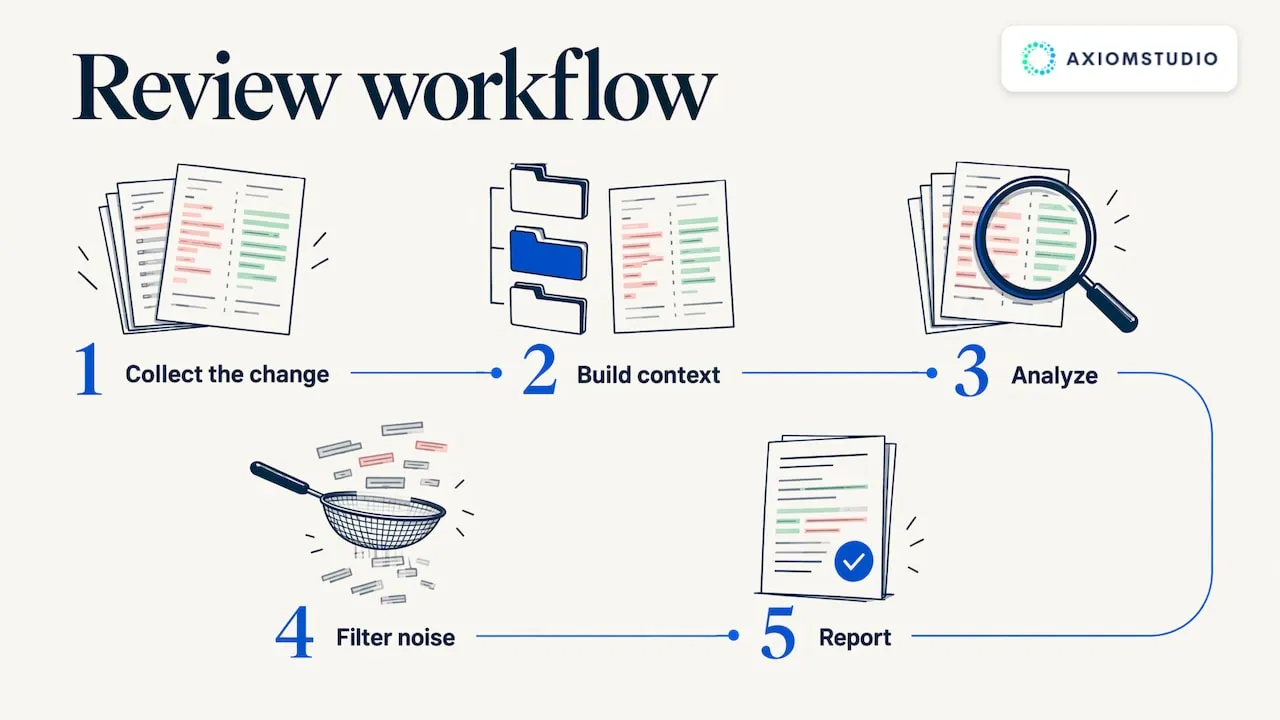
The common stages are the same across products: collect the change, build context, analyze, filter noise, then report. Our breakdown of the five stages of an AI code review agent walks through each one. What differs between tools is how much context they build, how they filter false positives, and what they record afterward.
The record matters more as AI coding agents write more of your code. Speed of output rises, and review becomes the queue everything waits in. If you see that pattern, our guide to measuring and fixing the AI code review bottleneck shows how to quantify it.
The five types of AI code review tool
No single feature list fits every product, so compare by type first. Then compare inside the type you need.
| Type | What it does | Typical fit | Audit and compliance output |
|---|---|---|---|
| Standalone PR bot | Comments on pull requests with summaries and suggested fixes | Teams wanting fast first-pass feedback | Comment history in the Git host |
| IDE assistant | Reviews code locally before commit | Individual developers | Usually none at team level |
| Static analysis and SAST scanner | Rule-based detection of known vulnerability patterns | Security teams with defined rule sets | Scan reports per run |
| Platform-native assistant | Review built into the code host | Teams standardized on one host | Depends on host plan |
| Governed review agent (Vera) | Reviews with guardrails, shows the evidence behind each finding, re-checks fixes | Enterprises that must prove how AI code was reviewed | Evidence per finding, plus traceable work items in VibeFlow |
Standalone PR bots and IDE assistants
These are the quickest to try. A bot installs on a repository and starts commenting. An IDE assistant catches issues before the code leaves the laptop. Both improve first-pass speed. Neither is designed around the questions an auditor asks months later: which version of the policy applied, who approved, what was the exception.
Static analysis and SAST scanners
SAST (static application security testing) matches code against known vulnerability patterns. It is deterministic and well understood, and OWASP’s standard lists it alongside other automated checks that should run on every PR with AI-generated code. It pairs well with an AI reviewer that reasons about logic and context.
Platform-native assistants
If your code host offers review, adoption is simple. Governance then follows whatever that host exposes, and a team working across several hosts or trackers ends up with several records.
Governed review agents
This is the category Vera belongs to. Each Vera finding names the trigger down to the file and line, explains the impact and shows the commands used to verify it. When Vera flags a blocker, your coding agent fixes it on the same pull request and Vera re-checks. Guardrails keep repeat reviews within a round budget and remember dismissed advisories, and Vera can run as a required merge check. You can read the product details on the Vera AI code review page.
What the benchmarks say about accuracy
Vendor demos use clean examples. Real pull requests are larger and messier. A 2026 arXiv comparative evaluation of five models on 150 review samples found a severe gap between synthetic and real data. On real bug-fix PRs alone, the best model reached an F1 score (a combined measure of precision and recall) of 0.066, against 0.847 on synthetic samples, a 92% drop. Diff size was the strongest predictor of quality: F1 fell from 0.657 on diffs under 10 lines to 0.043 on diffs over 150 lines. The same study found a smaller, cheaper model outperforming a larger one from the same family, so model size alone is a poor proxy.
The practical lesson is to measure any tool on your own repositories, with your own languages and your own PR sizes. Track three numbers:
- Precision: the share of comments that point to a real problem.
- Recall: the share of real problems the tool caught.
- Noise: comments reviewers dismiss without action.
Our article on measuring AI code review agents explains how to collect these. Vera attaches the evidence and verification commands to every finding, so a reviewer can confirm or dismiss a comment quickly and the noise count stays honest.
Criteria for enterprise, security and compliance teams
A feature checklist is not enough when an audit is coming. OWASP’s AI Security Verification Standard, Appendix C gives a concrete baseline for AI-generated code. Its requirements include:
- A written workflow naming approved AI tools, prohibited use cases and allowed data classifications (AC.1.1).
- A threat model for every AI tool, reviewers included, covering misuse, prompt injection, model inversion and training-data leakage (AC.2.1).
- Adversarial robustness testing before onboarding a reviewer (AC.2.3).
- Human review of AI-generated code by an identity different from the one that requested the generation. The AI agent itself does not count as the human reviewer (AC.4.1).
- Automated security testing on every PR with AI-generated code: SAST, IAST, DAST, secret scanning, IaC scanning and software composition analysis (AC.4.2).
- Merge blocks on critical findings (CVSS 9.0 or higher, or your policy’s equivalent), with bypass only through a written exception approved by an authorized person (AC.4.3).
Turn these into questions for every tool on your shortlist:
| Question | Why it matters |
|---|---|
| Does it keep a complete audit trail of findings, approvals and exceptions? | Auditors ask for evidence of AC.4.1 and AC.4.3 |
| Can it block merges on severity thresholds? | Maps to AC.4.3 |
| Can it produce evidence for the frameworks you answer to? | Each framework, such as SOC 2 or GDPR, needs its own evidence |
| Does source code persist, and for how long? | Retention is one of three data questions to audit |
| Is your code used to train models? | Training use, opt-in or opt-out, changes your risk |
| Whose account and data-processing agreement governs the model call? | Defines where inference happens and who is accountable |
The last three are the data-handling checks we recommend adding to every vendor security questionnaire alongside the OWASP items.
How Axiom Studio handles this: in VibeFlow, each work item is traceable from requirement to code, with commit attribution per agent and Security Lead and QA Lead review before it ships, and VibeFlow tracks work against compliance frameworks such as SOC 2 and GDPR. That keeps the evidence for items like AC.4.1 to AC.4.3 in one record instead of across several tools. Compliance leads can see how this works for audits on the AI coding compliance and GRC page.
Comparing capabilities that change daily work
Beyond governance, five capabilities decide whether developers keep using the tool.
Repository context
A reviewer that reads only the diff misses cross-file effects, which the benchmark above identifies as a cause of failure on real PRs. Ask how each tool gathers context across files and services. In VibeFlow, the AI agents share project, feature and work-item context, so the review happens with the ticket as well as the code.
Bug and security detection
Combine reasoning-based review with deterministic scanning. The OWASP list above treats both as required layers, not substitutes.
False-positive handling
Noise erodes trust faster than missed bugs. Look for evidence attached to each finding so a reviewer can confirm it in seconds, and for a way to track dismissal rates.
Integrations and deployment
Check your Git host, CI system, issue tracker and Kubernetes or GitOps setup. Vera reviews pull and merge requests on GitHub, GitLab, Bitbucket and Azure DevOps Repos, runs in coding agents such as Codex, Claude, Gemini, Qwen and Cursor, and files follow-up tickets in Linear, Jira, ClickUp, Inflectra, Azure DevOps or GitHub Issues.
Cost
Per-seat pricing is the norm, and add-ons for security reviews or usage credits change totals. Model your real PR volume before comparing list prices. Axiom Studio publishes its plans on the pricing page: Starter (free), Pro at $20 per month, Team at $49 per seat per month with a three-seat minimum, and Enterprise. Vera is free forever on all plans, with unlimited reviews and users.
Why a unified platform beats three separate tools
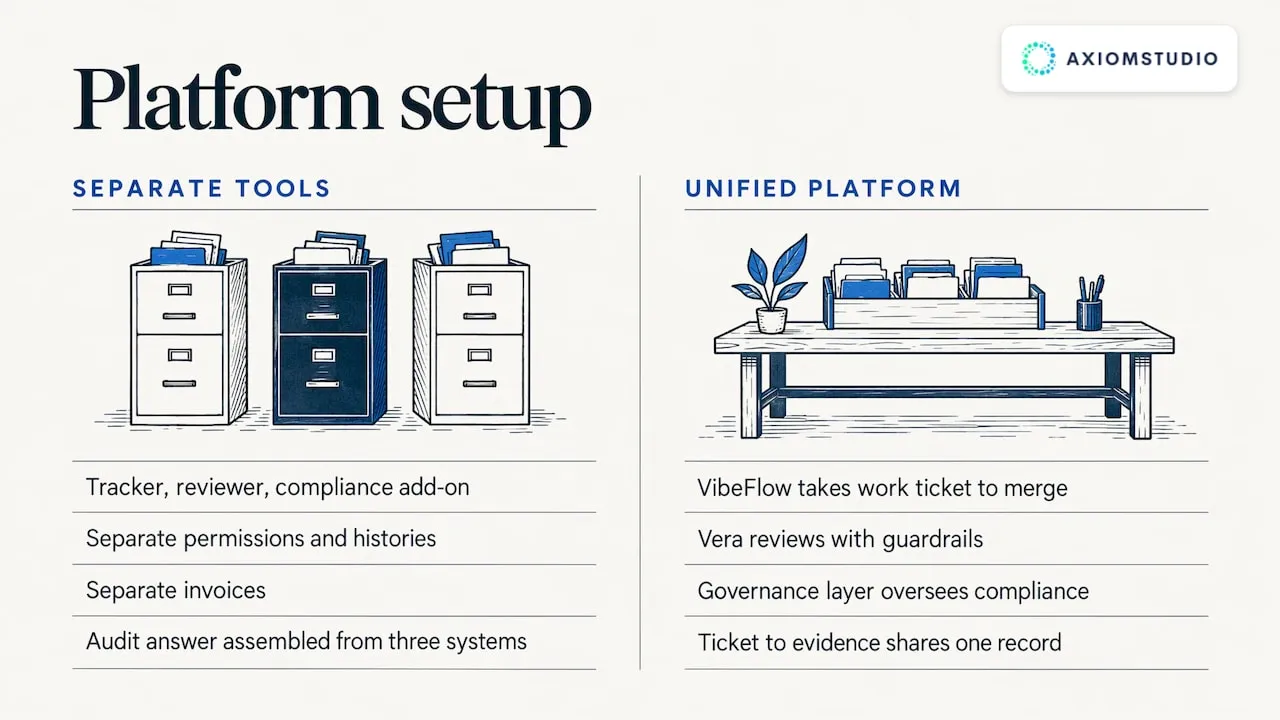
Teams adopting AI coding often buy a tracker, an AI reviewer and a compliance add-on. Each has its own permissions, its own history and its own invoice. When an auditor asks how a given AI-written change reached production, you assemble the answer from three systems.
Axiom Studio puts the pieces together. VibeFlow runs a 9-agent SDLC team that takes work from ticket to merge. Vera reviews the result with guardrails. VibeFlow also tracks the work against compliance frameworks such as SOC 2 and GDPR. The result is closed-loop engineering: the ticket, the change, the review, the fix verification and the compliance evidence share one record.
Platform engineers can see how this fits their stack on the VibeFlow for platform engineers page. For a broader view of the tools developers use to generate code, see our comparison of AI coding tools for enterprise teams.
How to roll out an AI code review tool
Follow these steps. Each is short enough to complete in a sprint or two.
- Write the policy first. Name approved AI tools, prohibited use cases and allowed data classifications. This is the OWASP AC.1.1 workflow, and it gives the pilot a scope.
- Pick a pilot set. Choose three to five repositories of different sizes and languages, including at least one with large multi-file PRs, since those expose the weaknesses benchmarks hide.
- Set the baseline. Record review turnaround, escaped defects and the share of comments reviewers act on, for the four weeks before the pilot.
- Turn on the reviewer in comment mode. Let developers see findings without blocking merges for two weeks. Collect dismissals with a reason.
- Add quality gates. Block merges on critical findings and require a written exception to bypass. Our guide to AI code quality gates shows a pipeline layout.
- Keep a human in the loop. The reviewer approving the merge should be a different identity from the one that requested the AI generation. For design patterns on where human review works and where it fails, see this piece on human in the loop review.
- Review the numbers monthly. Compare precision, recall and noise against the baseline and adjust rules and thresholds.
With Axiom Studio, steps 4 to 7 run inside one platform: Vera posts findings with their evidence, can run as a required merge check and files follow-up tickets, while VibeFlow keeps the work items and approvals in one record for the monthly review.
Where Axiom Studio fits
If your team uses AI coding agents and needs to show security and compliance functions how each change was reviewed, start with Vera and VibeFlow. Vera reviews code with actionable evidence and re-checks fixes on the same pull request. VibeFlow supplies the agent team and tracks features, todos and issues in one dashboard, along with compliance frameworks such as SOC 2 and GDPR.
See all plans on the Axiom Studio pricing page, or read the Vera AI code review overview.
Sources
- Bigger Isn’t Always Better: A Comparative Evaluation of LLMs for Automated Code Review (arXiv, 2026)
- OWASP AI Security Verification Standard, Appendix C: AI for Code Generation
Recommended
- Top AI Code Review Tools
- Anatomy of an AI Code Review Agent: The Five Stages
- AI Code Review on GitHub and GitLab: Setup Guide
- Measuring AI Code Review Agents: Precision, Recall, Noise
Frequently Asked Questions
What are the five types of AI code review tools?
Standalone pull request bots, IDE assistants, static analysis and SAST scanners, platform-native assistants built into the code host, and governed review agents such as Vera. They differ most in how much repository context they use and what audit evidence they record.
Can AI code review replace human reviewers?
No. OWASP's standard requires human review of AI-generated code by a different identity than the one that requested it. AI review handles the first pass and consistent checks, so human reviewers spend their time on design and intent.
How do I measure whether an AI code review tool works?
Track precision, recall and noise on your own repositories against a baseline taken before the pilot. Published benchmarks show results on real pull requests differ sharply from synthetic tests, so your own data is the reliable measure.
What should a security team ask a vendor about code privacy?
Ask three questions: does source code persist and for how long, is it used to train models, and whose account and data-processing agreement governs the model call. Record the answers in your written AI tool workflow.
Is Vera free?
Yes. Vera is free forever on all Axiom Studio plans, with unlimited reviews and unlimited users. It reviews pull and merge requests on GitHub, GitLab, Bitbucket and Azure DevOps Repos.
Written by
Axiom Studio