Top 10 AI Coding Tools for Enterprise Engineering Teams in 2026
A practical enterprise shortlist for AI coding tools in 2026, covering coding assistants, agents, review gates, governance layers, and the controls engineering leaders should evaluate.
 AXIOM Team July 3, 2026 10 min read
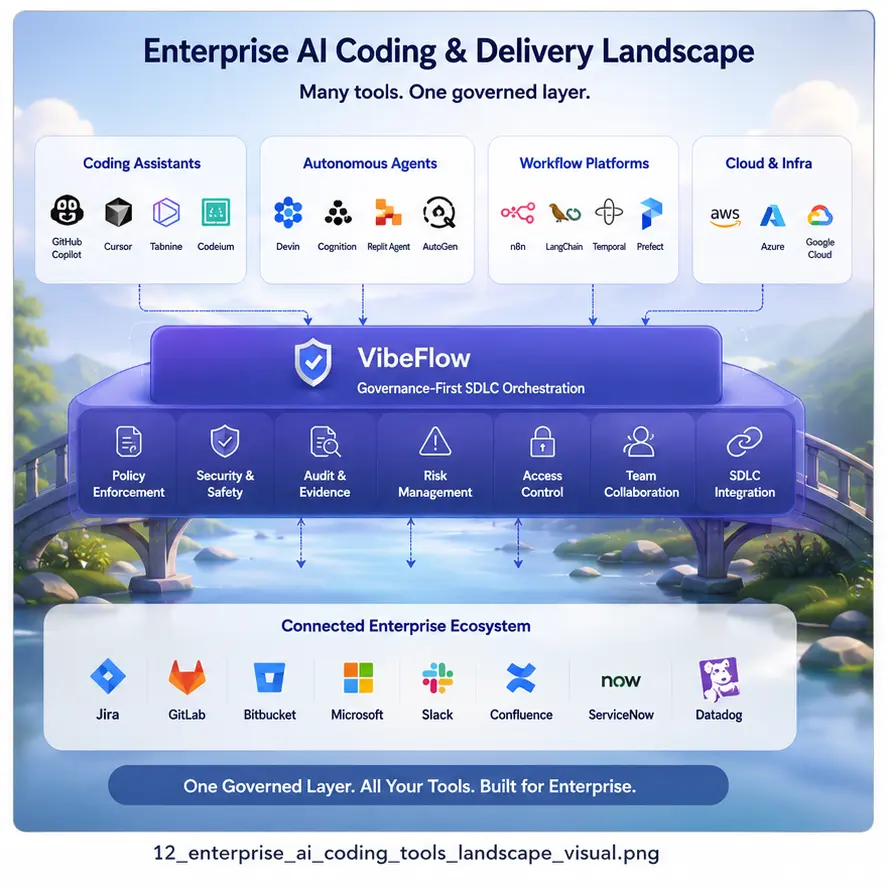
Enterprise teams do not buy AI coding tools the way individual developers adopt them.
A solo developer can optimize for speed, editor fit, and model quality. An engineering leader has to optimize for team controls: source-code exposure, commit provenance, review gates, identity, audit evidence, cost attribution, security review, QA, and whether the tool fits the existing SDLC.
That is why a useful “top tools” list should not pretend there is one universal winner. The right shortlist depends on the job you need the tool to do.
This guide compares ten categories and products that engineering leaders commonly evaluate in 2026. It focuses on enterprise fit: where each tool is strongest, where it needs surrounding controls, and how to route adoption into a governed operating model.
For background, read Best AI Coding Tools, What Is Agentic Coding, and the VibeFlow vs GitHub Copilot Enterprise comparison.
The Enterprise Evaluation Matrix
Before comparing tools, score each candidate across seven dimensions:
| Dimension | What to evaluate |
|---|---|
| Coding assistance | Inline completions, chat, refactors, test generation, documentation, and repo awareness |
| Agentic execution | Ability to plan, edit files, run tests, handle failures, and produce a reviewable diff |
| SDLC governance | Work-item linkage, planning logs, security review, QA, commit evidence, and audit trail |
| Model and tool controls | Which models are used, what context is sent, which tools can be called, and how policies apply |
| Enterprise administration | SSO, RBAC, team policy, data controls, billing, and admin reporting |
| Integration depth | IDEs, GitHub, GitLab, Bitbucket, Jira, CI/CD, Slack, and internal developer platforms |
| Rollout risk | How easy it is to pilot, restrict high-risk use cases, and expand without creating shadow AI |
The best tool for autocomplete may not be the best tool for autonomous changes. The best agent may not provide the evidence a regulated team needs. Treat the list below as a map of roles, not a single leaderboard.
1. VibeFlow - Governed AI SDLC Orchestration
VibeFlow is the best fit when the enterprise problem is not “which model writes code fastest?” but “how do we govern AI-assisted software delivery?”
VibeFlow tracks work from requirement through planning, implementation, commit linkage, security review, QA, and context maintenance. That matters when teams want AI agents to participate in the SDLC without losing evidence about what was requested, what files were read, what changed, what tests ran, who reviewed the output, and which commit carried the result.
Best for:
- Engineering leaders rolling out AI agents across multiple teams
- Regulated teams that need review gates and audit evidence
- Organizations that already use Jira, GitHub, Bitbucket, security review, and QA workflows
- Teams trying to convert individual AI usage into a governed team operating model
Watch for:
- VibeFlow is a governance and orchestration layer, not a replacement for every editor assistant.
- It is strongest when paired with the tools developers already use.
Related reading: Quality Gates for AI-Generated Code, Building an AI Audit Trail, and Jira + VibeFlow.
2. GitHub Copilot Enterprise - Broad Developer Adoption
GitHub Copilot Enterprise is often the default shortlist candidate because it sits close to repositories, pull requests, and the GitHub developer workflow. It is a strong fit for organizations standardized on GitHub that want broad coding assistance, chat, and repository-aware help inside a familiar ecosystem.
Best for:
- GitHub-centered engineering organizations
- Teams prioritizing low-friction developer adoption
- Inline assistance, code explanation, test suggestions, and PR-adjacent workflows
Watch for:
- Copilot adoption does not automatically solve SDLC-level governance.
- Enterprises still need a policy for agentic work, sensitive context, security review, QA, and evidence retention.
Use Copilot as a productivity surface. Pair it with a governed SDLC workflow when the output affects production systems.
3. Cursor - AI-Native IDE for Power Users
Cursor is strongest as an AI-native coding environment for developers who want fast chat, multi-file edits, repo-aware assistance, and model choice inside the editor.
Best for:
- Power users who want an IDE designed around AI interaction
- Teams experimenting with agentic code editing before standardizing
- Fast iteration on local code changes with human review nearby
Watch for:
- Enterprises need administrative controls, data policy, and rollout boundaries before broad deployment.
- Cursor can accelerate individual work faster than governance practices mature if adoption is unmanaged.
If your team is already using Cursor informally, treat it as a signal that you need an AI tool inventory and SDLC governance path. The shadow AI diagnostic can help.
4. Claude Code - Agentic CLI for Complex Tasks
Claude Code is useful when developers want an agentic command-line workflow that can read a repo, edit files, run commands, and iterate through failures.
Best for:
- Senior engineers comfortable supervising an agent in a terminal
- Multi-file changes where chat-only assistance is too shallow
- Teams evaluating autonomous implementation loops before wider rollout
Watch for:
- CLI agents need guardrails around file access, secrets, command execution, and commit discipline.
- The quality of the result depends heavily on the surrounding process: work item, tests, review, and QA.
For production use, route agentic CLI work through a tracked workflow with logs and commit linkage.
5. OpenAI Codex and Codex CLI - Agent-Native Development
OpenAI Codex and the Codex CLI are strong candidates for teams that want model-backed coding agents with an edit-test-fix loop.
Best for:
- Agentic coding workflows that need planning, file edits, and verification
- Teams already standardized on OpenAI models or APIs
- Internal developer platforms that can wrap coding agents with policy and observability
Watch for:
- A model or CLI is not an SDLC control plane by itself.
- Teams need clear rules for which repositories, data classes, commands, and deployment paths agents may touch.
Pair Codex-style execution with an AI governance platform when auditability matters.
6. Gemini Code Assist - Google Cloud-Aligned Coding Assistance
Gemini Code Assist is a natural fit for organizations anchored in Google Cloud and the broader Gemini ecosystem.
Best for:
- Google Cloud engineering teams
- Code assistance across cloud-native applications, infrastructure, and APIs
- Teams that value long-context model capabilities in the Google ecosystem
Watch for:
- Long context does not remove the need for context classification.
- Cloud alignment is useful, but cross-tool governance is still needed if teams also use GitHub, Jira, third-party agents, or multiple model providers.
If your AI coding program spans several providers, use a Unified AI Gateway to normalize routing, policy, and observability.
7. Amazon Q Developer - AWS-Centered Engineering Workflows
Amazon Q Developer belongs on the shortlist for AWS-heavy organizations that want coding help, cloud guidance, and modernization assistance close to the AWS toolchain.
Best for:
- AWS-native teams
- Cloud application development and infrastructure assistance
- Modernization and migration workflows where AWS context is central
Watch for:
- The tool’s value is strongest in AWS-centered environments.
- Teams still need broader controls for non-AWS repositories, alternate model providers, and AI-assisted SDLC review gates.
8. Sourcegraph Cody - Large-Codebase Understanding
Sourcegraph Cody is relevant when the problem is not only writing code, but understanding a large codebase.
Best for:
- Large monorepos and multi-repository environments
- Code search, explanation, and navigation-heavy workflows
- Teams that already rely on Sourcegraph for code intelligence
Watch for:
- Codebase understanding helps developers move faster, but production changes still need evidence.
- Pair code intelligence with review gates and commit-level traceability.
9. Tabnine and Windsurf - Enterprise Coding Assistants
Tabnine and Windsurf represent another important category: AI coding assistants with a focus on developer workflow, enterprise controls, and editor-based productivity.
Best for:
- Teams evaluating alternatives to the largest platform vendors
- Enterprises that need administrative policy and deployment options
- Developer productivity programs that want assistant choice without losing control
Watch for:
- Compare administration, privacy, model controls, and audit logging directly against your requirements.
- Avoid choosing on demo quality alone. Run a repo-specific pilot with real tasks and review gates.
10. Devin and Autonomous Agent Platforms - Task-Level Delivery
Autonomous agent platforms such as Devin belong in a different evaluation lane than autocomplete or chat tools. They aim to complete larger units of work with less step-by-step developer control.
Best for:
- Well-scoped tasks with clear acceptance criteria
- Backlog items that can be verified independently
- Teams experimenting with agent throughput beyond individual developer augmentation
Watch for:
- Autonomy increases the need for review gates, test evidence, security review, and QA.
- The enterprise question is not whether the agent can complete a task once. It is whether the organization can govern many such tasks repeatedly.
For a deeper platform comparison, see VibeFlow vs Devin vs Linear.
How to Build the Shortlist
Use this practical mapping:
| Need | Start with |
|---|---|
| Broad coding assistance for GitHub teams | GitHub Copilot Enterprise |
| AI-native IDE productivity | Cursor |
| Terminal-based agent execution | Claude Code or Codex CLI |
| Google Cloud alignment | Gemini Code Assist |
| AWS alignment | Amazon Q Developer |
| Large-codebase navigation | Sourcegraph Cody |
| Enterprise assistant alternatives | Tabnine or Windsurf |
| Autonomous task execution | Devin-style agent platforms |
| Governed SDLC orchestration | VibeFlow |
| Multi-model policy and observability | Unified AI Gateway |
Most enterprises end up with more than one tool. That is not a failure. It is a signal that coding assistance, agent execution, governance, and model routing are different layers.
The Governance Layer You Need Around Every Tool
Whatever you choose, define the control plane before the rollout spreads:
- Which tools are approved by team and use case?
- Which repositories and data classes can each tool access?
- Which model providers and MCP tools are allowed?
- Which AI-assisted changes require security review?
- Which changes require QA verification?
- How are prompts, context, outputs, tests, and commits logged?
- How does finance see model and token spend?
- How does leadership identify unmanaged usage?
That is the difference between an AI coding tool program and a shadow AI problem.
VibeFlow governs the SDLC side: work items, planning, implementation logs, commits, security review, QA, and audit evidence. The Unified AI Gateway governs the model and tool traffic side: routing, policy, observability, and cost controls. Together, they let teams adopt the right coding tools without losing the evidence needed to operate them responsibly.
Final Recommendation
Do not choose one AI coding tool for every job.
Choose an assistant for developer flow, an agent strategy for task execution, a gateway for model and tool governance, and an SDLC layer for review and audit evidence. The winning enterprise architecture is not a single tool. It is a governed system where the right tool can be used without turning every code change into an evidence problem later.
Written by
AXIOM Team