Open-Weight Models in 2026: DeepSeek, Kimi, and Open vs. Closed AI
Open-weight models like DeepSeek and Kimi have closed much of the gap with closed frontier AI. Here is how they work, how open-weight and closed-weight models differ, the pros and cons of each, and how enterprises can adopt open weights without losing governance.
 AXIOM Team July 20, 2026 7 min read
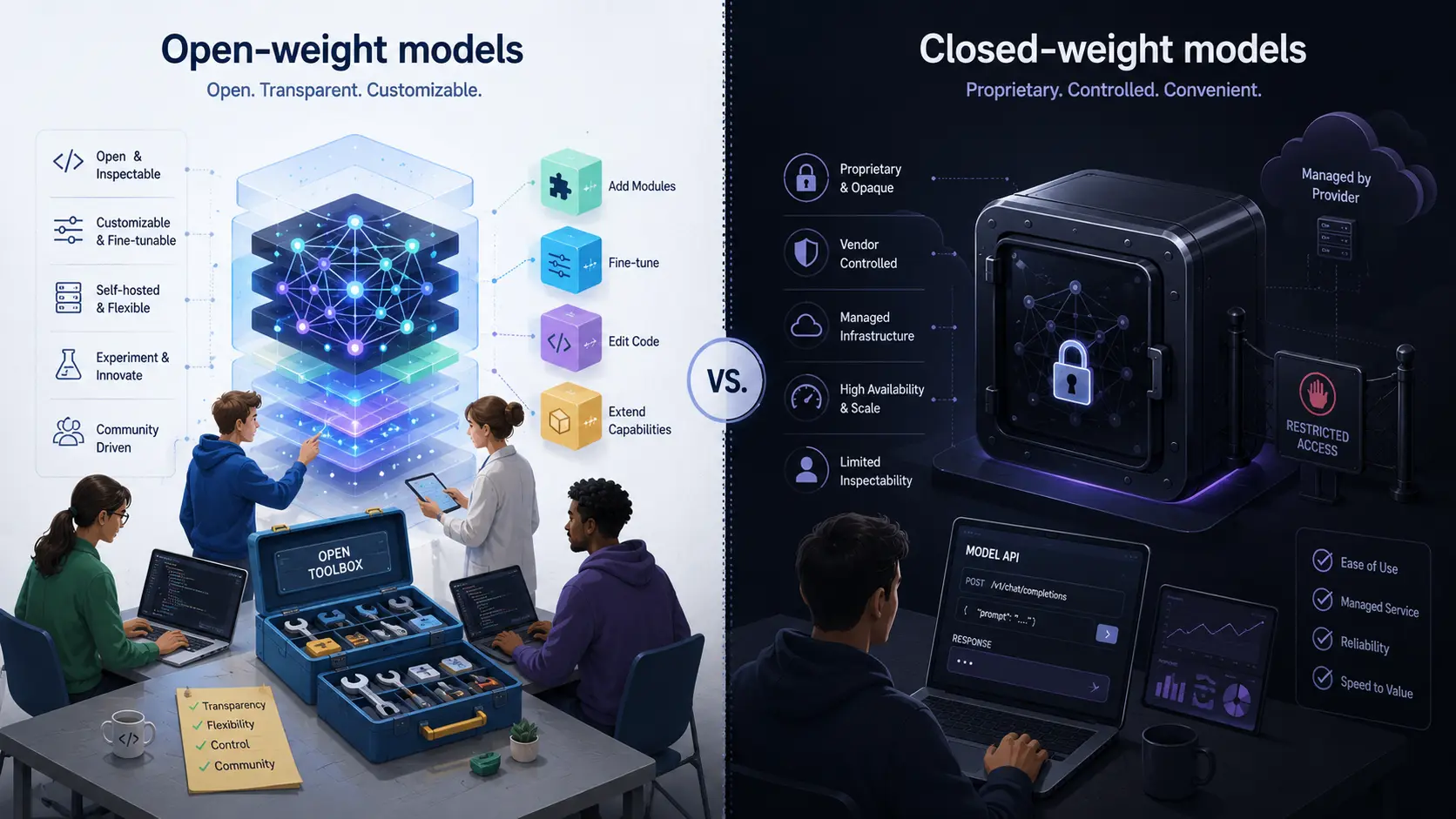
Two years ago, the answer to “which model should we build on?” was a short list of closed, API-only frontier systems. In 2026 that is no longer true. Open-weight models — led by DeepSeek and Moonshot AI’s Kimi, alongside Llama, Qwen, and Mistral — have closed enough of the quality gap that “open vs. closed” is now a real architecture decision, not an ideological one.
That shift matters most to enterprises, because open weights change where your data goes, how much you pay, how much you can customize, and — critically — who is responsible for governance. This guide explains what open-weight models are, what DeepSeek and Kimi actually advanced, how open and closed models differ, the honest pros and cons of each, and how to run open weights in production without giving up control.
What Is an Open-Weight Model?
An open-weight model is one whose trained parameters are published for anyone to download, run, fine-tune, and self-host. “Open weight” is deliberately narrower than “open source.” Most leading open-weight models release the weights and an inference recipe, but not the full training dataset or training pipeline. You get the finished brain, not the factory that built it.
It helps to separate three tiers:
- Closed-weight — the weights never leave the provider. You reach the model through a hosted API (for example, GPT-class and Claude-class frontier models). You rent capability.
- Open-weight — the weights are downloadable under a license, but data and training code may be withheld. You own a copy you can run anywhere. DeepSeek and Kimi live here.
- Fully open-source — weights, data, and training code are all released. This is rarer at the frontier because reproducing a frontier training run is enormously expensive.
For most enterprise decisions, the line that matters is the first one: can you run the model inside your own trust boundary, or does every token cross a vendor’s API?
DeepSeek and Kimi: The Open-Weight Frontier
Two labs did the most to make open weights credible at the top end of the market.
DeepSeek
DeepSeek pushed the idea that near-frontier capability does not require frontier-scale budgets. Its models popularized aggressive mixture-of-experts (MoE) designs, where only a fraction of the network activates per token, so a very large model can run at the inference cost of a much smaller one. DeepSeek is best known for two things: strong reasoning performance from its R-series models, and permissive licensing that let teams self-host serious capability without a per-token API contract. For enterprises, the appeal is a reasoning-grade model that can run inside a private VPC.
Kimi
Moonshot AI’s Kimi advanced a different frontier: agentic and long-context work. Kimi’s open-weight releases are oriented toward multi-step tool use, coding, and reasoning over very large inputs — the kind of tasks that agent workflows depend on. Releasing those capabilities as open weights meant that teams building autonomous agents were no longer forced to route every step through a closed API, which changes both the cost model and the data-exposure model for agent-heavy products.
The takeaway is not that any single open-weight model has “won.” It is that the open-weight tier now includes models good enough for production reasoning, coding, and agentic work — so the decision to use them is a genuine trade-off rather than a compromise. For a closer look at how these models stack up on real coding tasks, see our coding LLM comparison, and for the agent context driving demand, where the agentic economy is heading.
Open-Weight vs. Closed-Weight: The Core Differences
| Dimension | Open-weight (DeepSeek, Kimi, Llama, Qwen, Mistral) | Closed-weight (hosted frontier API) |
|---|---|---|
| Where it runs | Your infrastructure, VPC, or on-prem | Provider’s cloud only |
| Data exposure | Stays inside your trust boundary | Crosses the provider API boundary |
| Cost model | Compute you own or rent; no per-token markup | Per-token API pricing |
| Customization | Full fine-tuning and weight-level control | Prompting and limited fine-tuning |
| Portability | Run anywhere; avoid vendor lock-in | Tied to one provider |
| Turnkey ops | You own scaling, safety, and uptime | Managed scaling, safety, and support |
| Governance owner | You (logging, access, audit are yours) | Shared, but bounded by the API surface |
The Pros and Cons
No tier is strictly better. The trade-offs are real.
Open-weight — pros
- Data control and residency. Weights run inside your boundary, which is decisive for regulated data and sovereignty requirements.
- Cost at scale. High-volume workloads avoid per-token markup and can be tuned to your hardware.
- Deep customization. Full fine-tuning and distillation let you specialize a model for your domain.
- No lock-in. You keep a runnable copy regardless of a vendor’s roadmap or pricing changes.
Open-weight — cons
- You own the operations. Serving, scaling, evaluation, and safety tuning become your responsibility.
- Governance is not included. Self-hosting removes the vendor’s API guardrails, so logging, access control, and audit trails must be built.
- Total cost is not zero. GPUs, MLOps, and evaluation staff are real line items.
Closed-weight — pros
- Turnkey frontier quality with managed scaling, safety tuning, and support.
- Fast to adopt with no infrastructure to stand up.
Closed-weight — cons
- Data leaves your boundary, which some workloads cannot accept.
- Per-token cost and vendor lock-in grow with usage.
- Limited customization beyond prompting and light fine-tuning.
When to Choose Open-Weight vs. Closed
A simple lens: choose open-weight when data residency, cost at scale, deep customization, or avoiding lock-in dominate — and you have (or will build) the operational capability to run models well. Choose closed-weight when time-to-value, absolute peak quality, and managed operations matter more than control.
Most mature enterprises land on both. They route sensitive, high-volume, or specialized workloads to self-hosted open weights, and reach for a closed frontier API when they need the last increment of capability or want a managed fallback. The hard part is not picking one model — it is operating a fleet of them consistently.
Governing Open-Weight Models in the Enterprise
The moment you self-host DeepSeek or Kimi, you cross the vendor’s API boundary — and with it, the built-in logging, rate limits, and policy enforcement that a hosted API quietly provided. Open weights hand you control and hand you the governance bill at the same time.
That is exactly the problem an AI governance layer solves. Instead of wiring policy into each application, route open and closed models through a single control plane:
- The Unified AI Gateway gives you one policy, logging, cost-tracking, and access-control surface across every model — open-weight and closed — so you can add, swap, or retire a model like DeepSeek or Kimi without rewriting applications. (New to the pattern? Read what is an LLM gateway.)
- VibeFlow captures the SDLC evidence — work items, approvals, tests, security review, and commit linkage — that turns model usage into an audit trail.
- The result is AI governance that is model-agnostic: your controls survive whichever model wins next quarter.
Open weights are a genuine advance. They give enterprises leverage over cost, data, and customization that closed APIs cannot. The organizations that benefit are the ones that pair that leverage with governance — so a fleet of open and closed models stays observable, controlled, and provable, no matter how fast the model landscape keeps moving.
Ready to run open-weight and closed models under one policy? See the Unified AI Gateway or get started for free.
Frequently Asked Questions
What is an open-weight model?
An open-weight model is one whose trained parameters (the weights) are published for anyone to download, run, fine-tune, and self-host. The weights are open even when the training data and full training code are not, which is why open-weight is a more precise term than open-source for models like DeepSeek and Kimi.
Are DeepSeek and Kimi open-weight models?
Yes. DeepSeek and Moonshot AI's Kimi both release model weights under permissive licenses, so enterprises can download and run them on their own infrastructure. This is the key difference from closed frontier models such as GPT-class or Claude-class systems, which are only available through a hosted API.
What is the difference between open-weight and closed-weight models?
Open-weight models ship the parameters so you can self-host, fine-tune, and inspect behavior, trading convenience for control. Closed-weight models are delivered only as a managed API, trading control for turnkey performance, safety tuning, and support. The right choice depends on data residency, cost, customization, and governance requirements.
Can enterprises safely use open-weight models like DeepSeek and Kimi?
Yes, when they add a governance layer. Self-hosted open weights remove the vendor API boundary, so teams need their own logging, access control, cost tracking, and audit trails. Routing open and closed models through a unified AI gateway gives enterprises one place to enforce policy, capture evidence, and switch models without rewriting applications.
Written by
AXIOM Team