Jira + VibeFlow: The Governance Layer Your Atlassian SDLC Was Missing
How Jira-first engineering teams can add governed AI implementation workflows with VibeFlow: claim tracking, logs, security review, QA, commit evidence, and audit trails.
 AXIOM Team July 3, 2026 12 min read
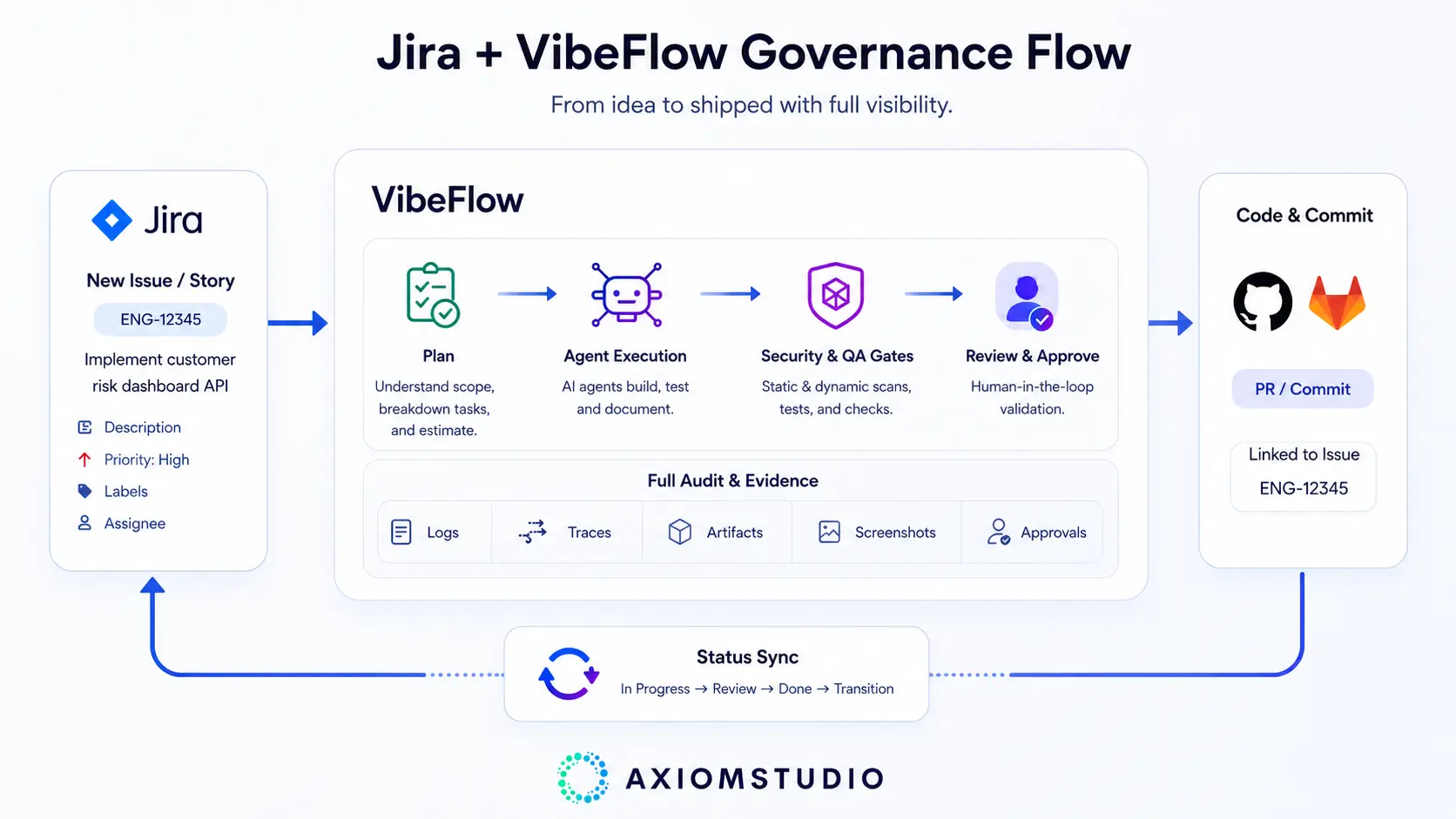
Jira is already the operating system for a large part of enterprise software delivery. Product managers write stories there. Engineering managers plan capacity there. Security and compliance teams ask whether the work was approved there. Release managers use Jira status as a proxy for whether the organization is in control.
That is why AI coding creates a strange gap for Atlassian teams.
The ticket still exists. The sprint board still exists. The Confluence page still exists. But the actual implementation work may now happen inside an AI agent, an IDE chat, a hosted coding environment, or a local CLI session. If that work is not governed, Jira becomes a record of intent while the AI system becomes a separate, weakly-audited execution path.
VibeFlow for Jira and Confluence teams closes that gap. It keeps Jira as the planning and coordination surface, then adds the governance layer around AI implementation: claim tracking, execution logs, security review, QA verification, commit linkage, and audit-ready evidence.
The result is not “replace Jira with an AI tool.” The result is simpler and more defensible: keep Jira as the system your teams already trust, and use VibeFlow to make AI-generated work flow through a governed SDLC.
The Gap Jira Does Not Solve by Itself
Jira is excellent at representing planned work. It can tell you which team owns an issue, which sprint it belongs to, what priority it has, who is assigned, which status it is in, and which release it may affect.
But Jira does not automatically answer the new questions created by AI implementation:
- Which agent claimed this ticket?
- What context did the agent read before editing code?
- Which files and callers were in the blast radius?
- What implementation plan did the agent follow?
- Which verification steps ran before the item moved forward?
- Did security review pass, or did it create a fix item?
- Did QA verify the original acceptance criteria?
- Which commit actually implemented the work?
- Can an auditor reconstruct the chain from Jira issue to code change?
Without a governance layer, teams answer those questions manually. They inspect chat transcripts, local terminal output, PR comments, CI logs, and whatever notes the developer remembered to leave behind. That may work for a pilot. It does not scale across dozens of teams and hundreds of AI-assisted changes.
The missing layer is not more ticket fields. It is a governed execution workflow.
What VibeFlow Adds Around a Jira Ticket
VibeFlow treats the Jira issue as the starting point, not the whole evidence chain.
A governed AI implementation flow looks like this:
- Jira captures the business request, owner, acceptance criteria, and priority.
- VibeFlow maps that request into a tracked work item with a target branch and owning feature.
- An agent claims the item so two sessions do not silently work on the same scope.
- The agent records a system map before editing: files, callers, invariants, and risks.
- Implementation happens against the claimed work item.
- Verification output is recorded before completion.
- The git commit is attached back to the work item with line counts and the Jira key.
- Security review and QA run as explicit gates.
- Status and evidence can sync back to Jira so the Atlassian record remains current.
This is the difference between “Jira says the ticket is done” and “the ticket has implementation evidence attached.”
For teams already using Jira, that difference matters because leadership and auditors usually start their review in the ticketing system. They do not want to chase an AI agent’s local context. They want to open the work item and see the chain of custody.
Claim Tracking: Stop Duplicate Agent Work Before It Starts
AI agents make parallelism easy. That is useful until two agents pick up the same ticket, edit the same files, or implement different interpretations of the same requirement.
In a human-only workflow, duplicate work is often controlled through assignment and team norms. In an AI workflow, assignment is not enough. Agents need an explicit claim model with concurrency control.
VibeFlow claims work before implementation begins. A claimed item records the session, persona, branch target, status, and timestamp. If another session tries to claim the same item, the system can reject that claim rather than letting two implementations drift apart.
For Jira teams, this maps naturally to ownership. Jira remains the visible planning object. VibeFlow becomes the execution lock and evidence record around the implementation. That matters most when teams introduce multiple agent roles: developer, architect, principal engineer, security reviewer, and QA lead. Each role needs to know which item is theirs and which state transition is valid.
The practical outcome is boring in the best way: fewer duplicate branches, fewer conflicting implementations, and a clearer answer to “who is working on this?”
Execution Logs: Turn Agent Reasoning into Reviewable Evidence
Most AI coding tools can produce a diff. Fewer can produce a useful explanation of how that diff came to exist.
For regulated or enterprise SDLC teams, the reasoning trail is often as important as the code:
- Why did the agent choose this route instead of another?
- What files did it consider in scope?
- Which assumptions did it make?
- What tests or build checks did it run?
- What did it intentionally leave alone?
VibeFlow execution logs capture those decisions while the work happens. A principal engineer agent can publish a system map, plan, implementation notes, verification output, and final diff. A security lead can record findings or approve the item. A QA lead can verify behavior or reject it with a concrete failure.
That makes the record teachable. A reviewer does not need to infer the agent’s intent from the final patch. They can read the work item as a story: requirement, plan, change, verification, review.
This is the operating model behind building an AI audit trail. The value is not just that logs exist. The value is that the logs are attached to the same work item the organization already uses to manage delivery.
Security Review as a State, Not a Slack Message
Many teams handle AI-generated code review informally at first. Someone asks security to “take a quick look.” A reviewer comments in Slack or on a PR. The team moves on.
That is not a governance system.
VibeFlow makes security review a workflow gate. A completed implementation is not simply finished; it enters the review pipeline. The security reviewer can pass the item, reject it, or create a linked fix item with severity and finding type. The result is recorded against the work item.
For Jira teams, this is important because security exceptions and remediation work often need to be visible outside the engineering repo. If an AI-generated change introduces a data-handling risk, authorization gap, unsafe dependency, or leaked endpoint, the remediation should be traceable to the original work item and visible in the same delivery system.
The goal is not to slow every change down. The goal is to make the gate consistent. A lightweight content change and a production API change do not need the same depth of review, but both need a recorded security outcome appropriate to their risk.
That is the same argument we make in Quality Gates for AI-Generated Code: a fluent AI diff is not the same as a verified change.
QA Verification Against the Original Jira Requirement
Automated tests are necessary. They are not sufficient.
The most common AI failure mode is not always a broken build. It is a plausible implementation that misses the actual requirement. The code compiles. The page renders. The PR looks reasonable. But the behavior does not match what the Jira issue asked for.
VibeFlow separates implementation from QA verification. QA reviews the original acceptance criteria, the implementation evidence, and the rendered behavior or test output. If the work misses the mark, QA rejects the item back to implementation with a targeted comment.
That separation is valuable for Atlassian teams because Jira acceptance criteria often carry product nuance. A generic agent may satisfy the literal task while missing workflow-specific details: status names, field mappings, component ownership, release labels, support expectations, or compliance language. QA is where those details are checked.
When QA passes, the team has more than a green build. It has an independent verification record tied to the original requirement.
Commit Linkage: Connect Jira Intent to Repository Truth
Jira tells the organization what was intended. Git tells the organization what changed. The governance gap lives between those two systems.
VibeFlow closes that gap by attaching commit evidence to the work item:
- Commit hash
- Commit message with Jira key
- Author identity
- Lines added and deleted
- Files changed
- Completion timestamp
- Verification notes
That creates a direct bridge from Atlassian planning to repository truth.
If a customer asks why a behavior changed, the team can start from the Jira issue and follow the trail to the commit. If an auditor asks whether AI-generated work passed review, the team can show the status flow and review gates. If an engineering leader wants to understand AI delivery throughput, the team can aggregate work item cycle time, review time, and rework.
This is where VibeFlow differs from a standalone AI coding assistant. The assistant may help create the code. VibeFlow keeps the evidence attached to the delivery system.
Confluence Becomes Agent Context, Not Just Documentation
Atlassian teams rarely keep all requirements in Jira. The real context often lives in Confluence: architecture notes, support runbooks, design decisions, customer constraints, rollout plans, and team conventions.
That context is critical for AI implementation. An agent that reads only the Jira issue may miss why a service is shaped a certain way, why a field cannot be renamed, or why a workaround exists for a regulated customer.
VibeFlow can use Confluence-style project knowledge as part of the agent context and then write back execution evidence or documentation as the work evolves. The important shift is that documentation stops being passive. It becomes a living input to the work and a place where decisions can be preserved.
For teams with years of Confluence history, this is a practical adoption advantage. You do not have to rebuild your knowledge base in a new AI platform before agents become useful. You can make the existing Atlassian context part of the governed workflow.
What Changes for Engineering Leaders
For a VP of Engineering or platform leader, the key question is not whether AI can write more code. It can. The question is whether the organization can absorb that extra code without losing control.
Jira plus VibeFlow gives leaders a more defensible operating model:
- Jira remains the place where work is planned, prioritized, and communicated.
- VibeFlow governs how AI implementation happens.
- Security and QA gates become state transitions, not informal favors.
- Commits attach back to the originating work item.
- Execution logs explain what happened and why.
- Confluence knowledge informs agent work instead of sitting outside the loop.
- Audit evidence exists because the work flowed through the system.
That last point is the one that changes the executive conversation. The platform is not only accelerating delivery. It is making delivery easier to inspect.
A Practical Migration Checklist for Jira-First Teams
If your engineering organization already lives in Jira, start with a narrow rollout. Do not try to govern every AI-assisted activity on day one.
Use this checklist:
- Pick one workflow: Start with a contained feature area, maintenance queue, or content/product surface where acceptance criteria are clear.
- Define the Jira status mapping: Decide which Jira states correspond to planning, implementation, security review, QA, and done.
- Require a work item before code: No AI implementation should begin from a loose prompt if the change affects production code or customer-facing content.
- Attach every agent session to the item: Record who claimed the work, which persona acted, and when status changed.
- Log the system map: Require agents to list files, callers, invariants, and verification plan before edits.
- Keep commits traceable: Include Jira keys in commit messages and attach commit hashes back to the work item.
- Make security review explicit: Define which changes need security signoff and how rejected findings become follow-up work.
- Make QA independent: Verify against Jira acceptance criteria, not just against the agent’s summary.
- Use Confluence as context: Identify the architecture pages and runbooks agents should read before implementation.
- Review the evidence monthly: Look at cycle time, rejection rate, missing acceptance criteria, and recurring security findings.
The rollout should feel like making your existing SDLC more observable, not like forcing teams into a new planning religion.
Where This Fits in the Atlassian Stack
Jira and Confluence remain the human coordination layer. They are where work is discussed, prioritized, planned, and explained.
VibeFlow sits beside them as the governed AI execution layer. It answers the questions Jira was never designed to answer alone:
- What did the agent do?
- Why did it do it?
- What evidence proves it worked?
- Who reviewed it?
- Which commit changed the repo?
- What context should the next agent inherit?
For Atlassian-heavy teams, this is the missing bridge between AI velocity and enterprise SDLC control.
Read the product integration overview at VibeFlow for Jira and Confluence teams. Then compare the broader workflow model in VibeFlow. If your team is already piloting AI coding agents and needs the governance layer around Jira, request a demo and bring a real ticket. The useful demo is not a generic code generation trick. It is watching one Jira issue move from requirement to agent execution to commit evidence to security review to QA.
Related Reading
- Building an AI Audit Trail: the traceability model behind governed AI implementation.
- Quality Gates for AI-Generated Code: how security, QA, and compliance checks become enforceable gates.
- Integrations and Branch Management: why Jira, Confluence, source control, and branch isolation shape real AI platform adoption.
- How We Built a Compliant Feature in Under an Hour with VibeFlow: a practical walkthrough of the same governance pattern in action.
Written by
AXIOM Team