How We Built a Compliant Feature in Under an Hour with VibeFlow
A practical walkthrough of how a governed feature moves through VibeFlow from requirement to implementation, security review, QA, audit trail, and demo-ready evidence.
 AXIOM Team July 3, 2026 10 min read
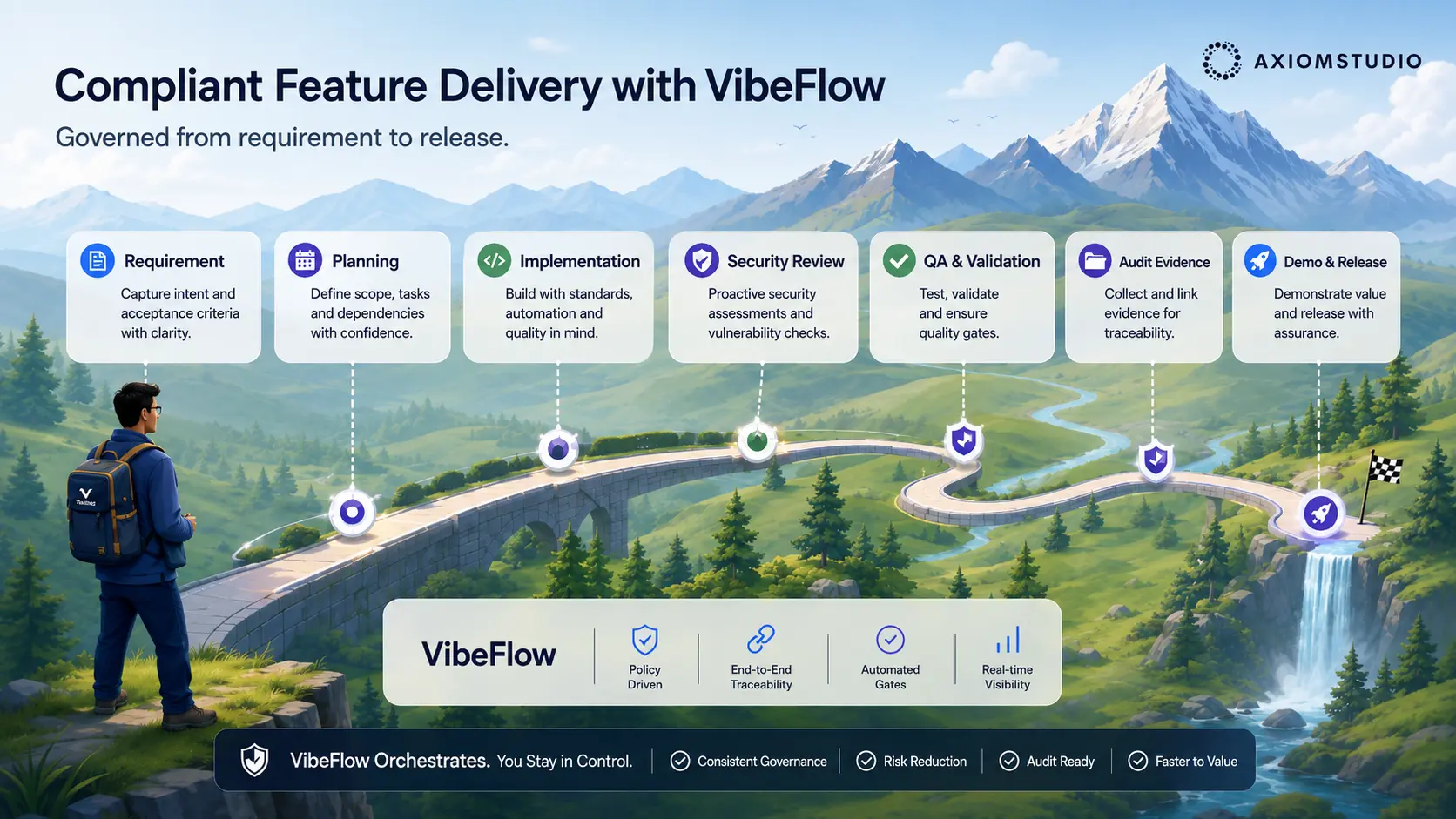
The fastest way to evaluate an AI development platform is not to ask whether it can write code. Most can. The harder question is whether it can produce a feature that a VP of Engineering, security lead, QA owner, and compliance reviewer can all defend after the fact.
That is the problem VibeFlow is designed to solve.
We recently used VibeFlow to move a small but real product change through a governed delivery loop in under an hour: requirement intake, scoped work item, implementation, security review, QA verification, git evidence, and an audit-ready execution record. The point was not to prove that agents are fast. Speed is table stakes. The point was to prove that speed does not have to erase control.
Here is the workflow, step by step.
The Feature Request
The request started the way many internal product requests start:
Add a conversion path to a product education page so readers who understand the governance problem can move directly to the VibeFlow demo flow.
In an unmanaged AI coding workflow, that sentence would often become a direct prompt to a coding assistant. The assistant would search the repo, edit a few files, maybe run a build, and leave a diff behind. That may be acceptable for a prototype. It is not enough for a regulated engineering organization.
The missing evidence is obvious when an auditor or security reviewer asks the next questions:
- Who approved the request?
- Which product area owned it?
- What files were in scope?
- Which assumptions did the agent make?
- What checks ran before completion?
- What changed in git?
- Did an independent reviewer verify security and behavior?
VibeFlow turns those questions into the default delivery path instead of a cleanup chore after the fact.
Step 1: Convert the Request into a Work Item
The first gate was planning. VibeFlow requires every implementation to map to a tracked todo or issue before files are modified. That sounds simple, but it changes the risk profile of AI-assisted development.
The request was classified as feature work because it enhanced a specific product-content surface. It was attached to the owning feature, given acceptance criteria, and moved into the implementation queue. That created the intent layer of the audit trail: the business goal, the owning feature, the expected behavior, and the branch target.
This is the same principle we describe in Vibecoding Shift-Left SDLC: no code should be written before the system knows what work item the code serves.
For a compliance reviewer, this matters because “AI changed the page” is not evidence. “A tracked work item requested a conversion path on this product surface, and this commit implemented it” is evidence.
Step 2: Map the Blast Radius Before Editing
Once the work item was claimed, the agent did not immediately write code. It mapped the blast radius:
- The page or content file that would change
- Shared layout or collection code that might render the change
- Existing internal-linking patterns
- Schema limits for metadata
- Generated artifacts that would change during the build
- Invariants that had to remain true after the edit
This is where governed AI development starts to diverge from single-agent code generation. The agent is not just producing output. It is creating a reviewable reasoning trail before the diff exists.
In a small content change, the blast radius may be one file plus generated sitemap output. In a product feature, it may include routes, components, tests, analytics events, access-control checks, and migration scripts. VibeFlow makes the map explicit either way.
That map becomes the design layer of the audit trail described in Building an AI Audit Trail. It answers: why these files, why this approach, and what must not regress?
Step 3: Implement the Smallest Reviewable Change
The implementation itself was deliberately narrow. The agent added the conversion path where the reader naturally reaches the “how would we solve this?” moment, reused existing site patterns, and avoided touching unrelated layout code.
That restraint matters. AI agents can make sprawling changes because they are not tired by diff size. Reviewers are. A governed workflow should push agents toward changes a human can review in one sitting.
In VibeFlow, the implementation log captures the plan, the design decision, and eventually the final git diff. That means a reviewer does not have to reverse-engineer the agent’s intent from the patch alone. They can read the work item, the system map, the implementation notes, the verification output, and the commit together.
For engineering leaders, this is the practical difference between “agent wrote code” and “agent participated in the SDLC.”
Step 4: Run Verification Before Marking Done
The implementation was not complete when the file was edited. The agent still had to prove the change:
- Build completed successfully
- Metadata satisfied the content schema
- Generated output included the expected route
- Internal links rendered in the final HTML
- Diff review showed only scoped changes
- Mirror or generated artifacts matched the expected behavior
For code features, the verification set would expand to unit tests, integration tests, type checks, lint, browser checks, and any domain-specific assertions. The principle is the same: correctness should be demonstrated before the work item moves forward.
This is the first layer of the gate model covered in Quality Gates for AI-Generated Code. A fluent diff is not a quality signal. Evidence is.
Step 5: Attach Git Evidence to the Work Item
After verification, the agent committed the scoped change with the work item’s Jira key in the commit message. VibeFlow recorded the commit hash, author, lines added, lines deleted, and status transition on the todo.
That record is not decorative. It is the bridge between product intent and repository truth.
If someone asks six months later why a specific conversion path exists, the team can trace:
- The original request
- The feature that owned it
- The implementation session
- The files touched
- The verification steps
- The commit that changed the repo
- The review gates that followed
This is where many AI coding workflows fail compliance. They may leave a git commit. They rarely leave a structured chain of custody from requirement to review.
Step 6: Security Review Runs as a Gate, Not a Favor
Once the implementation moved to done, it entered the security review queue. That review is mandatory in the VibeFlow workflow.
For a content-only change, security review may focus on link targets, unsafe embeds, secret exposure, and whether the diff introduces executable content. For an application feature, the review expands to authentication boundaries, authorization checks, data handling, dependency changes, injection risks, and logging behavior.
The important part is that security review is not an optional “please take a look if you have time” step. It is a state transition. A completed item remains in the review pipeline until the security gate passes or a linked fix item is created.
That matters for SOC 2, HIPAA, NIST AI RMF, and similar control frameworks because the evidence is procedural. The organization can show that every AI-produced change is routed through the same review path.
Step 7: QA Verifies Against the Original Requirement
After security review, QA verifies the work against the original acceptance criteria.
This is not the same as asking whether the build passed. A build can pass while the feature misses the requested behavior. QA reads the work item, reads the implementation evidence, checks the rendered behavior, and either verifies the item or rejects it with targeted feedback.
That independent verification is what keeps AI velocity from becoming unbounded churn. The implementation agent can move quickly because the system has a defined correction path if it misses the mark.
For leadership teams, this is the governance pattern that matters most: agents can accelerate delivery without becoming their own reviewers.
The Executive Takeaway
The compliant feature did not take under an hour because the team skipped process. It took under an hour because the process was encoded into the system.
VibeFlow compresses the administrative overhead around governed software delivery:
- Work item creation is part of the agent workflow
- Planning evidence is captured before implementation
- Diffs are linked to business intent
- Builds and checks are recorded in the execution log
- Security review and QA are mandatory gates
- The final audit trail exists because the work flowed through the system
This is the core buying-stage question for enterprise AI development: can the platform make responsible delivery faster than unmanaged delivery? If governance requires manual reconstruction after every agent-generated change, teams will route around it. If governance is the path of least resistance, teams can move faster and still defend the result.
A Practical Checklist for Governed AI Feature Delivery
Use this checklist when evaluating your own AI development workflow:
- Intent captured: Every change starts from a tracked work item with acceptance criteria.
- Ownership assigned: The work item belongs to a feature, project area, or explicitly documented cross-cutting scope.
- Blast radius mapped: The agent records files, callers, generated artifacts, and invariants before editing.
- Small diff preferred: The implementation changes the fewest files needed to satisfy the requirement.
- Verification run: Build, tests, schema checks, browser checks, or domain assertions run before completion.
- Git evidence attached: Commit hash, line counts, and message metadata connect the diff to the work item.
- Security reviewed: Security signoff is a required gate, not an informal favor.
- QA verified: A separate reviewer checks behavior against the original requirement.
- Context updated: Project and feature context reflect what changed so the next agent starts with current knowledge.
- Demo path clear: The resulting evidence is easy to show to an engineering leader, auditor, or buyer.
If your current AI coding workflow cannot satisfy those ten checks, the risk is not only that a bad change ships. The larger risk is that a good change ships without evidence.
Why This Changes the Demo Conversation
A conventional product demo often shows screens: dashboards, settings, charts, and reports. Those matter. But for AI software delivery, the more important demo is the trail.
Show the requirement. Show the agent’s planning notes. Show the diff. Show the build output. Show the security review. Show QA verification. Show the commit. Show the final work item state. That is the evidence an enterprise buyer actually needs to trust agentic software delivery.
VibeFlow is built around that trail. It is not just an agent runner. It is the governed operating model around agent work: planning, implementation, security review, QA, context maintenance, and auditability in one workflow.
If your team is already experimenting with coding agents and now needs the control layer around them, request a demo. We will walk through how a governed feature moves from requirement to evidence in your SDLC, not as a generic pitch but as the concrete operating model your engineering and compliance teams have to defend.
Related Reading
- Building an AI Audit Trail: the five traceability layers behind compliant AI-assisted development.
- Quality Gates for AI-Generated Code: the review pipeline that turns fluent diffs into evidence-backed changes.
- Vibecoding Shift-Left SDLC: how VibeFlow moves requirements, security, and QA earlier in the delivery process.
- From Vibes to Verifiable: the broader argument for replacing unmanaged AI coding with verifiable production workflows.
Written by
AXIOM Team