Building vs Buying Your AI Governance Layer: What Engineering Leaders Get Wrong
A neutral decision framework for AI governance build-vs-buy decisions across integration cost, audit evidence, review gates, model and tool governance, maintenance, rollout risk, and time to value.
 AXIOM Team July 3, 2026 13 min read
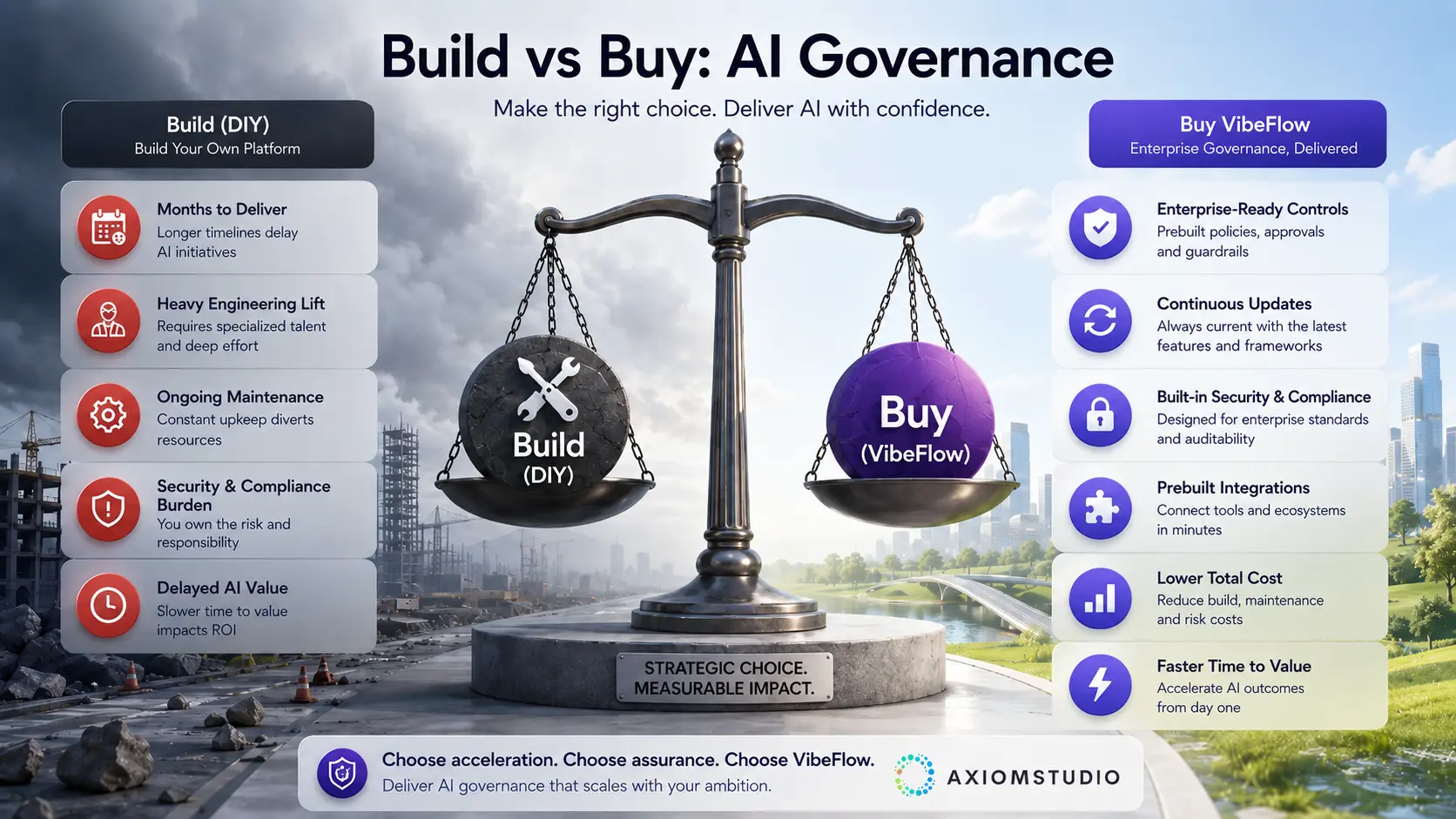
Engineering leaders usually frame AI governance as a technology choice: should we build our own control layer or buy a platform?
That is the wrong first question.
The better question is: which governance capabilities are strategic enough for us to own, and which ones are execution infrastructure we need to operate reliably?
Some organizations should build parts of the AI governance layer. If you have unusual data residency requirements, deep platform engineering capacity, proprietary model infrastructure, or a mature internal developer platform, custom control points may be justified.
But many teams underestimate what they are actually signing up to build. AI governance is not one dashboard, one policy file, or one model proxy. It is a system that has to sit across model calls, tool access, agent workflows, work items, review gates, audit evidence, cost controls, and compliance reporting.
This article gives engineering leaders a practical build-vs-buy framework. It is not a blanket argument against building. It is a way to decide which parts deserve internal engineering investment and which parts should be treated as platform capability.
The Short Version
Build when the governance requirement is unique to your business and tightly coupled to internal systems.
Buy when the requirement is common across enterprises, evidence-heavy, operationally repetitive, or risky to maintain as AI tools and regulations change.
For most teams, the durable architecture is hybrid:
- Keep internal ownership of policy decisions, data classification, approved use cases, and risk appetite.
- Use a governed platform for enforcement, workflow, evidence capture, routing, observability, review gates, and audit reporting.
- Integrate that platform with your repositories, ticketing systems, identity provider, CI/CD, and compliance processes.
That is where VibeFlow and the Unified AI Gateway fit. VibeFlow governs AI-assisted SDLC work. The gateway governs model and tool traffic. Your organization still owns the policy. The platform makes the policy enforceable and reviewable.
What You Are Actually Building
An AI governance layer has at least seven jobs:
- Discovery and inventory: find tools, agents, model providers, workflows, owners, and data paths.
- Model and tool governance: route model calls, enforce provider allowlists, scope MCP tools, and log agent actions.
- SDLC workflow governance: require tracked work items, planning evidence, implementation logs, review gates, QA, and commit linkage.
- Audit evidence: capture prompts, retrieved context, model IDs, outputs, tool calls, diffs, test results, approvals, and deployment events.
- Compliance mapping: translate evidence into SOC 2, HIPAA, NIST AI RMF, EU AI Act, or customer-security-review language.
- Cost and usage control: attribute token spend by team, workflow, feature, model, and environment.
- Operations: handle policy changes, model deprecations, provider outages, new agent tools, incident response, and reporting.
If your build plan covers only one or two of these jobs, you are not building an AI governance layer. You are building a useful component that will still need a layer around it.
The Decision Matrix
Use this matrix to decide where to build, buy, or combine.
| Dimension | Build makes sense when | Buy makes sense when | Hidden cost to watch |
|---|---|---|---|
| Integration cost | You already own a mature internal developer platform and identity model | You need Jira, Confluence, GitHub, Bitbucket, CI, model providers, and gateway controls quickly | Connectors are not one-time work; APIs and workflows drift |
| Audit evidence | You have a dedicated compliance engineering team and stable evidence requirements | Customers or auditors need defensible evidence soon | Evidence schemas change as AI use cases evolve |
| Review gates | Existing SDLC gates are already automated and enforceable | Security review, QA, and approval evidence are inconsistent today | Human-memory gates fail under agent velocity |
| Model and tool governance | You operate a custom model platform or proprietary policy engine | Teams use many models, providers, agents, and MCP tools | Every new tool needs routing, auth, logs, and policy |
| Maintenance burden | Governance is a core product capability for your company | Governance is necessary infrastructure, not your product differentiator | The backlog never ends: providers, agents, regulations, reports |
| Rollout risk | You can pilot slowly inside one controlled environment | Shadow AI is already spreading across teams | Slow governance rollout encourages workarounds |
| Time to value | You can wait quarters before full evidence exists | Leadership needs visibility this quarter | Manual interim processes become permanent |
The matrix usually reveals that “build vs buy” is too coarse. Teams often need to build policy logic and business-specific integrations, then buy the enforcement and evidence backbone.
Evaluation Dimension 1: Integration Cost
The first mistake is treating integration as setup work.
AI governance has to touch many systems:
- Source control
- Ticketing and planning
- CI/CD
- Identity and access management
- Model providers
- Internal tools and MCP servers
- Observability and logging
- Security review workflows
- Compliance evidence stores
- Cost and chargeback systems
Building connectors is only the first cost. The ongoing cost is keeping them correct as teams add workflows, rename statuses, change branch rules, rotate providers, adopt new agents, and update approval paths.
Build if your platform team already owns these integrations and can make AI governance a natural extension of the internal developer platform.
Buy if you need the governance layer to work across multiple delivery systems before a long internal platform project would land.
Evaluation Dimension 2: Audit and Compliance Evidence
Audit evidence is where homegrown governance gets expensive.
A useful AI governance layer has to answer:
- Why did this AI-assisted change happen?
- Which model and tools were used?
- What context entered the model call?
- Which policy checks ran?
- Which files changed?
- Which tests or builds passed?
- Who reviewed security?
- Who verified QA?
- Which commit or deployment carried the change?
- Which compliance controls does this evidence support?
That evidence needs to be structured, queryable, and consistent. It also needs to survive personnel changes and tool migrations.
If you build, budget for evidence schema design, retention rules, access controls, reporting, export paths, and framework mapping. If you buy, verify that the platform captures evidence at the moment of action rather than asking teams to upload proof later.
For the underlying model, read Building an AI Audit Trail and Quality Gates for AI-Generated Code.
Evaluation Dimension 3: Review Gates
Most organizations already have review gates. The problem is that they are not always enforceable for AI-generated work.
A pull request review is useful. It is not the same as knowing:
- Whether the agent had a tracked work item before editing
- Whether it mapped the blast radius
- Whether it read sensitive files
- Whether it generated tests that were independently checked
- Whether security review passed
- Whether QA verified against original acceptance criteria
Review gates should be state transitions, not favors. A governed workflow should know when implementation ends, when security review begins, when QA rejects, and which commit is attached.
VibeFlow is designed around that path: planning, implementation, commit evidence, security review, QA, context maintenance, and done. If you build this yourself, be clear that you are building a workflow engine, not just a review checklist.
Evaluation Dimension 4: Model and Tool Governance
AI governance is no longer only about model choice. Agents call tools.
That means the control layer has to govern:
- Which model can handle which data class
- Which fallback model is allowed
- Which team owns the cost
- Which MCP tools an agent can call
- Which user, tenant, branch, or environment the tool action belongs to
- Which tool calls require approval
- Which actions are blocked or logged
This is where point-to-point integrations break down. Every workflow starts with its own provider key, its own routing decision, and its own logs.
The Unified AI Gateway centralizes those decisions. It gives platform teams one place for model routing, MCP tool access, agent-to-agent communication, observability, policy, and cost controls. If you build, you need the same centralization or you are just moving shadow AI into internal code.
Evaluation Dimension 5: Maintenance Burden
The build path looks attractive because the first version feels small.
The maintenance path is not small:
- New model providers
- Model deprecations and upgrades
- New agent runtimes
- MCP server growth
- Tool permission changes
- Compliance framework updates
- New customer security-review requirements
- Token-cost changes
- Data retention policy changes
- Incident investigation needs
The question is not whether your team can build the first version. The question is whether this backlog should compete with your product roadmap every quarter.
Build if governance capability is a strategic differentiator for your business or deeply tied to regulated internal operations.
Buy if the core value is getting reliable control, evidence, and reporting so your engineering teams can focus on the product customers pay for.
Evaluation Dimension 6: Rollout Risk
Governance rollout has a failure mode: if the approved path is slower than the workaround, the workaround wins.
That is especially true for AI. Developers already have access to useful tools. They will not wait a year for an internal governance platform if the current workflow helps them ship today.
The approved path has to be:
- Easy to request
- Fast enough for real work
- Integrated with existing tools
- Clear about what is allowed
- Useful to developers, not only auditors
- Able to produce evidence without manual cleanup
This is why pricing and implementation cost should be compared against rollout risk, not just license cost. A platform that lands in weeks may be cheaper than a custom system that lands after shadow AI behavior has become entrenched.
Evaluation Dimension 7: Time to Value
The most practical build-vs-buy question is time to evidence.
How long until leadership can see:
- Which teams are using AI tools
- Which model calls are happening
- Which AI-assisted work items completed
- Which commits are tied to AI work
- Which security reviews passed or failed
- Which QA checks rejected AI work
- Which workflows are spending the most
- Which compliance evidence exists
If the answer is “after the platform team finishes phase two,” be honest about the gap. You may still choose to build, but interim governance has to be explicit.
When Building Is the Right Answer
Building can be right when:
- You operate a large internal platform team with governance as a core mandate.
- Your data boundary or deployment environment is unusual enough that vendors cannot support it.
- You need custom policy logic that is a competitive or regulatory differentiator.
- Your AI workflows are tightly coupled to internal infrastructure that cannot expose standard integration points.
- You can staff long-term operations, not only initial development.
In that environment, the smart move may be to build the differentiating layer and buy commodity pieces: model routing, logging, evidence capture, workflow state, or compliance reporting.
When Buying Is the Right Answer
Buying is usually right when:
- Shadow AI is already spreading and visibility is urgent.
- Engineering leaders need evidence this quarter.
- Security review and QA gates are inconsistent.
- Multiple model providers, agents, or tools are already in use.
- Compliance or customer security review requires proof of controls.
- The internal team would rather spend roadmap capacity on the product.
- You need support for Jira, Confluence, GitHub, Bitbucket, CI, and model gateways without building every connector.
In that environment, the platform becomes leverage. Your team still owns the policy and rollout decisions. The platform provides the enforcement and evidence path.
A Practical Hybrid Architecture
Most serious teams should think in layers:
- Policy ownership: internal. Your company decides data classes, approved use cases, review requirements, and risk appetite.
- Model and tool control plane: platform-backed. Route calls through the Unified AI Gateway for policy, observability, cost, and tool access.
- SDLC governance: platform-backed. Use VibeFlow for work-item tracking, agent sessions, execution logs, review gates, QA, and commit evidence.
- Custom integrations: mixed. Build the few that are truly specific to your environment; buy or configure the common ones.
- Compliance reporting: platform-backed plus internal review. Let the system produce evidence, then let compliance map it to customer and framework requirements.
This architecture avoids the false choice. You are not outsourcing judgment. You are buying the machinery that makes judgment enforceable.
How to Evaluate Vendors Without Getting Sold a Dashboard
Ask these questions:
- Does the platform enforce policy during the workflow, or only report after the fact?
- Can it capture evidence from requirement to commit to review outcome?
- Can it govern both model calls and tool calls?
- Can it integrate with our source-control and ticketing systems?
- Can it support security review and QA as workflow states?
- Can it attribute cost by team, feature, workflow, or work item?
- Can it export evidence for compliance and customer reviews?
- Can developers use it without routing around it?
- What happens when a model provider changes or an agent runtime is added?
- Which parts remain our responsibility?
The last question matters most. A good platform should be clear about boundaries. It should not pretend to replace your security program, data classification, risk decisions, or engineering judgment.
Where Axiom Fits
Axiom is built for teams that want the hybrid path: internal ownership of policy and product context, with a governed platform for the enforcement and evidence backbone.
VibeFlow handles AI-assisted SDLC governance: work intake, feature ownership, agent claims, planning logs, implementation evidence, security review, QA verification, commit linkage, and context handoff.
The Unified AI Gateway handles model and tool governance: provider routing, fallback, token budgets, MCP tool access, agent-to-agent communication, policy enforcement, observability, and cost attribution.
The commercial question is not only license price. It is whether buying the platform is cheaper than building and operating the same evidence chain yourself. Review pricing, then bring one real workflow to a demo: one model call path, one agent workflow, one review gate, and one audit question. That is enough to compare build cost against platform time to value.
Related Reading
- AI Governance Platform vs DIY Policies: the broader platform-vs-manual-governance comparison.
- Enterprise AI Risk Management: how operational, financial, reputational, and regulatory risks shape the control model.
- Building an AI Audit Trail: the evidence model behind governed AI work.
- Top 5 Signs Your Engineering Team Has a Shadow AI Problem: a diagnostic scorecard for deciding whether the need is urgent.
Written by
AXIOM Team