Top 5 Signs Your Engineering Team Has a Shadow AI Problem
A diagnostic scorecard for engineering leaders: identify shadow AI risk across unmanaged tools, sensitive data exposure, unreviewed outputs, spend leakage, and missing audit evidence.
 AXIOM Team July 3, 2026 11 min read
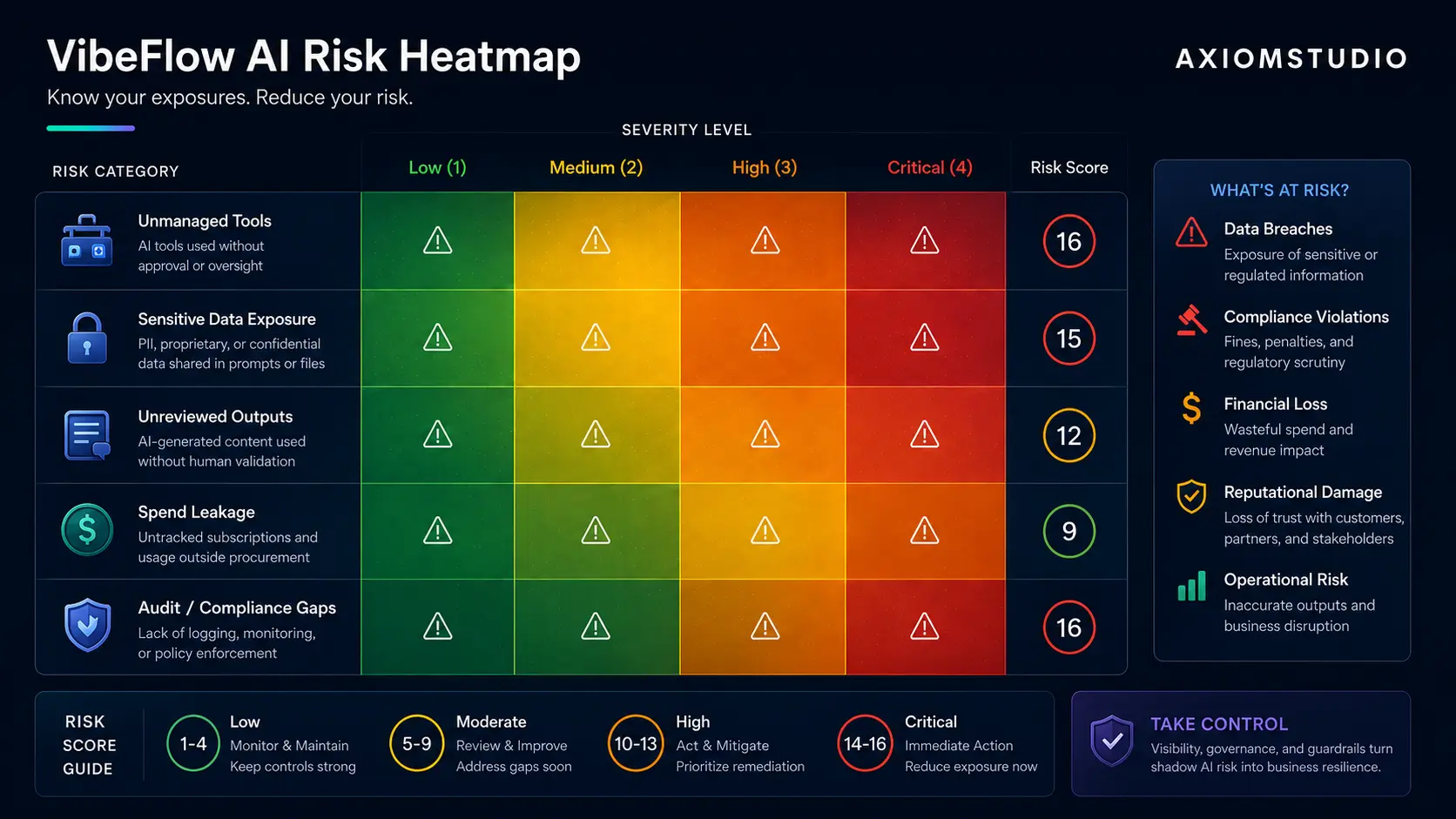
Shadow AI rarely announces itself as a breach, a failed audit, or a runaway model bill. It usually starts as engineering initiative.
A developer installs a coding assistant because it saves time. A team creates a shared API key for a model provider. A platform engineer wires an LLM into a build workflow. A support engineer pastes logs into a chatbot to debug an incident. A product team asks an agent to summarize customer feedback.
Each action may be reasonable in isolation. Together, they can create an unmanaged AI surface that security, compliance, finance, and engineering leadership cannot see.
That is the shadow AI problem.
This post is a diagnostic scorecard for engineering teams. It does not invent a market benchmark or claim that every company has the same exposure. Instead, it gives you five measurable signs you can evaluate inside your own SDLC. If two or more signs are true, you do not need a bigger policy document. You need a governed operating model.
For the definition layer, start with what shadow AI is. For the control layer, VibeFlow governs AI-assisted SDLC work, while the Unified AI Gateway centralizes model routing, policy, observability, tool access, and cost controls.
The 10-Minute Diagnostic
Score each sign from 0 to 2:
| Score | Meaning |
|---|---|
| 0 | Controlled: the team has clear ownership, policy, and evidence. |
| 1 | Partially controlled: the team has a process, but evidence is incomplete or manually reconstructed. |
| 2 | Uncontrolled: the team cannot answer the question with current systems. |
Then add the five scores:
| Total | Interpretation |
|---|---|
| 0-2 | Low visible exposure, assuming the inventory is complete. |
| 3-5 | Emerging shadow AI problem. Prioritize instrumentation and ownership. |
| 6-8 | Material governance gap. Route high-risk AI workflows through approved controls. |
| 9-10 | Immediate executive attention needed. Freeze high-risk unmanaged workflows until evidence exists. |
The number is not a benchmark against other companies. It is a way to force an honest internal conversation.
Sign 1: Nobody Can Produce the AI Tool Inventory
Ask a simple question: which AI tools are engineering teams using today?
If the answer is a spreadsheet from last quarter, a procurement export, or “we think mostly Copilot,” you have the first sign of shadow AI.
The inventory should include more than sanctioned SaaS tools:
- IDE extensions and coding assistants
- Browser-based chat tools used for engineering work
- Personal or team model-provider API keys
- Local agents and CLI tools
- CI/CD or code-review assistants
- Internal scripts that call LLM APIs
- MCP servers and tool-using agents
- Vendor products that now embed AI features
The cost/risk category here is visibility debt. You cannot set permissions, route model calls, or prove compliance for tools you do not know exist.
Diagnostic questions:
- Can engineering leadership list every approved AI tool by team?
- Can security list every unapproved AI endpoint seen in network or endpoint telemetry?
- Can finance identify model-provider spend by team or cost center?
- Can platform engineering identify internal workflows that call LLM APIs?
- Can developers request a new AI tool through a known path?
If the answer to most of these is no, start with inventory before writing another policy.
Sign 2: Sensitive Context Enters AI Tools Without Classification
The second sign is unmanaged context.
Engineering AI workflows often touch sensitive material:
- Proprietary source code
- Customer data in logs or fixtures
- API schemas and architecture diagrams
- Security controls and threat models
- Secrets accidentally present in local files
- Support tickets and customer escalations
- Regulated data governed by SOC 2, HIPAA, or similar obligations
The issue is not that AI tools can never see sensitive context. The issue is that the organization needs to know which context went where, under which policy, and for what purpose.
The cost/risk category here is data exposure. The team may be sending sensitive context to external model APIs, browser tools, or local agents without DLP, logging, redaction, or data-residency controls.
Diagnostic questions:
- Are repositories, logs, and documents labeled by data sensitivity?
- Are developers told which data classes can enter which AI tools?
- Are prompts, retrieved context, and outputs logged for high-risk workflows?
- Are secrets and PII redacted before model calls?
- Can compliance reconstruct which AI system saw a regulated data sample?
If you cannot answer those questions, your AI data boundary is informal.
The CISO guide to AI agent security covers the threat model in more depth. The practical control is to route model calls through a governed gateway and route production code changes through a tracked SDLC workflow.
Sign 3: AI-Generated Outputs Bypass Review Gates
Shadow AI becomes a software delivery problem when AI output changes production systems without the same evidence expected from human work.
Watch for patterns like:
- Agent-generated code merged through normal-looking commits with no provenance
- Large AI-generated diffs reviewed as if they were small human edits
- Tests generated by the same agent that wrote the feature, with no independent verification
- Security-sensitive changes treated as ordinary productivity wins
- Prompt, tool, and model decisions missing from pull request context
- “It passed the build” used as the only quality signal
The cost/risk category here is unreviewed change. The organization may ship code that passed CI but never passed the right human or workflow gates.
Diagnostic questions:
- Can you identify which production commits used AI assistance?
- Do high-risk AI-assisted changes require security review?
- Does QA verify AI-generated work against the original acceptance criteria?
- Are model, prompt, and tool decisions attached to the work item or PR?
- Can a reviewer see what files and context the agent read before editing?
If the answer is no, your review process may be reviewing only the final diff, not the AI workflow that produced it.
VibeFlow addresses this by making work-item tracking, execution logs, commit linkage, security review, and QA verification part of the default path. That turns AI-generated work from an opaque output into a reviewable chain of custody.
Sign 4: AI Spend Is Visible Only After the Bill Arrives
Shadow AI also shows up in finance.
The first bill may not be large. The governance problem is that no one can explain it:
- Which team used the tokens?
- Which workflow caused the spike?
- Which model was selected?
- Was the expensive model necessary?
- Did retries or prompt size drive the cost?
- Was the spend tied to a product outcome?
- Could a cheaper model have handled the same task?
The cost/risk category here is spend leakage. AI spend becomes a series of provider invoices, personal reimbursements, and team-level guesses rather than an operating metric.
Diagnostic questions:
- Can finance attribute model spend by team, project, workflow, or environment?
- Are model choices governed by task type or left to each workflow?
- Are token budgets and rate limits enforced centrally?
- Are fallback chains controlled, or can every workflow choose its own provider path?
- Can engineering compare AI spend against delivery outcomes?
The fix is not only cost dashboards. It is routing discipline.
The Unified AI Gateway and LLM Gateway provide a central layer for provider routing, quotas, trace IDs, prompt and output policy, and cost attribution. That lets teams keep using AI while leadership sees where spend maps to work.
Sign 5: Audit Evidence Has to Be Reconstructed Manually
The fifth sign is the one customers and auditors notice first.
When someone asks “prove this AI-assisted change was controlled,” the team opens five systems:
- Jira or Linear for the ticket
- GitHub or Bitbucket for the commit
- CI for the build
- Slack for the review conversation
- A chat transcript or local terminal history for the agent’s reasoning
Then someone manually narrates the chain.
That may work once. It does not scale.
The cost/risk category here is evidence debt. Even if the team did the right work, it cannot prove the work consistently.
Diagnostic questions:
- Can you trace a production change from requirement to implementation to review to commit?
- Is the agent session attached to the work item?
- Are security and QA outcomes explicit state transitions?
- Are prompts, model calls, tool actions, tests, and diffs stored in one evidence path?
- Can the next agent inherit the relevant context without rereading every transcript?
If evidence has to be reconstructed by a senior engineer, your governance process is too fragile.
The stronger pattern is a work-item-centered audit trail. Building an AI audit trail describes the five layers: intent, design, code, test, and deploy. VibeFlow operationalizes those layers for AI-assisted SDLC work.
The Shadow AI Risk Matrix
Use this matrix to prioritize remediation:
| Risk category | Early signal | Business impact | First control |
|---|---|---|---|
| Visibility debt | Unknown tools or personal API keys | Security cannot scope exposure | Tool inventory and owner mapping |
| Data exposure | Sensitive context in prompts | Compliance and confidentiality risk | Data classification, redaction, gateway routing |
| Unreviewed change | AI diffs merge without provenance | Defects, vulnerabilities, audit gaps | Work-item tracking, security review, QA |
| Spend leakage | Provider bill without workflow attribution | Budget drift and poor ROI signal | Central routing, quotas, cost attribution |
| Evidence debt | Manual audit reconstruction | Slow diligence and weak control proof | Work-item audit trail and commit linkage |
The most important row is often evidence debt. Many teams have controls in theory. They fail when asked to prove those controls ran.
A Governance Remediation Path
Do not try to solve everything in one platform rollout. Start with the highest-risk path and make it observable.
Step 1: Inventory the Current AI Surface
List tools, model providers, API keys, agents, workflows, and vendors. Include sanctioned and unsanctioned usage. Assign an owner to every item or mark it as orphaned.
Output: a live inventory with owners, data classes, and approved use cases.
Step 2: Draw the Data Boundary
Define which data types can enter which tools. Separate public documentation, proprietary code, customer data, regulated data, secrets, and production logs.
Output: a simple data handling matrix that developers can follow.
Step 3: Route Model Calls Through a Gateway
Move high-risk AI traffic through a central gateway so routing, redaction, observability, quotas, and policy enforcement are not copied into every workflow.
Output: one policy-controlled model path for engineering AI work.
Step 4: Require Work Items for Production Changes
Any AI-assisted change to production code, infrastructure, security policy, customer-facing content, or regulated workflow should start from a tracked item.
Output: a governed SDLC path with planning, implementation, review, QA, and commit evidence.
Step 5: Measure Outcomes, Not Just Usage
Track usage, delivery, quality, cost, and risk together:
- Approved tool adoption
- Unapproved endpoint detections
- Work items completed with AI assistance
- Security findings by AI-assisted change type
- QA rejection rate
- Model spend by team and workflow
- Missing evidence incidents
Output: a leadership view that shows whether AI adoption is increasing delivery without increasing unmanaged risk.
What Good Looks Like
A governed engineering AI program has a few visible properties:
- Developers have an approved path that is faster than going around the system.
- Security can see which tools, models, and agents are active.
- Sensitive context is classified before it reaches model calls.
- Production changes start from tracked work items.
- AI-generated changes carry commit and review evidence.
- Model routing and tool access are centrally governed.
- Finance can attribute spend to teams and workflows.
- Compliance can review evidence without reconstructing chat history.
This is not bureaucracy. It is the control plane that lets AI adoption keep growing.
Where Axiom Fits
Use VibeFlow when the shadow AI risk is inside the SDLC: coding agents, autonomous implementation, work tracking, execution logs, security review, QA verification, commit evidence, and context handoff.
Use the Unified AI Gateway when the risk is model and tool sprawl: provider routing, MCP tool access, agent-to-agent communication, policy enforcement, observability, cost, and audit traces.
Use the shadow AI explainer to align leadership on the problem, then use the diagnostic scorecard above to identify where the first controls should land.
For security teams, pair this with the CISO guide to AI agent security. For compliance teams, pair it with building an AI audit trail and quality gates for AI-generated code.
If your team can already feel the productivity gain but cannot prove the control model, request a demo. Bring one AI-assisted workflow, one sensitive data concern, and one audit question. That is enough to find the first governance gap.
Written by
AXIOM Team