AI Identity Management: How to Govern Agent Access
AI identity management gives every AI agent its own verifiable identity, scoped access and audit trail. Learn the components, lifecycle and first steps.
 Axiom Studio November 18, 2026 11 min read

On this page
AI identity management is the practice of giving every AI agent its own verifiable identity, a named human owner, narrowly scoped and time-bound access, and an audit trail of what it did. It exists because agents act on their own. Reusing a developer’s login or a shared service account hides who did what. Axiom Studio’s Unified AI Gateway pairs credential vaulting and granular permissions for agent tool access with audit trails, so each agent action can be tied back to a policy and a record.
This guide is for security, compliance and engineering teams. It explains what an agent identity is, the lifecycle to manage, and a stepwise way to start.
TL;DR
- AI identity management treats each agent as a distinct non-human identity with an owner, a purpose and an expiry, not as a borrowed human account.
- Access should be least-privilege, just-in-time and checked at runtime on each tool call, according to NIST’s design tenets for agent identity.
- Evidence matters as much as control: keep tamper-evident records of the agent, the delegated intent and the resulting action.
- Most organizations are behind. A Cloud Security Alliance research note reports that 78% of surveyed teams had no formal policy for creating or removing AI-agent identities.
- Start with coding agents. They hold repository, pipeline and cloud permissions, which makes them the highest-value place to apply these controls first.
What AI identity management means
The term covers two things, and search results mix them. One is using AI to improve identity security, such as anomaly detection on logins. The other, which this article covers, is managing AI agents themselves as identities. Teams searching for this usually have agents already running and want to control them.
The September 2026 IETF WIMSE draft on an AI Identity Management System defines the goal as making sure the right agent can access the right resources and tools at the right time and for the right reason. Each of those four conditions maps to a control you can build:
| Condition | Control |
|---|---|
| Right agent | Unique, verifiable agent identity |
| Right resources and tools | Scoped permissions and allowlists |
| Right time | Short-lived, just-in-time grants |
| Right reason | Declared intent tied to a task or approval |
How it differs from traditional IAM
Traditional identity and access management (IAM) assumes two kinds of principals. People authenticate, get roles and change jobs slowly. Service accounts run fixed code with predictable behavior. An AI agent is neither. It chooses its own steps, calls tools in sequences nobody scripted and can be redirected by the content it reads.
That is why NIST’s October 2026 tenets say agents should have unique, cryptographically verifiable identities that are distinguishable from people and service accounts. Ideally the identity is tied to a specific workload, environment and approved configuration. They also call for an identity, credential and access management lifecycle distinct from human principals, because an agent does not follow a hiring, transfer and exit pattern.
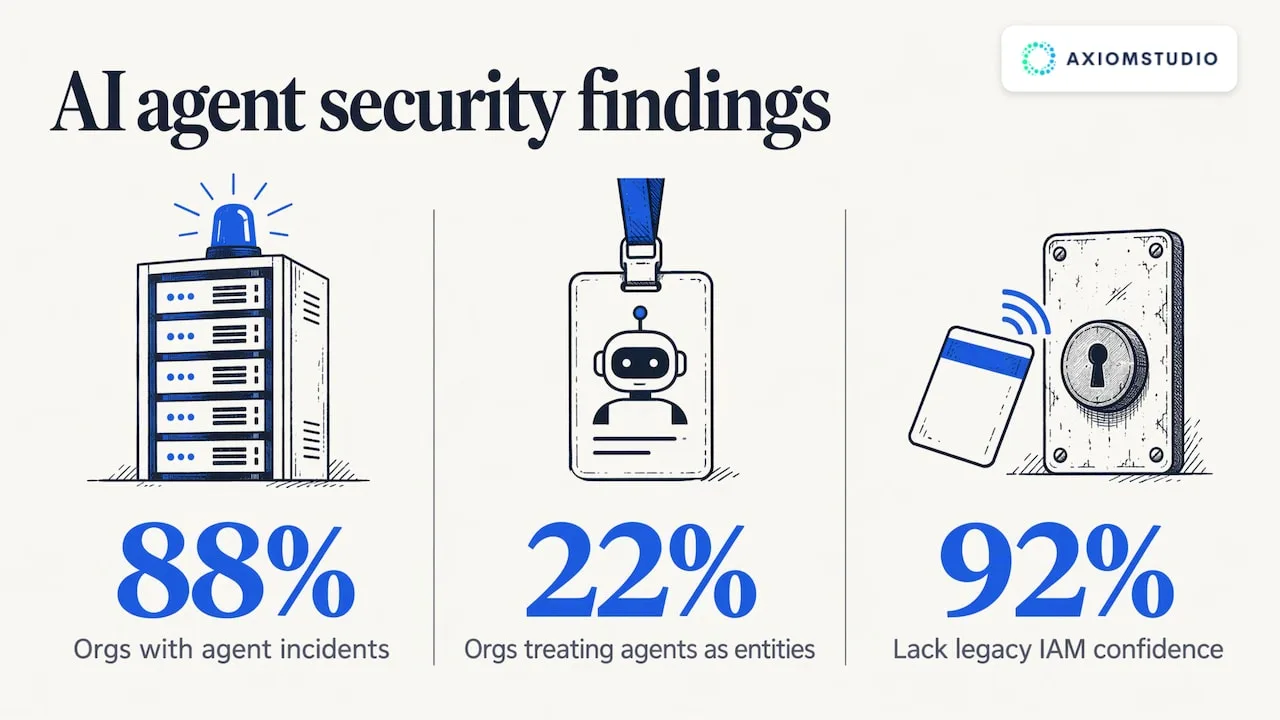
The gap shows in practice. The same Cloud Security Alliance note reports that the Gravitee State of AI Agent Security 2026 survey found 88% of organizations had confirmed or suspected AI-agent security incidents in the prior year. Only 22% treated agents as independent identity-bearing entities. In a separate January 2026 survey by the Cloud Security Alliance and Oasis Security of 383 IT and security professionals, 92% lacked confidence that legacy IAM could manage AI and non-human identity risk.
Why coding agents come first
An AI coding agent typically holds some mix of repository write access, CI tokens, package registry access and cloud credentials. If it runs under a developer’s personal token, every commit, pull request and deployment looks like that developer’s work. Three failures follow:
- No attribution. An audit cannot separate what the person did from what the agent did.
- Excess privilege. The agent inherits everything the developer can reach, not what the task needs.
- No clean revocation. Removing the agent means rotating the developer’s credentials.
These gaps grow as more teams adopt coding agents, a pattern covered in our analysis of AI coding governance challenges solo tools can’t solve.
Our guide to governing agentic coding tools covers the tooling side, and the CISO guide to AI agent security threat models lists the threats these identity controls are meant to contain.
Core components of an agent identity program
The IETF draft lists the components a complete system needs: agent identifiers, credentials, credential provisioning, authentication, authorization, observability and remediation, policy, and compliance measurement. Read as a checklist for your team, they group into five jobs.
1. Identity and ownership
Every agent gets a unique identifier that is never shared between agents or reused. Each identifier records a human owner who answers for the agent, the environment it runs in and the configuration it was approved with. If an agent’s model, prompt or tool list changes materially, treat it as a new version that needs approval.
2. Credentials
The draft’s guidance is to bind credentials cryptographically to the agent, provision them at runtime and keep them short-lived. Avoid long-lived API keys pasted into configuration files. The draft names WIMSE, SPIFFE and OAuth as standards to build on rather than inventing a scheme.
3. Authorization and delegation
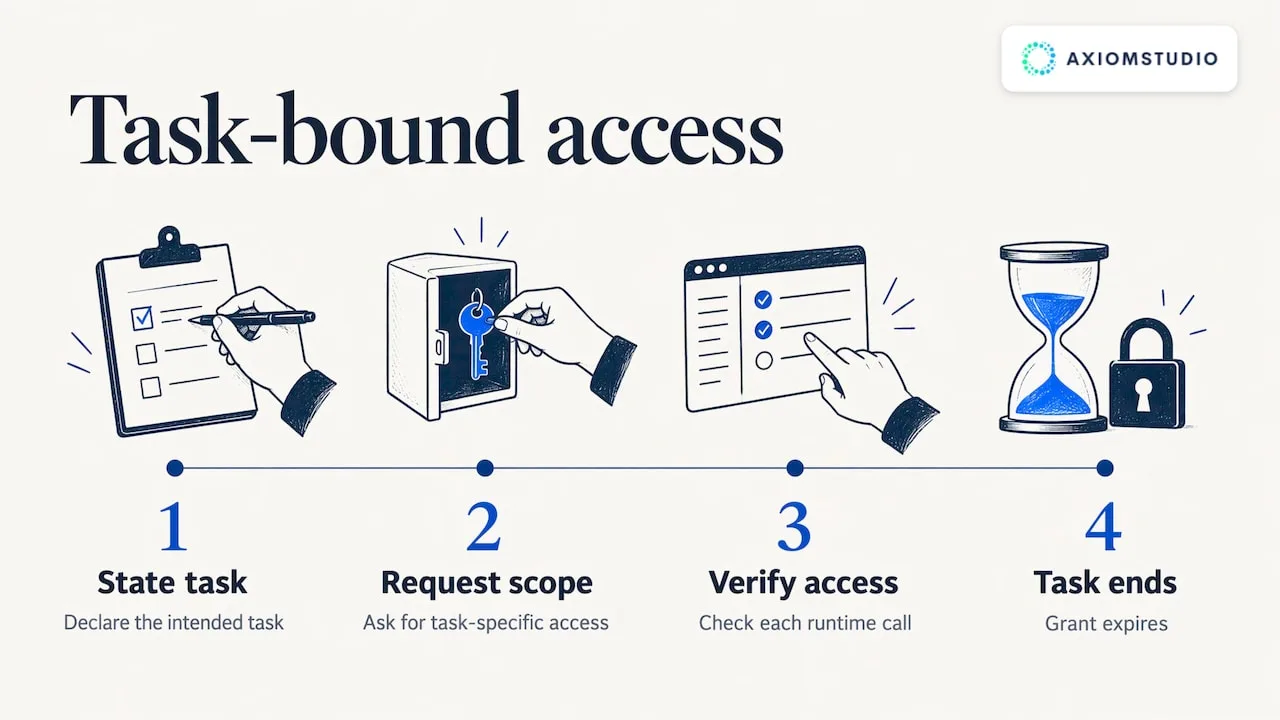
NIST’s tenets describe access grants that are just-in-time, time-bounded and audience-specific. Individual tool calls or resource access should go through runtime verification. The Cloud Security Alliance’s Agent Identity Governance Framework centers on intent-declared, time-bound, scope-limited grants in place of standing privileges. In practice that means an agent asks for a scope for a stated task, and the grant expires when the task ends.
For more depth on enforcing permissions before a model acts, see this write-up on LLM access control.
4. Monitoring and remediation
Authorization should not be a one-time decision. The IETF draft says it should be reconsidered using observed behavior and system state. Risk or revocation signals should trigger prompt privilege reduction, session termination or token disposal. Examples of signals include an agent touching repositories outside its task, a spike in tool calls, or a request for a scope it never used before.
5. Audit evidence
NIST recommends an independent, append-only evidence chain linking identity, delegated intent and resulting actions. The IETF draft is specific about what each record contains:
- agent identifier and delegated subject, where present
- target resource or tool and requested action
- decision, timestamp and correlation identifier
- risk state and remediation cause
The records must be durable and tamper-evident. Our guide to building an AI audit trail for the enterprise walks through this from model selection to production.
The agent identity lifecycle
NIST and the Cloud Security Alliance both frame agent identity as a lifecycle with its own stages, from creation to revocation. A workable version for an engineering organization has six stages:
- Request. An owner registers the agent, its purpose and the systems it needs.
- Approval. Security or the system owner reviews the requested scopes against least privilege.
- Issuance. The agent receives an identity and short-lived credentials at runtime.
- Operation. Each tool call is verified and logged. Grants are time-bound and renewed per task.
- Change. A new model, prompt or tool list triggers re-approval.
- Revocation. The identity is disabled when the task ends, the owner leaves or a risk signal fires.
The weakest stage in most organizations is the last. The Cloud Security Alliance’s survey figure above, 78% with no formal policy for creating or removing agent identities, suggests many agents are created ad hoc and never retired.
How to start: a stepwise plan for your team
You do not need a complete program before you gain control. This order delivers the most risk reduction first.
Step 1: Inventory your agents
List every AI agent and coding assistant that can act in your environment: IDE agents, CI-integrated reviewers, autonomous delivery agents and chat-based assistants with tool access. For each, record the credential it uses today. Most teams find shared tokens and personal accounts here.
Step 2: Assign owners and unique identities
Give each agent a distinct identity and a named human owner. Where a platform cannot yet issue distinct identities, create separate service principals per agent as an interim measure and document the exception.
Step 3: Define scopes and allowlists
For each agent, write down the tools, repositories and environments it may use. Deny everything else. Separate read scopes from write scopes, and keep production deployment behind an approval rule that requires a person.
Step 4: Replace standing access with task-bound grants
Move from permanent tokens to grants that expire with the task. This is the single change that most limits the damage from a hijacked or misbehaving agent.
Step 5: Log every decision
Capture the fields listed above for each authorization decision and store them where the agent cannot edit them. Tie logs to pull requests and deployments so an auditor can follow one change from request to production.
Step 6: Review and revoke on a schedule
Review agent inventories and scopes on a fixed cadence, and revoke anything unowned or unused. Add event-driven revocation for departures and risk signals.
For a phased approach to governance steps mapped to NIST, this AI data governance framework is a useful companion to your plan.
Rules and standards that apply
No single law is titled “AI identity management”, so teams usually map controls to frameworks they already follow.
- NIST. In the United States, NIST’s National Cybersecurity Center of Excellence has sought public comment on a concept paper about identifying and authorizing AI agents. Together with the October 2026 design tenets, it signals where US guidance is heading.
- EU AI Act. For high-risk systems, Article 12 requires automatic event logging over the system’s lifetime. That page lists the Annex III application date as 2 December 2027. Agent audit trails give you a head start on that requirement.
- SOC 2, ISO 27001, HIPAA, GDPR. Auditors for these frameworks already ask who accessed what and when. Agent identities and logs let you answer that for non-human actors.
Our comparison of AI governance frameworks and the AI compliance guide help you map these to specific controls. Confirm obligations with your counsel, since dates and scope for the EU Act have been subject to change.
Where Axiom Studio fits
Axiom Studio is an enterprise platform for AI governance, observability and compliance automation. The Unified AI Gateway provides credential vaulting, granular permissions, audit trails and token-level cost tracking for agents and model calls. The VibeFlow agent team tracks work against compliance frameworks such as SOC 2 and GDPR, and the Vera code review agent reviews AI-assisted code before it merges. That gives your team a single place to set what agents may do and a record of what they did.
Plans are Starter (free), Pro at $20 per month, and Team at $49 per seat per month with a three-seat minimum. Enterprise pricing is not published. See current plans on the pricing page, or explore the documentation for setup guides.
Sources
- Design Tenets for Agent Identity Management Systems | NIST
- AI Identity Management System | IETF WIMSE draft
- AI Agent Identity Crisis: Standards Emerge as Enterprises… | Cloud Security Alliance
- Agent Identity Governance Framework | Cloud Security Alliance
- Article 12: Record-Keeping | EU AI Act
- LLM Access Control: Enforce Permissions Before the Model
- AI Data Governance in 30–90 Days
Recommended
- CISO Guide: AI Agent Security Threat Models
- Agent Skill Security: Provenance, Permissions, Scripts, Secrets, and Governance
- Build an MCP Registry Before Agents Get Tools
- Governing Agentic Coding Tools
Frequently Asked Questions
What is AI identity management?
It is the discipline of giving each AI agent a unique, verifiable identity, assigning a human owner, limiting its access to what a task needs and recording its actions. It treats agents as non-human identities with their own lifecycle rather than as extensions of a user account.
How is it different from traditional IAM?
Traditional IAM was designed for people and fixed service accounts. Agents are autonomous and unpredictable, so they need runtime verification of each tool call, short-lived grants and continuous reassessment. NIST also recommends a lifecycle separate from human principals.
What should an AI agent identity include?
At minimum: a unique identifier, a named owner, the workload and environment it runs in, its approved configuration and the scopes it may request. NIST says the identity should be cryptographically verifiable and distinguishable from people and service accounts.
Which agents should we manage first?
Start with agents that can change code or infrastructure, such as AI coding assistants and autonomous delivery agents. Their repository, pipeline and cloud permissions carry the highest risk.
When should an AI agent's access be revoked?
Revoke it when the task ends, when the agent's owner leaves, or when a risk signal fires, such as access outside its task or an unusual spike in tool calls. Review agent inventories on a fixed schedule and remove any agent that is unowned or unused.
Which standards apply to AI agent identity?
No single law covers it. Teams map controls to NIST's design tenets for agent identity, the IETF WIMSE draft, the EU AI Act's Article 12 logging duty for high-risk systems, and existing SOC 2, ISO 27001, HIPAA and GDPR access-control requirements.
Written by
Axiom Studio