AI Incident Response: A Playbook for Teams Shipping AI
How to prepare for, detect, contain and learn from AI incidents: logging, narrow containment, human oversight, EU reporting clocks and what software must do.
 Axiom Studio November 20, 2026 14 min read

On this page
AI incident response is the process of detecting, containing, investigating and recovering from failures and attacks in systems that use AI models and agents. It differs from classic incident response in one way that matters: the evidence is probabilistic and short-lived. A prompt, an output or an agent’s tool call can be gone before anyone looks. The teams that handle these incidents well do three things before anything breaks: they log what the model and its agents do, they pre-authorize containment, and they review AI-generated changes before those changes reach production. We build Axiom Studio around that last point, and the rest of this article gives you the full routine.
TL;DR
- An AI incident is harm, or a likely harm, caused by the development, use or malfunction of an AI system. It often first looks like an ordinary security event.
- Log prompts, outputs, tool calls, retrieval queries and the identity behind each interaction from day one. You cannot investigate what you did not capture.
- Contain narrowly: revoke one agent’s access to one connector, switch models or disable one tool, instead of taking the whole service down.
- Keep a named human accountable for key decisions, and keep evidence that AI findings were validated.
- Check your reporting clocks. In the EU, the AI Act, DORA and NIS2 can apply to the same incident.
What AI incident response means
There are two things people mean by the phrase, and your team needs a plan for both:
- Incidents in AI systems. A model leaks data, an agent takes an action it should not have, a poisoned dataset changes outputs.
- AI used to help respond. AI summarizes alerts, drafts case notes and suggests owners during any incident.
This article focuses on the first, then covers the second in the section on designing a harness around AI defenders.
There is no single accepted definition yet. OWASP’s GenAI guide adopts the OECD expert-group wording: an event or series of events where the development, use or malfunction of an AI system directly or indirectly leads to specific harms. Japan’s AI Safety Institute frames an AI incident as AI behavior deviating in unexpected ways beyond the risk tolerance of an organization or society, and notes it is often first detected as a conventional cybersecurity incident.
How it differs from traditional incident response
In a traditional incident you find the line of code, the misconfiguration or the stolen credential. With AI, GLACIS, summarizing Microsoft’s guidance, notes that the same prompt may produce different outputs, that the root cause may be a probability distribution rather than a line of code, and that a classifier gap can produce thousands of harmful outputs before anyone reviews them. OWASP adds that root-cause analysis is significantly harder than debugging a conventional attack, because even developers may be unable to explain why a given output was generated.
The practical differences for your runbook:
| Area | Traditional IR | AI IR |
|---|---|---|
| Main focus | Systems, data, access | Model behavior, output quality, fairness, plus the systems around it |
| Typical incident types | Malware, intrusion, misconfiguration | Drift, adversarial inputs, bias, hallucination, prompt injection |
| Detection | Network and endpoint telemetry | Performance monitoring, drift and anomaly detection, output review |
| Forensics | Disk, memory, logs | Model interrogation, feature attribution, training-data analysis |
| Recovery | Patch, rebuild, restore | Model rollback, retraining, data cleaning, validation |
The table follows the GLACIS AI incident response playbook comparison. It also lists the people you need: data scientists and ML engineers alongside security staff.
The incidents to prepare for
The Cloud Security Alliance lists recurring AI security scenarios: prompt injection, data poisoning, model poisoning and supply-chain attack, tool poisoning and misuse, and rogue agent deployment. The Bank of England’s November 2026 guidance adds that poisoning can take a long time to cause detectable harm, and names extraction, evasion, jailbreaking and misuse of retrieval-augmented generation (RAG) pipelines, plus attacks by highly autonomous AI agents.
For software teams using coding agents, translate these into your own terms:
- An agent opens a pull request that adds a vulnerable dependency or weakens an authorization check.
- An agent holds a token with broader scopes than its task needs, and a prompt injection in a ticket or file steers it to use them.
- An unapproved tool or skill is added to an agent’s allowlist and runs a script you never reviewed.
- Teams adopt AI tools you do not know about. Our post on signs of shadow AI in engineering teams lists what to look for, because you cannot respond to an incident in a tool you have not inventoried.
The Cloud Security Alliance makes a point that changes how you set severity. A chatbot manipulated into revealing another user’s data looks, from the network, like an ordinary API call returning a 200 response. The incident happens at the application and semantic layer. So rate severity by what the model could access, not only by what it actually did.
For a deeper threat model of autonomous code generation, see our CISO guide to AI agent security threat models.
Prepare before the incident
Preparation decides the outcome. In-Q-Tel’s AI Incident Response Guidebook, presented at a NIST event in May 2026, says every AI system needs a Short-Term Containment Plan before it is deployed, because finding the cause of an AI failure can take weeks. It also lists nine topics an AI incident response policy should address:
- Who is involved in response activities.
- Who decides during an incident.
- Triage guidance.
- Procedures for reproducing and verifying incidents.
- Guidance on surveillance versus interdiction.
- Chain-of-custody instructions for affected systems and data.
- Communications guidance.
- Accountability for the response.
- Who revises the policies over time.
The Bank of England asks for the same discipline in playbook form: document escalation thresholds, emergency decision-making authority, evidence requirements and the authority to isolate, reduce or take services offline, before the incident. The gap most teams have is item 2. If an agent is misbehaving at 2 a.m., someone must already have the right to switch it off.
Build the inventory
IAPP’s NIST-aligned sequence starts with governance and identification: write AI-specific incident policies, set contractual responsibilities with third-party model vendors, and inventory every LLM tool, API, endpoint and connector. Threat-model jailbreaking against each one. A practical inventory row has the agent or tool, its owner, the model provider, its scopes, the data it can reach and the person who can disable it.
Log what you will need
The Cloud Security Alliance says AI incident management starts with logging. At minimum, retain:
- prompts submitted to the model
- outputs generated
- tool and function calls
- queries issued to the retrieval system
- the identity context of the user or system behind each interaction
IAPP’s Brian Hengesbaugh stresses the same point from the legal side: pre-plan how to capture and preserve ephemeral artifacts such as prompts, outputs, session context, agent memory and tool-call history before they are lost. Decide retention periods with your privacy and legal teams, because prompt logs can hold personal data.
Detect and triage
AI detection watches different signals. Per the Bank of England, monitor prompt patterns, output anomalies and system behavior, and compare logs from LLM APIs, tool executions and chat sessions. It also notes that you can use an LLM-as-a-judge tool to flag anomalous behavior. AWS Prescriptive Guidance for agentic AI recommends operational observability for harmful content, bias, unexpected usage patterns, privacy violations and regulatory breaches, with post-operation log scanning as a fallback.
A triage checklist that fits on one screen:
- What can this system reach? Data, repositories, production credentials, customers.
- What did it actually do? Pull the tool-call history for the affected session.
- Is it still happening? A model that misbehaves once may do it again on the next prompt.
- Is regulated data involved? If yes, start the reporting clock check (below) now, not after the investigation.
- Who is the named owner? One person, with authority to contain.
Contain without a full shutdown
Broad shutdowns are costly, and AI systems rarely need them. The Cloud Security Alliance recommends a graduated containment strategy, tested regularly. Its test: can you revoke an AI agent’s access to one connector in minutes without redeploying the whole application? If you can, containment is surgical. If you cannot, it is an outage.
Japan’s AI-IRS framework builds on two criteria, observability and controllability, and wants designs that allow localized action: stop one module, switch one function, switch to an alternate model, remove injected training data or disconnect an agent’s unauthorized API use. Autonomous processing continues while only the affected component is suppressed.
AWS lists emergency shutdown capabilities (rollback, disable a function, safe mode) and safe fallback systems in the business continuity plan. Put these into a ladder your on-call engineer can follow:
- Reduce: lower the agent’s scopes or put it in read-only mode.
- Isolate: revoke one connector, tool or credential.
- Switch: route traffic to another model or a prior version.
- Stop: disable the agent or feature.
- Take the service offline, only when the lower steps fail.
Microsoft Learn prescribes a three-stage remediation as summarized by IAPP: containment in the first hour, expanded mitigation within 24 hours, then source fixes over days or weeks with watch periods.
Designing the harness around AI defenders
If your responders use AI to triage and investigate, the Bank of England asks you to build a “harness” around it: workflow design, controlled tool access, contextual information, validation steps, integration with existing engineering and security platforms, and meaningful human review, including targeted retesting of AI findings, with evidence of validation and named accountability. Secure defaults make that harness easier to trust; shipping security by default settings is a good first move before you give any agent access to your systems.
Investigate and recover
Investigation starts from the preserved artifacts. Reconstruct the sequence: the input, the retrieved context, the model version, the tool calls and the output. Where you cannot explain the model’s decision, document that, and focus on what you can show: what the system had access to and what it did.
IAPP’s recovery step includes restoring services, rolling back models or agent states, redacting unsafe memory or embeddings, retraining, and running AI-specific post-mortems. Add these to every post-mortem:
- Which control should have stopped this, and why did it not?
- Was the model’s access broader than the task required?
- Did the logs hold everything needed to reproduce the event?
- Which approval rule or guardrail changes now?
For AI-generated code, the cheapest fix is upstream. Our write-up on quality gates for AI-generated code describes an automated review pipeline that catches defects before merge.
Know your reporting clocks
Reporting duties depend on your sector and region, and several can apply at once. Under Article 73 of the EU AI Act, providers of high-risk AI systems must report serious incidents immediately after establishing a causal link or reasonable likelihood, and within 15 days. The deadline is 10 days if a person dies, and two days for widespread infringements or serious disruption of critical infrastructure. Regulation AI explains that DORA requires financial entities to report major ICT incidents at 4 hours, 72 hours and one month, and NIS2 requires a 24-hour early warning, a 72-hour notification and a final report at one month. One incident can trigger both, so a single procedure should assess every threshold.
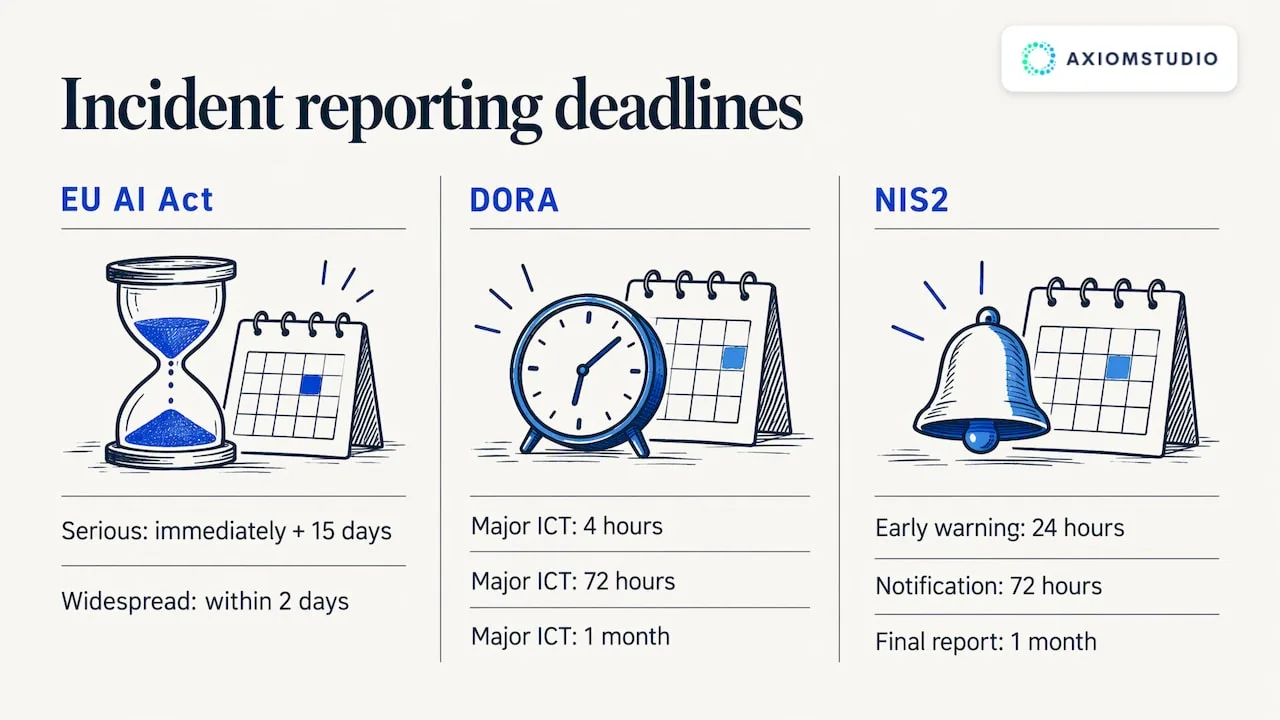
Morgan Lewis notes the AI Act timeframes are tighter than GDPR’s and that an initial report may be incomplete and later completed. Ask your counsel which rules cover your products and customers; this article is not legal advice.
What AI incident management software should do
Teams searching for AI incident management software usually need one of two things: a place to coordinate a response, or controls that make incidents rarer and cheaper. Judge any tool against the lifecycle above:
| Need | What to look for |
|---|---|
| Evidence | Real-time audit trail of prompts, outputs, tool calls and identities |
| Containment | Policy-based access controls that can revoke one tool or scope fast |
| Routing | Ability to switch model providers without redeploying |
| Review | Automated checks on AI-generated changes before merge |
| Compliance | Mapped scans against the frameworks you answer to |
| Workflow | Tickets, owners and post-mortem actions in the same place as the code |
This is where we built Axiom Studio. Vera, our code review agent, reviews AI-generated changes and shows the evidence and commands behind each finding. VibeFlow supplies a team of AI agents that takes work from ticket to merge, tracks features, todos and issues in one dashboard, and tracks work against compliance frameworks such as SOC 2 and GDPR, so incident follow-up work lives next to the code. Our Unified AI Gateway covers audit trails, credential vaulting and granular permissions for agent tools, token-level cost tracking and routing across 18+ LLM providers. That matches the evidence, containment and switching needs in the table.
Measure whether your process works
A plan that has never been exercised is a guess. Run a tabletop for each major scenario: a prompt-injected agent, a poisoned data source, a leaked credential in an agent’s context. Include a containment drill where an engineer actually revokes an agent’s connector. Then track:
- Time from first anomalous output to detection.
- Time from detection to containment, and whether containment was narrow.
- Share of incidents where the logs let you reproduce the event.
- Post-mortem actions closed before the next exercise.
- Whether a named human signed off each key decision.
The Bank of England’s requirement for validation evidence and named accountability gives you the audit-side measures. Compliance teams can ask for the same records during an audit, so keep them in one system. Our AI production readiness checklist is a useful starting list for what must be true before an AI system ships.
Put controls in front of the incident
Most AI incidents in software delivery start with a change nobody reviewed carefully enough. If your team uses AI coding agents, review is the control that pays back first. Vera reviews code with actionable evidence and is free forever on all Axiom Studio plans, with unlimited reviews and users. Published plans, per our pricing page: Starter (free), Pro at $20 per month, Team at $49 per seat per month with a three-seat minimum, and Enterprise. If you want to see the audit trail and guardrails against your own workflow, request a demo.
Sources
- GLACIS: AI Incident Response Playbook
- Japan AISI: Approach Book for AI Incident Response
- OWASP: GenAI Incident Response Guide
- Cloud Security Alliance: When the Playbook Breaks
- Bank of England: Effective practices for AI cyber risk and resilience
- IAPP: Preparing for AI incidents
- In-Q-Tel: AI Incident Response Guidebook (hosted by NIST)
- AWS Prescriptive Guidance: Incident response for agentic AI
- EU AI Act Article 73
- Regulation AI: AI Act vs DORA vs NIS2
- Morgan Lewis: EU AI Act and NIST on cyberattacks on AI
Recommended
- AI Operations (AIOps): Managing AI Systems at Enterprise Scale
- What is AI Security?
- AI Observability: The Enterprise Guide to Monitoring LLMs & Agents
- CISO Guide: AI Agent Security Threat Models
Frequently Asked Questions
What is the first thing to do when an AI agent misbehaves?
Contain it narrowly: reduce its scopes, revoke the specific connector or credential involved, or switch to another model. Then preserve the prompts, outputs and tool-call history for that session before they are lost. Escalate to the person your playbook names as decision-maker.
What should an AI incident response plan include?
In-Q-Tel's AI Incident Response Guidebook lists who is involved, who decides, triage guidance, procedures to reproduce and verify incidents, surveillance versus interdiction, chain of custody, communications, accountability and who revises the policy. It also says every AI system needs a short-term containment plan before deployment. Add an inventory of agents and tools, plus logging of prompts, outputs, tool calls and identities.
Is AI incident management the same as IT incident management?
They overlap but are not the same. IT incident management tracks outages and restores service. AI incident management also covers harmful or unexpected outputs, drift, poisoning and agent misuse, where the system may look healthy while causing harm. Your IT process is the base; add AI-specific logging, severity criteria and containment steps.
Can AI help with incident response itself?
Yes, for triage, summarizing alerts, drafting case notes and coordination. The Bank of England says meaningful human review remains essential, especially for key decisions. Keep controlled tool access, validation evidence and a named accountable person.
Do I have to report an AI incident to a regulator?
It depends on your sector, region and the system. In the EU, the AI Act, DORA and NIS2 each set their own clocks, and one incident can trigger several. Ask your legal counsel to map the thresholds before an incident happens.
Written by
Axiom Studio