Code Review Tools: How to Compare Your Options in 2026
Compare code review tools by type: platform built-ins, static analysis, security scanners and AI reviewers. See what enterprise teams should check first.
 Axiom Studio November 22, 2026 10 min read
On this page
The best code review tool for an enterprise team is the one that reviews AI-generated changes, records who approved what, and runs where your pull requests already live. Most lists rank tools by feature count. For teams shipping code written by AI agents, the better question is what happens to a change between the pull request and the merge, and who can prove it afterward. Vera, the free code review agent from Axiom Studio, is built for that question: each finding shows its evidence and the commands used to verify it, and inside VibeFlow every task is traced to a git commit.
This code review tools comparison covers all four types, not only AI reviewers. For the AI category on its own, see our guide to the five types of AI code review tools.
TL;DR
- Code review tools fall into four types: platform built-ins, static analysis, security scanners and AI reviewers. Most enterprise teams need more than one.
- Independent benchmarks show AI reviewers still miss many issues, so evidence, verification and human routing matter more than a ranking.
- A reviewer holds privileged access to your repositories. Evaluate it as a CI integration with an audit trail, not as a linter.
- Published starting prices range from $10 to $350 a month, so compare on the unit (seat, contributor, credit, lines of code), not the headline number.
- Vera reviews with evidence, re-checks fixes on the same pull request and is free on every Axiom Studio plan.
The four types of code review tools
A code review tool helps a team inspect a change before it merges. Manual review checks a pull request (a proposed code change) against business and technical requirements, with human context and accountability. Automated tools scan files, functions, configuration and dependencies against predefined rules in IDEs, pre-commit hooks and CI pipelines. They are consistent and repeatable for the same rule set but lack business context.
| Type | What it does | Typical gap |
|---|---|---|
| Platform built-ins | Pull request comments, approvals, branch rules in your Git host | No compliance evidence, little help with AI-written volume |
| Static analysis and linting | Rule-based checks for quality and style | No business context, rules need upkeep |
| Security scanners (SAST, dependency scanning) | Finds known vulnerability patterns | Coverage varies by language and vulnerability class |
| AI reviewers | Reads the diff and comments on bugs, risks, design | Precision and recall vary widely |
In the static analysis vs AI code review choice, the two layers do different jobs: rules catch known patterns the same way every time, while an AI reviewer reads intent and context but misses more and varies between runs. Most teams run both.
Axiom’s own guides cover the named AI code review products and the five stages inside an AI review agent in more detail.
What the benchmarks say about AI review
AI review is useful, but you should size your expectations with data. A November 2026 analysis of the AACR-Bench results published by OpenCodeReview, Alibaba’s open-source reviewer (200 pull requests from 50 repositories, 1,505 verified issues), found a best F1 score of 25.1%, with 33.9% precision and 20% recall. With the same Claude 4.6 Opus model, a general coding agent (Claude Code) posted 29.9 comments per pull request at 11.6% F1: many comments, few useful ones.
A 2026 research summary reports that no frontier model detects more than 31% of human-flagged issues from a diff in independent benchmarks, and that security-vulnerability recall stays below 0.5 even for state-of-the-art models.
Two lessons follow for an enterprise buyer:
- Noise and misses are both costs. Measure precision, recall and comments per pull request on your own repositories. Our guide to measuring AI review agents shows how.
- Rules decide coverage. The same analysis found that OpenCodeReview’s Java, Kotlin and C++ rule files have no security section, so injection checks in those languages are not guaranteed. Treat a model or rule upgrade as a change to your review system and rerun it on a sample first.
Also check who ran the benchmark. Vendors build or publish most 2026 review benchmarks, and the analysis above notes that AACR-Bench was built with Alibaba’s help. Ask where the conflicts of interest sit before you trust a ranking.
Why AI-generated code raises the stakes
A Checksum survey of 105 engineering leaders found that 78% trust AI-generated code more than a year ago, yet 61% shipped production incidents from it within 90 days. Speed of output outpaces rigor of review, which is the gap a tool for reviewing AI-generated code has to close.
That is why the question for your team is not only “which tool finds bugs” but “which setup stops an unreviewed AI change from merging.” Merge gates, approval rules and a recorded decision for each change answer that. See how quality gates for AI-generated code fit into an automated pipeline.
Code review tool pricing: what vendors publish
Prices are published on vendor pages and change often, so read the unit as carefully as the number. A ranking of secure code review tools listed these starting prices, correct as of November 2026:
| Tool | Type | Listed starting price | Unit |
|---|---|---|---|
| SonarQube Cloud Team | Static analysis and quality gates | $34/month | Up to 100k lines of code |
| Snyk Team | SAST and dependency scanning | $25/month | Up to 10 developers |
| Semgrep Code | Rule-based SAST | $30/month | Per contributor |
| Aikido Security Basic | All-in-one application security | $350/month | 10 users |
| Codacy Team | Quality and security checks | $21/month | Per developer |
| GitHub Copilot code review | AI review | $10/month | Copilot Pro plan |
| Checkmarx One, Veracode | Enterprise application security | Custom quote | Negotiated |
Per-seat, per-contributor, per-credit and lines-of-code plans do not compare directly. Estimate your cost with your own contributor count, codebase size and pull request volume, and note that enterprise suites are quoted individually.
Axiom Studio publishes its plans on the pricing page: Starter (free), Pro at $20 per month, Team at $49 per seat per month with a three-seat minimum, and Enterprise. Vera is included free on every plan, with no caps on reviews or users.
Governance criteria: an enterprise code review checklist
A code reviewer reads your source and often writes to your repositories. At Black Hat USA 2025, Kudelski Security disclosed two exploit chains in commercial AI review tools. In one, a malicious linter configuration in a pull request led to code execution and write access to one million connected repositories. In the other, a pull request comment led to code execution and a leaked AWS admin key. Both were fixed after disclosure. The takeaway is to evaluate every reviewer as a privileged CI integration.
Use this checklist:
- Audit trail: is every finding, fix and approval recorded and exportable for auditors?
- Access scopes: what can the tool read and write, and can you restrict it by policy?
- Compliance coverage: which frameworks (SOC 2, GDPR, HIPAA, ISO 27001) does it map findings to, and does it produce evidence?
- Merge control: can findings block a merge? GitHub’s AI Scan reached general availability as an advisory layer whose findings cannot block pull request merges.
- Verification: does the tool check that a fix actually resolves the issue?
- Rules as code: can you version and test your review rules? See code review rules as code.
Where humans stay in the loop
No AI reviewer removes the need for human judgment on high-risk changes. A sound pattern is to route authentication, payments, data access and infrastructure changes to mandatory human approval and use AI as an advisory layer for the rest. This write-up on where human review works and fails explains how to set that routing.
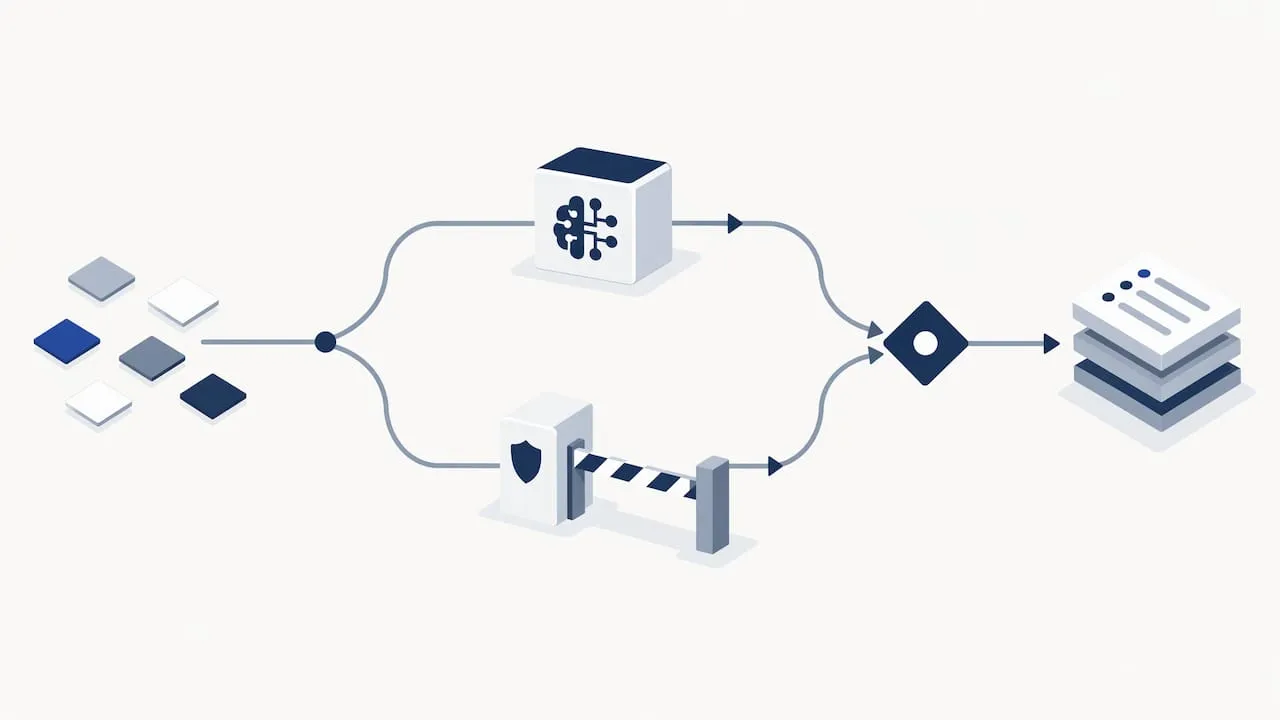
In practice that means an approval rule per path or risk class, plus a queue you can measure. If review is becoming your bottleneck, see how to measure and fix the review queue.
How Vera and VibeFlow compare on those criteria
Vera is Axiom Studio’s code review agent. Each finding names the trigger down to the file and line, explains the impact, and shows the evidence and the commands used to verify it. When Vera flags a blocker, your coding agent fixes it on the same pull request and Vera re-checks it. Vera can run as a required merge check, keeps repeat reviews within a round budget, remembers dismissed advisories, and files tickets in Linear, Jira, ClickUp, Inflectra, Azure DevOps and GitHub Issues.
VibeFlow supplies a team of nine specialist agent personas across planning, development, security, QA and delivery. Every task is traced to a git commit with line counts, and the same work item passes Security Lead and QA Lead review before it ships. VibeFlow tracks features, todos and issues in one dashboard, along with compliance frameworks such as SOC 2 and GDPR.
That covers most of the checklist above in the review step itself: evidence for each finding, verified fixes, merge control and a record from ticket to commit. For a deeper look at splitting a pull request across reviewers, read about specialist review agents. To connect Vera to your Git host, follow the GitHub and GitLab setup guide.
How to choose: a short decision path
- List your risk. AI-written code, regulated data or audit deadlines raise the bar beyond built-in review.
- Pick your layers. Keep your Git host’s review, add static or security scanning for known patterns, and use an AI reviewer with evidence and verification for the rest.
- Price by unit. Use your contributor count, codebase size and pull request volume.
- Score on your own code. Track precision, recall and noise on a sample of past pull requests.
- Set human routing. Define which paths always need a person.
For the wider set of coding agents your reviewer will meet, see this comparison of AI coding tools.
Sources
- Manual vs. automated (AI) code review: key differences (DevCom)
- OpenCodeReview review: Alibaba’s open-source AI code reviewer (FDE Interviews, November 2026)
- AI-assisted code review in 2026: risks, limitations and adoption barriers (Atlas)
- Security-focused code review (The State of Play)
- Best secure code review tools in 2026 (Superblocks)
- How we exploited CodeRabbit: from a simple PR to RCE and write access on 1M repositories (Kudelski Security, 2025)
- How we exploited Qodo: from a PR comment to RCE and an AWS admin key (Kudelski Security, 2026)
Recommended
- 5 Types of AI Code Review Tools and How to Compare Them
- Top AI Code Review Tools for Engineering Teams
- Code Review Rules as Code: Policies and Tests
- Measuring AI Code Review Agents: Precision, Recall, Noise
Frequently Asked Questions
What are the main types of code review tools?
There are four types: platform built-ins in your Git host, static analysis and linting, security scanners such as SAST and dependency scanning, and AI reviewers. Most enterprise teams combine more than one.
How much do code review tools cost?
Listed starting prices ranged from $10 to $350 a month as of November 2026, and enterprise suites such as Checkmarx One and Veracode are quoted individually. Plans are priced per seat, per contributor, per credit or by lines of code, so compare on the unit rather than the headline price.
Which tool is best for code review?
It depends on your risk. Most teams keep their Git host's review, add static analysis or security scanning for known patterns, and use an AI reviewer for the rest. For teams shipping AI-generated code, choose a reviewer that shows the evidence for each finding, re-checks fixes and can run as a required merge check.
Can ChatGPT do a code review?
A general chat model can comment on a pasted snippet, but it has no pull request integration, merge gate, approval rules or audit trail. Enterprise review needs those controls, which a dedicated reviewer built into your workflow provides.
Is SonarQube a code review tool?
It is a static analysis platform that checks code quality and security against rules. It complements pull request review, and teams often pair it with an AI reviewer that adds context and evidence for each finding.
What is the best way to review code?
Combine automated checks for known issues with human review for high-risk changes. Measure precision and noise, version your rules and record every approval so you can show auditors what was checked.
Written by
Axiom Studio