AI Brainstorming Tools Compared for Engineering Teams
Compare four types of AI brainstorming tools for engineering teams, the security checks that matter, and how VibeFlow brainstorms end in a reviewed PRD.
 Axiom Studio November 24, 2026 13 min read
On this page
An AI brainstorming tool earns its place on an engineering team when the ideas it produces become specs, tickets and reviewed code without losing their trail. Most tools stop short of that. They generate and cluster ideas, then leave you to copy the output into a tracker by hand. For teams that build with AI agents, we recommend running the brainstorm where the work is delivered. In VibeFlow, Axiom Studio’s AI delivery team, a brainstorm is a structured review between agent personas that ends in a PRD attached to the project.
This comparison covers the four kinds of tools you will meet, the criteria that matter to developers, security teams and compliance teams, how a VibeFlow brainstorm session works, and a short pilot you can run with your own team.
TL;DR
- Most AI brainstorming tools fall into four types: chat assistants, visual whiteboards, mind mapping apps, and brainstorms built into a delivery platform. They differ in how far they carry an idea.
- For software teams, the deciding question is what happens after the session: does the idea become a spec and work items in the same system that builds and reviews the code?
- VibeFlow runs brainstorms as rounds between agent personas. A lead persona owns the draft, while reviewers challenge it from architecture, security, QA and UX angles. The session ends in a PRD.
- Before you adopt any tool, check data handling, access control, audit logs and certifications. If personnel or customer data enters prompts, privacy law applies.
How to compare AI brainstorming tools
A search for AI brainstorming tools returns long lists of tools ranked on creativity features: prompt templates, sticky notes, mind map layouts. Those matter for a marketing workshop. For a software organization the criteria shift.
Use these six:
- Idea generation and structure. Can the tool produce options, group them and rank them against criteria you set, such as risk, effort or customer impact?
- Challenge and review. Does anything push back on an idea before it is approved, or does the tool only add more ideas?
- Handoff to delivery. Does an approved idea become a spec with scope and requirements, or does someone retype it?
- Traceability. Can you show later why a feature was built, who approved it and what changed?
- Access control and audit evidence. Can you restrict who sees the content and which models process it, and does the vendor provide audit logs and certifications your security team can file?
- Cost model. Is pricing per user, and does it replace other licences or add one more?
Ideation tools usually score well on the first criterion and weakly on the rest. A delivery platform with planning built in can score on all six, which is why the type of tool matters more than the feature list.
The four types of AI brainstorming tools
| Type | Strength | Typical gap for engineering teams |
|---|---|---|
| Brainstorm inside a delivery platform (VibeFlow) | Agent personas challenge a shared draft, and the PRD lands in the project the agents build from | Built for teams that ship software, not for open-ended creative workshops |
| General chat assistants | Fast, flexible idea generation on any topic | Output lives in a chat window, so traceability and access control depend on your own process |
| Visual whiteboards | Live collaboration with sticky notes and voting | Planning stays separate from the tracker and the repository |
| Mind mapping apps | Clear hierarchy and structure for one topic | Ideas must still be exported into a delivery system |
Brainstorms inside a delivery platform
This is the category we build in. VibeFlow supplies a team of nine specialist agent personas, including a product manager, architect, developer, QA lead, security lead and UX designer. It tracks features, todos and issues in one dashboard, and every task is traced to a git commit.
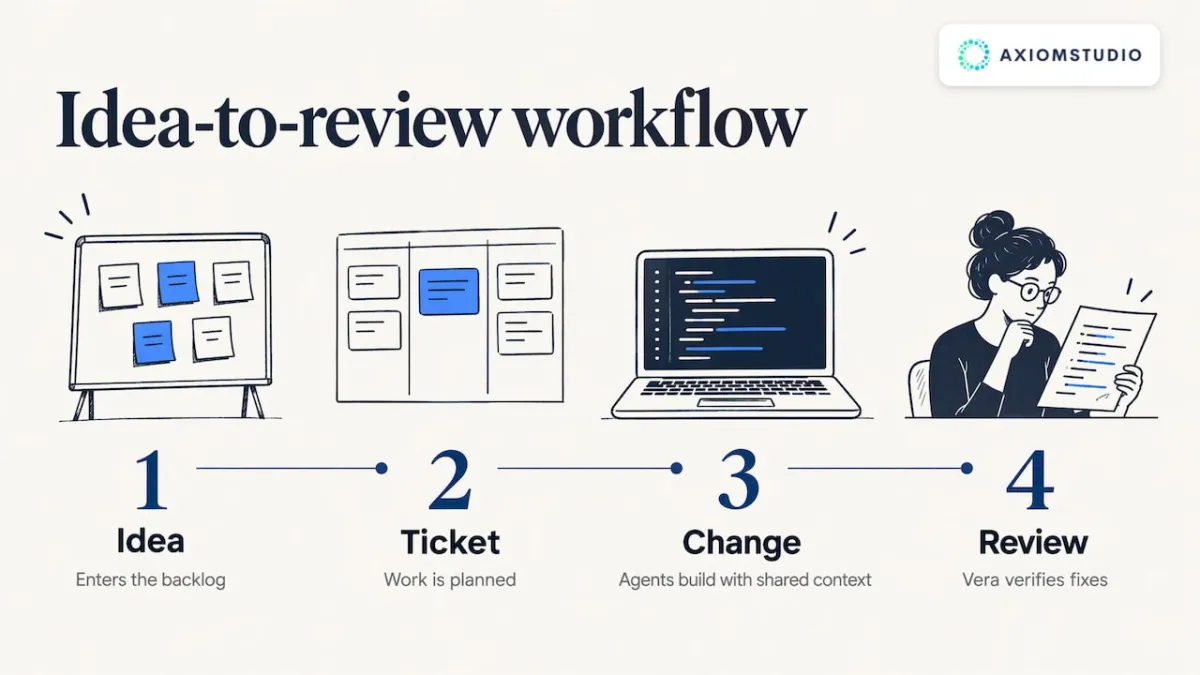
For a brainstorming need, the practical effect is that the brainstorm and the build share one project. The PRD a brainstorm produces is attached to that project, and the agents that later plan and implement the work load the same project context. Nothing is copied between a whiteboard and a tracker, so nothing is lost on the way to the pull request. Vera, our free code review agent, then reviews the resulting changes and re-checks fixes.
General chat assistants
Chat assistants are the quickest way to get fifty options on a design question. They suit a single person exploring a problem. Their weakness for enterprise use is governance: sessions are individual, access rules depend on how each person configured an account, and there is rarely a shared record linking a conversation to a decision. If your team uses them, decide which data may be pasted in and where conclusions are recorded.
Visual whiteboards
Whiteboards give a distributed team a shared canvas with sticky notes, voting and templates, and most now include AI that clusters or summarizes notes. They work well for workshops. The usual cost for engineering is the integration step: outputs go to the tracker through connectors, and every connector is another system to review for access and data handling.
Mind mapping apps
Mind mapping tools expand one topic into branches with AI suggestions. They are strong for outlining a feature area or a research plan. They are single-purpose, so the map still has to be converted into work items elsewhere.
How a VibeFlow brainstorm session works
Most AI brainstorming tools are built to generate ideas. A VibeFlow brainstorm session is built to test them. It is a structured, multi-persona collaboration on one shared working document. One persona, often the product manager or the architect, leads and owns the draft. The other participating personas review each round from their own perspective, challenge assumptions, raise risks and approve sections.
You start a session from the Brainstorm panel on the project’s Teams Chat page, or through the API. You give it a topic, a lead persona and the reviewers. The draft starts from a built-in template with Overview, Problem Statement, Requirements, Open Questions, Assumptions, Risks & Mitigations, Scope Boundaries and Decision Log sections. It can also start as a copy of an existing document. You can scope the session to a feature and set an ordered agenda, with one topic active per round.
One brainstorm round
- Snapshot and fan-out. The draft is recorded, and review prompts go to each participating persona that has a live agent session.
- Tagged review. Reviewers tag every item as
[CHALLENGE],[RISK],[QUESTION],[SCOPE],[APPROVED],[ESCALATE]or[NEEDS_INPUT: @persona]for a directed question to another persona. - Lead update. The lead receives the aggregated feedback, updates the draft and moves resolved items to the Decision Log.
- Convergence check. The controller decides whether to start another round, escalate to a human or finish.
A session converges when no items are open, every reviewer has approved in the current round and no directed questions are pending. Open items are tracked across rounds as open, addressed, deferred or rejected. If one persona challenges a section that another approved in the same round, the conflict is surfaced. If items are raised at least as fast as they are resolved for three rounds in a row, the session is flagged as looping instead of grinding on.
Three limits keep a session from running away:
- Rounds. The default is 5 and the hard cap is 10, with at least 10 seconds between rounds.
- Token budget. Output tokens are counted against a session budget (500,000 by default). At 80% the session pauses for human review, and at 100% it force-converges instead of starting new rounds.
- Scope guard. After each round the draft is compared with the seed. More than 20 KB of growth in one round pauses the session. New sections, a Requirements section more than 50% larger than the seed, new “nice to have” or “stretch goal” language, and requirements that overlap the out-of-scope list are all flagged. Flags block convergence until a round is clean.
When you end the session, VibeFlow generates a clean final document from the working draft, either a PRD (the default) or a general document. A cancelled session produces no document. That PRD is the spec your team breaks into features and todos for the agents to claim. Only one brainstorm can be active per project at a time.
What security and compliance teams should check
Whatever you choose, run the same due-diligence list. A brainstorming session often contains architecture details, customer scenarios and unreleased plans, which are exactly the things your security function protects.
- Certifications. Ask for current SOC 2 Type II and ISO/IEC 27001 reports, and whether the vendor holds an AI management certification. Check the report period and scope, not just the badge.
- Encryption. Data should be encrypted in transit and at rest.
- Access control. Look for role-based permissions, board-level sharing rules and the ability to limit which AI tools and models can see content.
- Audit logs. You need a record of who viewed, changed, exported or shared content, and the ability to export it for an audit.
- Sensitive-data handling. Find out whether the tool detects personal or confidential data before it is sent to a model.
- Model routing and data use. Confirm which model providers process your prompts and whether your content is used for training.
- Integrations. List every connector to your tracker, chat and repository, and review what scopes each one requests.
On our side, credentials are encrypted at rest with AES-256, data is scoped per organization, actions are recorded in immutable audit logs, and the platform supports SSO with SAML 2.0 and OIDC plus role-based access control. Our guide to AI compliance explains how the major frameworks map to AI tooling, and the AI production readiness checklist turns them into pre-launch checks.
Privacy and AI regulation
Two rule sets come up most often when a brainstorming tool uses AI on team content.
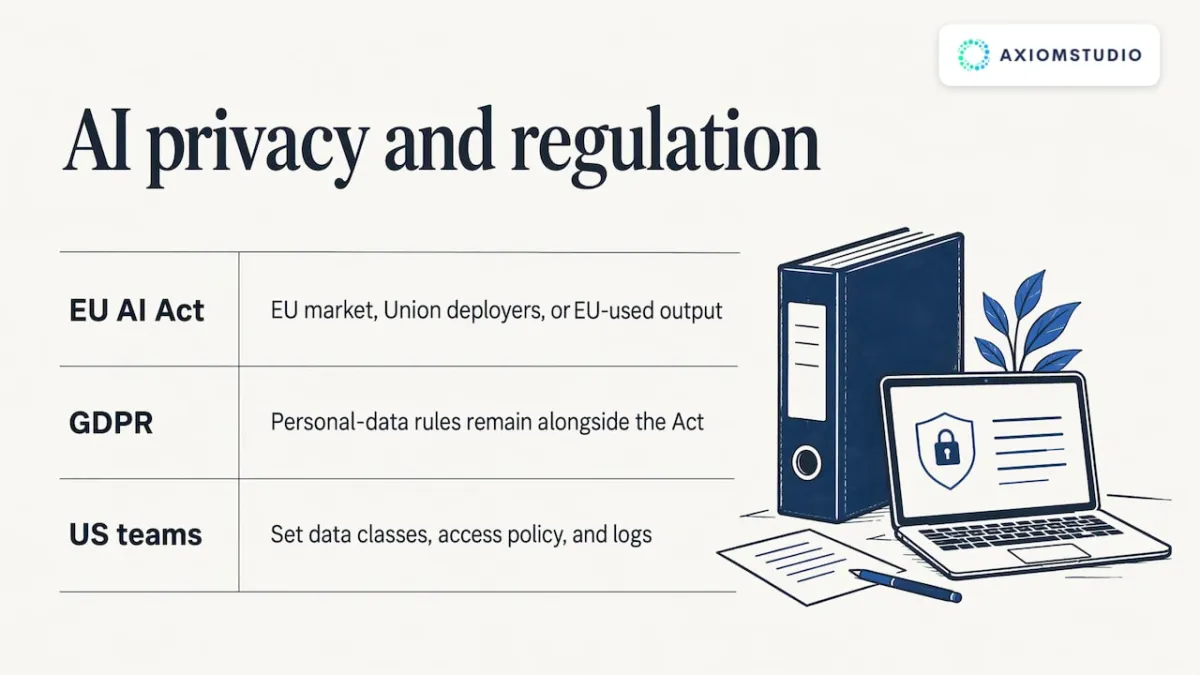
EU AI Act. Article 2 of the consolidated EU AI Act text (27 July 2026) applies the Act to providers placing AI systems on the EU market wherever they are established, to deployers in the Union, and to third-country providers and deployers when the system’s output is used in the Union. A US company with European customers or staff can therefore fall in scope. Our EU AI Act compliance guide walks through what that means in practice.
GDPR. Article 2(7) of the same text states that the Act does not affect GDPR, so the GDPR keeps applying alongside it. If your brainstorm includes names, user feedback or support tickets, check how the tool treats that data. A practical overview of GDPR requirements for AI features helps legal and privacy teams find the high-risk gaps.
For US teams, the practical rule is simple: decide which data classes may enter an AI tool, enforce it with access policy rather than a memo, and keep logs so you can demonstrate it. For a broader view of frameworks, see our comparison of NIST, the EU AI Act and ISO 42001.
Which tool fits which team
Software development teams. You want ideas to land as a spec with context and flow through to merge. A VibeFlow brainstorm produces the PRD, and the same personas carry the work through architecture, development, QA and security review. See what agentic coding involves if your team is new to it.
IT security teams. Your concern is the growth of AI tools you did not approve. Bringing the brainstorm, agent execution and review onto one platform shrinks the number of vendors to assess, a problem we describe in our piece on AI vendor sprawl. Adding the security lead persona to a brainstorm also puts threat questions into the draft before any code exists.
Compliance teams. Your concern is evidence. A brainstorm leaves a Decision Log with each resolved item, and VibeFlow traces every task to a git commit, so you can follow a requirement to the change that implemented it. Our article on risk management beyond checkbox compliance covers how to keep that evidence continuous.
Platform engineers. If you own the toolchain, the page on VibeFlow for platform engineers covers Kubernetes-native agent deployment, LLM routing and governance controls.
Why consolidation beats stacking tools
Teams adopting AI coding commonly end up buying three things: a tracker, an AI reviewer and a compliance add-on. Add a brainstorming tool and that is four systems, four sets of permissions and four places where context can leak or go missing.
The argument for one platform is not only convenience. AI output can arrive faster than review can keep up, and the gap is widest at the seams between tools, where nobody owns the handoff. When the brainstorm, the build and the review share context, the reviewer knows what the spec asked for. Our write-up on governance challenges of AI coding at scale lists the five problems single-purpose tools leave open.
Plans are listed on the pricing page: Starter (free), Pro at $20 per month, Team at $49 per seat per month with a three-seat minimum, and Enterprise.
Run a two-week pilot
A pilot beats a feature checklist. Use one real workstream.
- Pick one team and one initiative. Choose something with a real deadline, such as a new integration or a refactor.
- Define data rules first. Write down which data classes may enter prompts and set access policy to match. Your security team signs off before day one.
- Run the brainstorm inside the delivery system. Generate options, let reviewers challenge them, and finish with a spec your team accepts.
- Let the agents build, and review every change. Track how many items reach merge and how many review findings come back.
- Pull the audit evidence. Ask your compliance lead to trace three shipped changes from the original decision to merge using only the platform’s records.
- Compare the tool count. Note which licences and connectors you could retire.
If step five takes minutes rather than days, the tool is doing its governance job.
Sources
- VibeFlow documentation: Brainstorm Sessions
- Consolidated EU AI Act text (Regulation 2024/1689), 27 July 2026
- Regulation (EU) 2016/679 (GDPR), EUR-Lex
- GDPR for AI: Close High Risk Gaps in Weeks for Legal and Privacy Teams
Recommended
- Top AI Coding Tools for Enterprise Teams
- Best AI Coding Tools in 2026: Claude Code, Cursor, Devin & 10 More Compared
- Top AI Code Review Tools
- Top 5 Signs of Shadow AI in Engineering Teams
Frequently Asked Questions
What is the best AI brainstorming tool for software teams?
Pick a tool where ideas turn into delivery work without being retyped. For teams that build with AI agents, a brainstorm that runs inside the delivery platform, such as a VibeFlow brainstorm session, ends in a PRD attached to the project the agents already work from.
How does a VibeFlow brainstorm session work?
One agent persona leads and owns a shared working draft. Other personas, such as the architect, security lead and QA lead, review each round and tag feedback as challenges, risks, questions, scope concerns or approvals. Rounds repeat until the group converges, a budget limit is hit or you end it, and the result is a finished document, typically a PRD.
Are AI brainstorming tools safe for confidential product plans?
They can be, if you verify encryption, access control, audit logs and certifications such as SOC 2 and ISO/IEC 27001 before use. Set rules for which data may be pasted in and enforce them through policy. Your security team should review the vendor's current reports.
Does GDPR apply to AI brainstorming?
Yes, whenever personal data is processed, for example customer names or support transcripts in a session. Article 2(7) of the EU AI Act states that the Act does not affect GDPR. If you operate in or serve the EU, involve your privacy lead before you roll out a tool.
How much does VibeFlow cost?
The pricing page lists Starter (free), Pro at $20 per month, Team at $49 per seat per month with a three-seat minimum, and Enterprise. Prices were read from the site in November 2026.
Written by
Axiom Studio