AI Vendor Sprawl: Why LLMs, MCP Servers, and Agent Frameworks Drain Engineering Teams
LLM providers, MCP servers, and agent frameworks are multiplying faster than procurement can track them. Here is why AI vendor sprawl is quietly killing ROI—and what engineering leaders can do about it.
 AXIOM Team August 12, 2026 7 min read
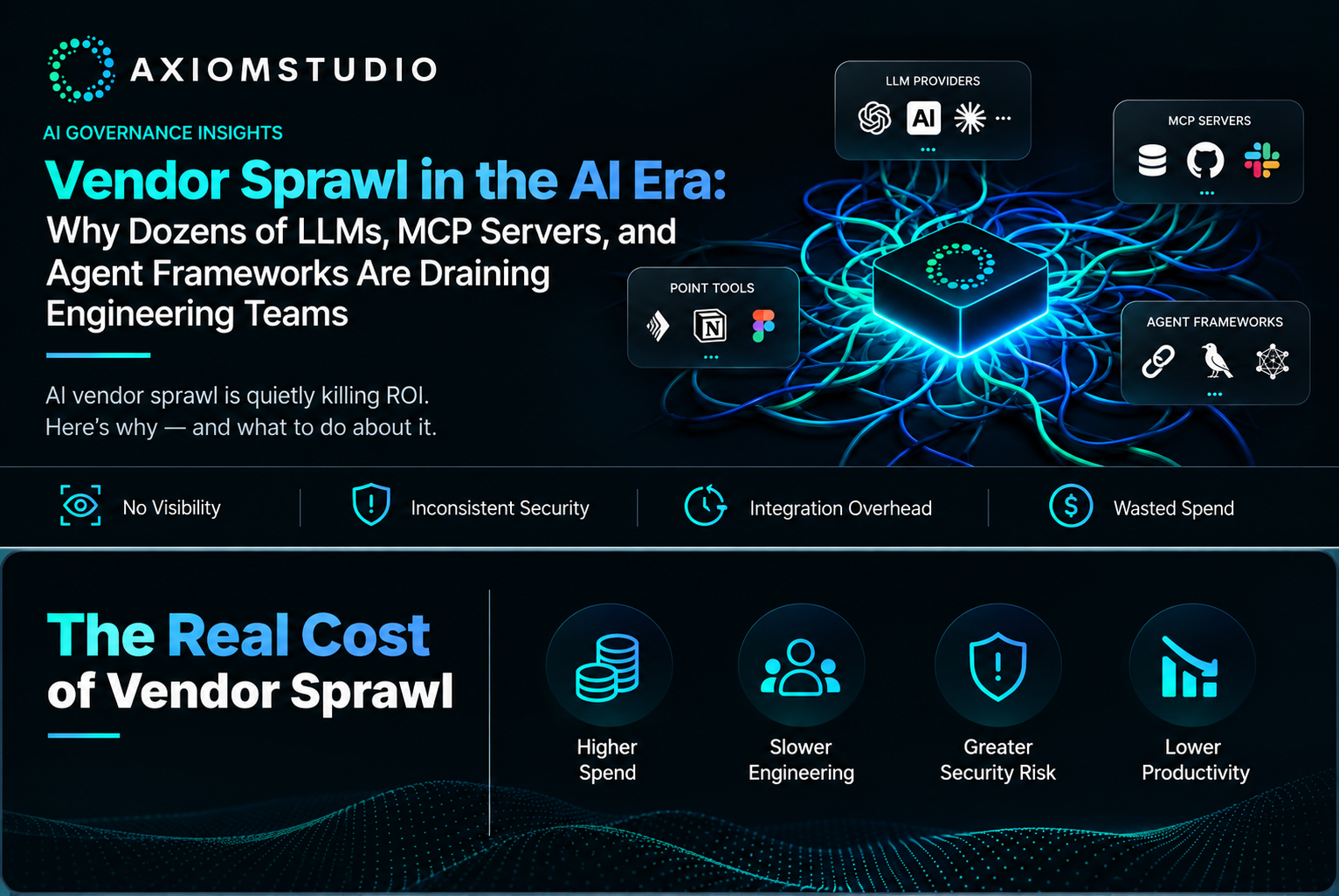
Eighteen months ago, adopting AI meant picking a coding assistant and a chat provider. Today, that same company may be running three or four LLM providers for different workloads, a dozen-plus MCP servers connecting agents to internal systems, two or three agent orchestration frameworks nobody fully agreed on, and a growing list of point tools each team adopted independently because it solved a problem fast.
Nobody planned this. It happened one integration at a time, and now it is quietly draining engineering hours and procurement patience.
This is AI vendor sprawl, and in 2026 it has become one of the most common—and least discussed—costs of moving fast on AI adoption.
How AI Vendor Sprawl Actually Happens
It rarely starts as a strategy failure. It starts as a series of individually reasonable decisions.
One team picks the LLM provider that is best for a specific use case. Another adopts a different model for cost reasons. A SaaS vendor ships its own MCP server, and connecting it seems like a five-minute task, so an engineer wires it up without going through procurement. A few months later, another team does the same with a different vendor.
The pattern repeats until what started as “let’s connect our agent to Jira” has become twenty MCP connectors across the organization within two quarters—a phenomenon now common enough to have its own name: MCP sprawl.
Layer agent frameworks on top of that. Different teams pick different orchestration tools for the same underlying job because each framework works well for the person who evaluated it and nobody owns cross-team standardization. The result is AI agent sprawl: uncontrolled growth of agents and integrations without centralized visibility, consistent security controls, or lifecycle management.
Fragmented telemetry, inconsistent policy enforcement, and no shared evaluation framework are not edge cases for companies that adopted AI tooling team by team instead of platform first. They are the default state.
Where the Cost Actually Lands
The sprawl problem does not show up as one large bill. It appears as friction spread across three groups, each absorbing a different part of the cost.
Procurement
Procurement is tracking a vendor list that did not exist two years ago: dozens of LLM providers and API vendors, each with its own contract terms, billing cycle, security review, and renewal date. Multiply that by the speed at which AI vendors ship new capabilities, and procurement is permanently behind—re-reviewing terms and rerunning vendor risk assessments faster than it can close them out.
Engineering
Engineering pays the sharpest cost. Every vendor has its own API shape, authentication model, rate limits, and failure modes. When a provider changes its API—which happens often in a market moving this quickly—someone has to rewrite the integration.
Teams may do this quarterly, sometimes more often, for integrations that were supposed to be plug and play. That is engineering time spent on integration maintenance instead of product work. It is also largely invisible in sprint reporting because it gets absorbed into maintenance or technical-debt line items rather than counted as a direct cost of the AI strategy.
Security and compliance
Security and compliance inherit the hardest problem: nobody has a complete inventory of what is connected to what.
When agents and MCP servers are wired up team by team without a central registry, there is no single place to answer: “What systems can this agent reach, and what data can it touch?” Governance requires visibility, and sprawl is the absence of visibility by definition.
For a practical view of what happens when individually useful tools spread without shared controls, read AI coding at scale: the governance challenges solo tools cannot solve.
Why “Best of Breed” Made This Worse, Not Better
The instinct that created this problem was reasonable: pick the best tool for each job. Choose the best LLM for code generation, the best framework for orchestration, and the best MCP server for each system integration. Individually, every decision optimized for something real.
The failure mode is that nobody optimized for the sum.
A comparison of the top AI coding tools for enterprise engineering teams makes the issue clear: there is no shortage of excellent point solutions. Tool quality was never the core problem. Solo, best-of-breed tools were built for individual productivity, not organizational coordination. That gap becomes the bottleneck once AI adoption moves from a few power users to the whole engineering organization.
Every additional vendor adds integration surface, another API to monitor, another SLA to track, and another attack surface to secure. The productivity gain from picking the “best” tool gets eaten by the coordination cost of running twelve of them at once.
Workflow orchestration tools were supposed to be part of the answer. Platforms such as n8n became a default way to stitch together AI services without custom code for every connection. That helps with integration mechanics, but it does not solve governance. An orchestration layer that connects everything still needs a policy layer above it deciding what may connect to what, and most orchestration tools were never designed to be that layer. Our guide to n8n for AI explores that boundary in more detail.
What Reducing AI Vendor Sprawl Actually Requires
Fixing this is not about choosing one LLM provider and calling it done. That is neither realistic nor desirable given how quickly model capabilities shift. It is about placing a governed platform layer between the engineering organization and the growing vendor list, so adopting a new capability does not mean adopting a new integration, contract, and blind spot every time.
That requires three things in practice:
- A single point of integration. The systems AI agents need—project management, code repositories, design tools, and cloud infrastructure—should connect through a shared platform instead of one-off integrations maintained by whichever engineer arrived first.
- Centralized visibility and access control. Teams need one inventory showing which agents can reach which systems, with consistent policy enforcement regardless of the underlying model or framework.
- Flexibility without fragmentation. Organizations need to swap or add model providers and capabilities without rebuilding the integration layer whenever the market changes.
This is the problem VibeFlow was built to sit in front of. Rather than having engineering teams wire up individual MCP servers and orchestration frameworks integration by integration, VibeFlow provides a governed platform that connects to the systems enterprise teams already run on—Jira, Confluence, Bitbucket, GitHub, Figma, and a growing set of AI development environments—behind one governance layer.
New capabilities get added to the platform instead of being bolted onto your infrastructure as another point-to-point integration your team owns and maintains.
The Real Question for 2026
The question worth asking is not “Which LLM provider is best?” or “Which MCP server should we adopt next?” Those answers will keep changing, and that is fine.
The real question is whether your organization has a platform layer that absorbs that churn—or whether every vendor decision becomes a new integration engineering has to build, a new contract procurement has to track, and a new blind spot security has to worry about.
Vendor sprawl does not announce itself. It accumulates one reasonable decision at a time until a company realizes integration maintenance has become a full-time job nobody budgeted for.
The teams avoiding that outcome in 2026 are not necessarily the ones with the fewest vendors. They are the ones that put a governed platform between their engineering organization and the vendor list before the list got out of hand.
For a deeper look at the policy layer, see what AI governance means for engineering teams. To turn visibility into measurable controls, start with what engineering teams should measure when coding agents create shadow AI.
Written by
AXIOM Team