Governed AI Engineering: Building a Better Product Development Model for the AI Era
Learn how shared context, traceability, multi-agent orchestration, and continuous governance turn AI coding velocity into production-ready software.
 AXIOM Team September 9, 2026 12 min read
AI is changing software engineering faster than most development processes can adapt.
Developers can now generate features, tests, documentation, refactoring, and infrastructure code with AI. Coding agents are becoming capable of handling increasingly complex tasks with less human intervention. Multiple agents can work simultaneously across different parts of a project.
The productivity opportunity is significant.
But faster code generation does not automatically create faster or better product delivery.
As AI becomes embedded throughout engineering, organizations are encountering a broader challenge: traditional product development processes were designed around humans performing and coordinating most engineering work—not autonomous AI agents executing work at machine speed.
Requirements still need to guide implementation. Architecture decisions still need to be respected. Security policies still apply. Tests still need to validate requirements. Releases still need to be managed. Engineering decisions still need to be understood and audited.
AI changes the speed of execution, but it does not eliminate these responsibilities.
The next stage of AI adoption therefore requires organizations to move beyond isolated AI coding toward governed AI engineering.
AI Engineering Is Creating a New Coordination Problem
The first wave of AI coding focused primarily on individual developer productivity.
A developer opens an AI coding assistant, describes a task, generates code, reviews the result, and commits the changes.
This model works well for isolated development tasks.
Product development, however, is a connected system.
A feature typically begins with a business objective and moves through:
Business Intent → Requirements → Architecture → Development → Testing → Security → Release → Production
Each stage creates information needed by the next.
Requirements define expected behavior.
Architecture defines technical boundaries and patterns.
Development turns those requirements into software.
QA validates expected behavior.
Security verifies that implementation meets organizational controls.
Release management connects the resulting software to broader product objectives.
AI agents are increasingly entering several of these stages simultaneously.
Without a shared operating model, this creates fragmentation instead of acceleration.
Challenge 1: AI Agents Often Operate Without Complete Product Context
AI is highly dependent on the context available when a task is executed.
A coding agent might receive a ticket describing a new authentication capability while missing important information contained elsewhere:
- Product requirements and acceptance criteria
- Existing architecture decisions
- Security requirements
- Previous implementation decisions
- Dependencies on other features
- Known project risks
- Testing requirements
- Release objectives
Developers compensate by manually adding context to prompts, referencing files, explaining architecture, or correcting the agent after implementation begins.
This approach becomes increasingly difficult as organizations introduce more AI tools and autonomous agents.
Every agent may receive a slightly different representation of the project.
Over time, the organization develops multiple versions of engineering context distributed across requirements systems, repositories, developer prompts, AI conversations, documentation, and individual knowledge.
The result is context fragmentation.
Best practice: Establish shared, persistent engineering context
AI agents should operate from structured project context rather than relying primarily on ad hoc prompts.
Product requirements, architecture decisions, implementation constraints, tests, risks, and relevant engineering knowledge should be available as part of the workflow.
The objective is to move from:
Prompt → AI → Code
toward:
Product Context → Engineering Context → AI Execution → Validated Output
This reduces the amount of critical information that must be manually reconstructed for every AI task.
Challenge 2: Faster Code Generation Can Create Downstream Bottlenecks
AI can generate code considerably faster than traditional development.
But the rest of the software delivery lifecycle does not automatically become faster at the same rate.
Engineering teams can therefore experience an unexpected effect: AI increases development throughput while creating additional pressure downstream.
More generated code can mean:
- More pull requests to review
- More tests to validate
- More security findings to investigate
- More architectural inconsistencies to resolve
- More generated dependencies to evaluate
- More changes for QA teams to understand
- More implementation details for product teams to reconcile
The bottleneck simply moves from code creation to verification and coordination.
Increasing code volume without improving the surrounding engineering system can therefore produce more work rather than greater organizational productivity.
Best practice: Optimize for validated delivery, not code generation
AI engineering success should not be measured primarily by how much code AI produces.
Organizations should optimize for how quickly validated software moves from requirement to production.
That requires AI workflows to include testing, security, architecture, and quality as part of execution rather than treating them exclusively as downstream review functions.
The desired outcome becomes:
Generate → Validate → Verify → Deliver
rather than simply:
Generate → Review Later
Challenge 3: Requirements Can Become Disconnected From Implementation
Product requirements provide the original intent behind engineering work.
As development progresses, however, that intent can become separated from implementation.
This problem becomes more pronounced with AI because agents can make many implementation decisions very quickly.
An agent may interpret a requirement, choose an architecture, modify several files, generate tests, and refactor adjacent code within a short execution window.
Without traceability, teams can lose the relationship between:
Requirement → AI Decision → Code Change → Test → Release
When that connection disappears, product owners, QA teams, engineering leaders, and compliance teams must reconstruct what happened after the fact.
Best practice: Maintain requirement-to-code traceability
The requirement should remain connected to engineering execution throughout the lifecycle.
AI engineering systems should preserve relationships between requirements, implementation activity, tests, risks, and resulting changes.
Traceability transforms AI development from a black-box activity into an observable engineering process.
Challenge 4: Multi-Agent Development Creates an Orchestration Problem
The industry is rapidly moving beyond a single AI coding assistant.
Engineering workflows increasingly involve specialized agents performing different responsibilities.
For example:
Product Agent → Architecture Agent → Development Agent → QA Agent → Security Agent
Specialization can improve results because each agent can operate with a clearer responsibility.
But adding agents without orchestration introduces another form of complexity.
Agents can duplicate work, make conflicting decisions, operate from different context, modify overlapping components, or validate against different assumptions.
Multi-agent engineering therefore requires more than simply running several agents simultaneously.
Best practice: Orchestrate agents around defined responsibilities
Each agent should have a clearly defined role, scope, context, and expected output.
Work should move through an intentional engineering workflow.
A product agent can help structure requirements.
An architecture agent can establish implementation boundaries.
Development agents can execute within those boundaries.
QA agents can validate behavior against requirements.
Security agents can evaluate relevant controls and implementation risks.
This creates a coordinated AI engineering team rather than a collection of independent AI assistants.
Challenge 5: Governance Applied After AI Execution Does Not Scale
Traditional governance frequently operates as a checkpoint.
Development happens first. Reviews, security checks, compliance validation, and approvals follow.
AI changes the economics of this model.
When agents can execute hundreds of actions quickly, reconstructing those actions later becomes increasingly expensive.
Organizations need visibility into what AI is doing while engineering work is happening.
Governance therefore needs to become part of the execution layer.
Best practice: Make governance continuous
Governance should accompany AI engineering throughout the lifecycle.
Organizations should maintain visibility into areas such as:
- Agent activity
- Model interactions
- Engineering decisions
- Context used during execution
- Requirements being implemented
- Code changes
- Testing outcomes
- Security validation
- AI resource consumption
This makes governance an operational capability rather than a final approval exercise.
The principle is simple:
Govern while AI works—not after AI finishes.
Challenge 6: AI Decisions Need to Become Verifiable
AI agents do not always produce identical results from identical-looking tasks.
Their output depends on available context, model behavior, instructions, tools, and previous actions.
For experimental development, this variability may be acceptable.
For production engineering, organizations need stronger evidence around how software was created.
A production-ready AI engineering process needs to preserve enough information to understand how requirements became implementation.
Best practice: Build an audit trail into the engineering workflow
Important AI activity should produce traceable artifacts.
Rather than relying on chat history scattered across developer machines and tools, organizations should establish an operational record connecting:
Requirement → Context → Agent → Decision → Implementation → Test → Validation
This becomes increasingly important for enterprise software where security, compliance, reliability, and customer trust depend on understanding how systems change.
Challenge 7: AI Cost and Resource Usage Becomes an Engineering Concern
Multi-agent engineering introduces another dimension: AI consumption.
One developer interacting with one coding assistant creates a relatively simple usage model.
An autonomous workflow might involve several agents, multiple models, repeated context retrieval, validation loops, testing, and agent-to-agent interactions.
As these workflows scale across engineering teams, token consumption and model usage can become meaningful operational costs.
Best practice: Treat AI consumption as infrastructure
Organizations should manage AI resources similarly to other engineering infrastructure.
That means creating visibility into model usage, agent activity, context consumption, and cost.
The objective is not simply minimizing tokens.
It is ensuring that AI resources are being used efficiently to produce valuable engineering outcomes.
A Best-Practice Model for Governed AI Engineering
Together, these challenges point toward a new engineering operating model.
Production AI engineering should combine several capabilities.
1. Start with structured requirements
AI execution should begin with clear product intent, requirements, acceptance criteria, risks, and release context.
2. Provide persistent project context
Agents should have access to relevant architecture, project knowledge, implementation patterns, and previous decisions.
3. Orchestrate specialized agents
Product, architecture, development, QA, and security agents should operate with defined responsibilities rather than acting as independent assistants.
4. Connect context through open protocols
Standards such as Model Context Protocol (MCP) can help connect AI agents with external systems and project knowledge.
5. Validate continuously
Testing, quality, architecture, and security validation should become part of AI execution rather than exclusively downstream processes.
6. Preserve end-to-end traceability
Organizations should maintain the connection from product requirement through agent activity, implementation, testing, and delivery.
7. Make governance continuous
Policies, observability, auditability, and cost controls should operate throughout AI execution.
The resulting workflow looks fundamentally different from unmanaged AI coding:
Business Intent
↓
Structured Requirements
↓
Shared Project Context
↓
Orchestrated AI Agents
↓
Continuous Testing + Security + Validation
↓
Traceable Production Software
This is the foundation of governed AI engineering.
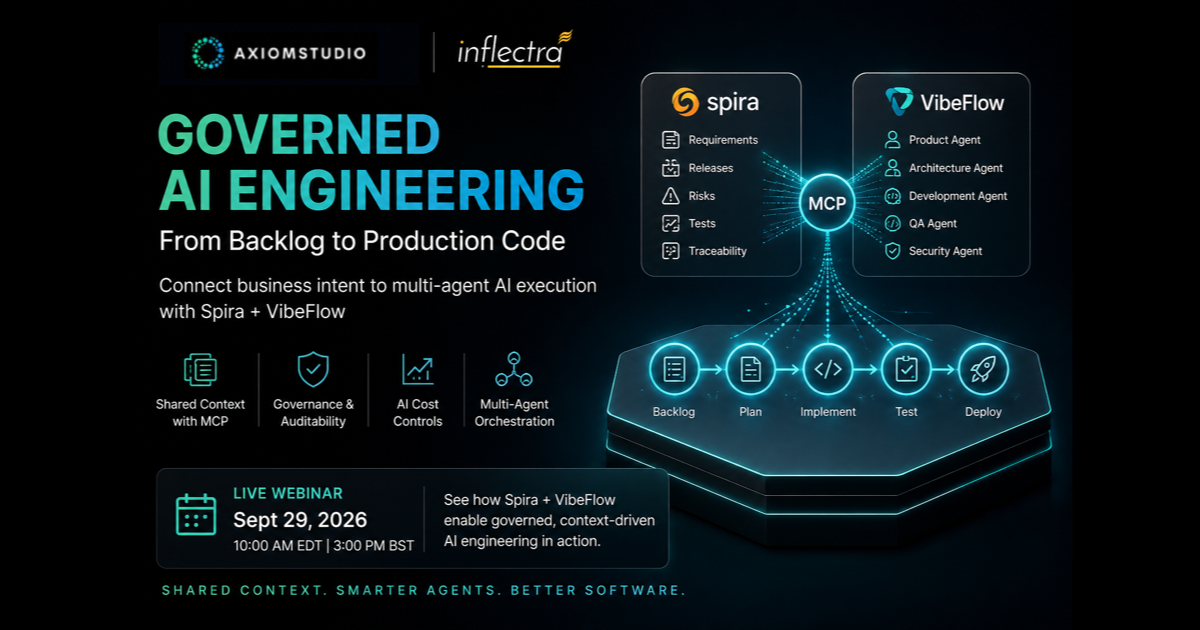
Connecting Product Development With AI Execution: Spira + VibeFlow
This is also the problem AxiomStudio and Inflectra are working together to address.
Inflectra Spira provides structured product and software lifecycle context, including requirements, releases, risks, tests, and traceability.
AxiomStudio VibeFlow provides the AI engineering execution and orchestration layer for specialized agents working across product, architecture, development, QA, and security.
Through MCP, product lifecycle context can become available to AI engineering workflows.
This creates a connected model:
Spira
Business Intent → Requirements → Releases → Risks → Tests → Traceability
↓
MCP
Shared Context
↓
VibeFlow
Product Agent → Architecture Agent → Development Agent → QA Agent → Security Agent
↓
Production
Validated + Governed + Traceable Software
The objective is not simply connecting two tools.
It is connecting product intent with AI execution.
Moving From Vibe Coding to Governed AI Engineering
Vibe coding demonstrated how dramatically AI can accelerate software creation.
The next stage is making that capability operational for real engineering organizations.
Individual productivity alone is not enough.
Enterprise engineering needs shared context.
Autonomous agents need orchestration.
Generated code needs continuous validation.
Requirements need traceability.
AI activity needs observability.
Security needs to participate throughout the workflow.
And engineering leaders need visibility into how AI is contributing to product delivery.
The organizations that establish these practices can move beyond isolated AI experiments toward a repeatable AI engineering operating model.
The goal is not to constrain AI.
It is to create the infrastructure that allows organizations to use more AI with greater confidence.
See Governed AI Engineering in Action
AxiomStudio and Inflectra are bringing these concepts together in a joint webinar:
Context-Driven AI Engineering: Orchestrating Spira Backlogs with VibeFlow Agents
September 29, 2026
10:00 AM EDT | 3:00 PM BST
During the session, we’ll demonstrate how Spira and VibeFlow can connect structured product lifecycle context with multi-agent AI engineering.
The webinar will explore:
- Connecting business intent and requirements with AI execution
- Orchestrating specialized engineering agents
- Sharing product context through MCP
- Maintaining traceability across AI-driven development
- Building governance and auditability into engineering workflows
- Managing AI usage and cost
- Moving from isolated AI coding toward governed product development
Most importantly, you’ll see the approach in action through a live multi-agent engineering demonstration.
From faster coding to better engineering
AI has already changed how quickly software can be generated.
The bigger transformation will come from changing how the entire product development lifecycle operates around AI.
That means connecting product intent with execution.
Giving agents persistent context.
Coordinating specialized AI workers.
Validating continuously.
Preserving traceability.
And embedding governance directly into the engineering workflow.
AI coding creates speed.
Governed AI engineering turns that speed into production-ready software.
Join AxiomStudio + Inflectra
See how Spira + VibeFlow bring requirements, shared context, multi-agent AI execution, validation, and governance together—from backlog to production.
Written by
AXIOM Team