This Week in AI: Speed Needs Control
Cursor expanded cloud agent environments, OpenAI added GPT-Live voice and Agents API tools, and Anthropic shipped API, access and fast-mode changes. Here is what AI teams should test before rollout.
 Axiom Studio October 24, 2026 6 min read
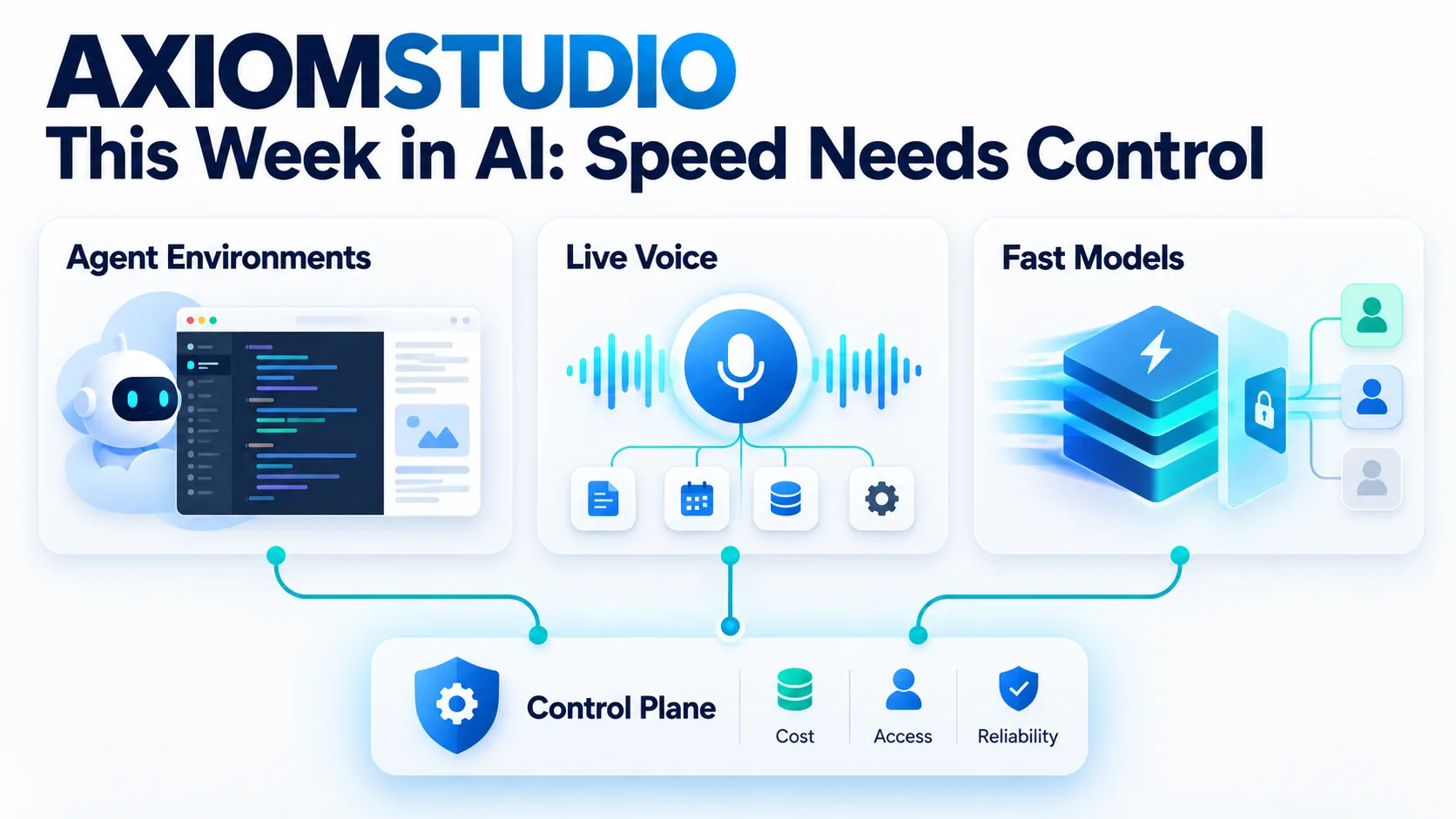
Three pieces of AI news from October 15–22, 2026 matter if you run AI agents in production. Cursor gave cloud agents much bigger environments, OpenAI let live voice apps act mid-conversation, and Anthropic shipped a new API version alongside new access controls and a wider fast mode.
Each one can cut wait time, and each one also adds spend or widens what an agent can reach. Before rolling any of them out, run a small test with clear limits, and treat the speed feature as a change to your system rather than a setting.
Cursor cloud agents gained bigger environments
On October 16, Cursor said cloud agents can build shareable canvases. Its Environments API entered beta. Cloud agent environments can hold up to 300 repositories, and Cursor says large environments load five times faster (Cursor changelog, October 16, 2026).
That helps platform teams that manage many related repos: an agent can work across a large group of code, produce a visual report, or have its environment built through an API.
The beta label matters. Test the Environments API before using it in a key release path. Ask:
- Which repos can each agent read?
- Can it write to every repo it loads?
- Who can share a canvas?
- What data appears in that canvas?
- What happens when setup fails halfway?
More repos means more context and more risk. Start with two test repos and one access rule that should block the agent, then confirm the block shows up in the logs.
Cursor did not list a price for the Environments API in the release note. Check the current plan and usage terms before rollout. Count environment time, model use, retries, and review time.
OpenAI added more live voice and agent options
OpenAI’s API changelog lists several changes from October 15 and 16.
On October 15, GPT-Live gained native Decisions integration. This lets an app act while a user is speaking or react to transcript events. On October 16, OpenAI also released prompt-to-voice for API customers and added nine natural voices in German, French, Hindi, Japanese, and Korean.
The same day, OpenAI-hosted sandboxes in the Agents API began to include tools for creating and editing spreadsheets, slides, and Word files. The Agents API also gained an Ultrafast service tier for supported models.
Together these let a support app act during a call and let an agent finish office-file tasks in a single hosted run.
But a GPT-Live voice action can fire before a person has time to think. Add a spoken confirmation before any action that changes money, access, health data, or a customer record.
For a voice test, measure:
- Time from speech to action.
- Wrong or incomplete transcript rate.
- Tool-call failure and retry count.
- Cost per finished session.
- Human review time for sensitive actions.
OpenAI’s changelog says prompt-generated voice creation is free, but speech uses normal GPT-Live billing. Sandbox work, backend model use, and tools can add more cost. Read the current OpenAI API changelog and pricing page before launch.
Anthropic shipped API and control changes
Anthropic released API version 2026-10-21 (Claude API release notes). New SDK and CLI versions use it by default. Anthropic says these versions also include breaking changes and move from the MIT license to Apache 2.0.
That means an SDK update needs a real migration test. Pin the current version. Run the same tool calls against the new version. Compare request fields, error handling, streaming, and logs before you change production.
On October 20, Anthropic also added user profiles and organization webhooks. A platform can link a request to one end customer. A safety action can then apply to that customer instead of the full organization. Admins can also turn off web fetch or limit its domains (Claude API release notes, October 20, 2026).
Those are useful controls for gateways and shared AI platforms. Test them with a blocked user, a blocked domain, and a redirect to a blocked domain.
Fast mode for Claude Opus 5.5 moved out of research preview on October 15. On October 22, Anthropic added its managed Claude API on Google Cloud, with Google Cloud IAM and Marketplace billing. Fast mode is available there for Claude Opus 5.5 (both changes are in the Claude API release notes).
Fast output helps an urgent coding or review task, but it costs more. Run the same test set in standard and fast mode, compare end-to-end time, token use, retries and reviewer time, and keep fast mode for the jobs where the saved wait actually matters.
Before turning on any of these changes, follow the five-day rollout plan below.
What changed for AI engineers
The hard part is no longer just picking a model. From where we sit, building an LLM gateway, the common thread this week is that each release adds a new dimension to track: repos per environment, actions taken mid-call, service tiers, and end-customer IDs on each request. A setup where every app manages its own keys and logs cannot see those across the organization.
Use the Axiom Studio LLM gateway guide to draw one request path. Mark where identity enters, where data leaves, and where cost is recorded.
Use the AI operations guide before changing a model or tier. A faster option still has limits, rate rules, and review cost.
For agent work, trace the steps described in the code review skill guide. Each tool call needs clear input, evidence, and a human gate for risky changes.
A five-day rollout plan
Day 1: Pick one low-risk task and record the current time and cost.
Day 2: Turn on one new feature in a test account. Keep the old path ready.
Day 3: Test normal use, denied access, timeout, retry, and bad input.
Day 4: Review logs with engineering, security, and the task owner.
Day 5: Compare total cost. Include model tokens, cache writes, environment time, retries, and human review.
Ship only if the new path passes the checks and has a clear rollback step.
Takeaways
- This week’s releases make agents faster and give them more reach: bigger environments, actions during live calls, and faster model tiers.
- Treat every speed feature as a system change. Test who can use it, what it can reach, what it costs and how it fails.
- A faster model or agent helps only when the whole task becomes safer or cheaper to finish.
Want one place to route and meter new models and service tiers? See how the LLM Gateway applies access controls, cost tracking and audit trails across providers.
Frequently Asked Questions
What did Cursor change for cloud agents in October 2026?
On October 16, Cursor said cloud agents can build shareable canvases, its Environments API entered beta, and cloud agent environments can hold up to 300 repositories. Cursor says large environments load five times faster.
What did OpenAI add to GPT-Live and the Agents API?
GPT-Live gained native Decisions integration, so an app can act while a user is speaking or react to transcript events. OpenAI also released prompt-to-voice, added nine natural voices, gave hosted sandboxes spreadsheet, slide and Word file tools, and added an Ultrafast service tier for supported models.
Does the Anthropic API version 2026-10-21 need a migration test?
Yes. New Anthropic SDK and CLI versions use API version 2026-10-21 by default and include breaking changes. Pin the current version, run the same tool calls against the new one, and compare request fields, error handling, streaming and logs before changing production.
When should a team use fast mode for Claude Opus 5.5?
Run the same test set in standard and fast mode and measure end-to-end time, token use, retries and reviewer time. Pick fast mode only when the saved wait time matters, because fast output can also raise cost.
How should AI teams roll out new agent and model features safely?
Pick one low-risk task, turn on one new feature in a test account, and test normal use, denied access, timeout, retry and bad input. Review logs with engineering and security, compare total cost, and ship only if the new path passes the checks and has a clear rollback step.
Written by
Axiom Studio