AI Product Manager: Role, Skills and Governance
What an AI product manager does, how the role differs from using AI tools, the skills it takes, and how governance and review fit into AI product work.
 Axiom Studio November 25, 2026 13 min read

On this page
An AI product manager owns a product whose value depends on model behavior, not only on software behavior. That means deciding what the system is allowed to do, what a good output looks like, and which checks catch a bad one before customers do. In an engineering organization that also means the AI PM’s decisions have to be enforceable in the delivery pipeline: written into specs, reviewed on every pull request and traceable in an audit. This article covers the role, how it differs from a conventional PM, the skills it takes, and how your team can put product judgment into a governed workflow with VibeFlow.
TL;DR
- An AI PM manages products whose core value comes from a machine learning or LLM model. Using ChatGPT to speed up ordinary PM work does not make someone an AI PM.
- The job adds data strategy, acceptable-error decisions, evaluation design, guardrails, cost and latency trade-offs, and post-launch monitoring to classic product work.
- The partner set widens: data science, ML engineering, security, legal, risk and compliance all become regular stakeholders.
- Product decisions only hold if they are enforced: approval rules, review gates and audit trails turn a spec into a control.
- VibeFlow includes a Product Manager persona, Aria, that writes specs and reviews inside the same delivery workflow as the engineering agents, without committing code.
What an AI product manager does
Boston University’s Faculty of Computing & Data Sciences describes the AI product manager as someone who identifies, shapes, launches and improves AI-enabled features and platforms, rather than building models from scratch. The work sits between the business, the technology and the data.
O’Reilly’s account of bringing an AI product to market lists the responsibilities in practical terms:
- Choose the product’s function, audience and intended use.
- Maintain the input-data pipelines.
- Coordinate the technical specialists.
- Shape the user experience and feature engineering.
- Integrate models and infrastructure.
- Ship, then manage the product after release.
The last item matters most. O’Reilly adds that production monitoring should cover both model performance and application performance, and that developers must stay available after deployment to fix data or model problems. An AI product is never finished at launch.
Two jobs under one title
Jonathan Evens, AI Product Lead at Google DeepMind, told Mind the Product that the title covers two distinct jobs. The modelling PM defines and measures a model’s core capabilities, such as factuality, reasoning and long context. The AI feature PM builds on an existing model and needs domain expertise and user empathy more than technical depth.
Most enterprise teams hire the second kind. Your PM decides how a model-backed feature behaves inside your product, for your users, under your regulators.
How an AI PM differs from a traditional PM
The core question is whether the product’s value depends on the model. The venture firm CRV separates PMs who use AI tools to do standard product work faster from AI product management, which is for products whose value comes from an ML or LLM model. In the second case the PM ships a system whose behavior they influence rather than specify.
CRV lists five parts of the work that change compared with deterministic software:
| What changes | What it means for the PM |
|---|---|
| Probabilistic outputs | The same input can give different results, so the PM defines a default experience for when the model fails |
| Data dependency | Data collection, verification and preparation take most of the engineering effort |
| Model lifecycle ownership | Retraining and drift monitoring continue after launch |
| Wider stakeholder set | Data scientists, ML engineers, ethics and legal reviewers join the table |
| Trust and evaluation | Bias and explainability become acceptance criteria |
The AI Product Manager Hiring Report 2026 points the same way with four differences. The unit of uncertainty changes, so “good enough” must be decided before launch. Quality becomes a product surface: guardrails, hallucination handling, human-in-the-loop review and escalation paths are product requirements. Cost and latency become roadmap items, and inference cost per request appears in AI PM job postings. And legal and risk functions are named far more often as partners.
The failure mode is different
Writing on the role in October 2026, Matthew Mamet frames the shift as moving from the document to the system that writes the document. The AI PM decides what the system may do, defines a good output and builds the checks that catch a bad one. The failure also changes: from bugs that throw errors to confident output that is wrong and passes every check.
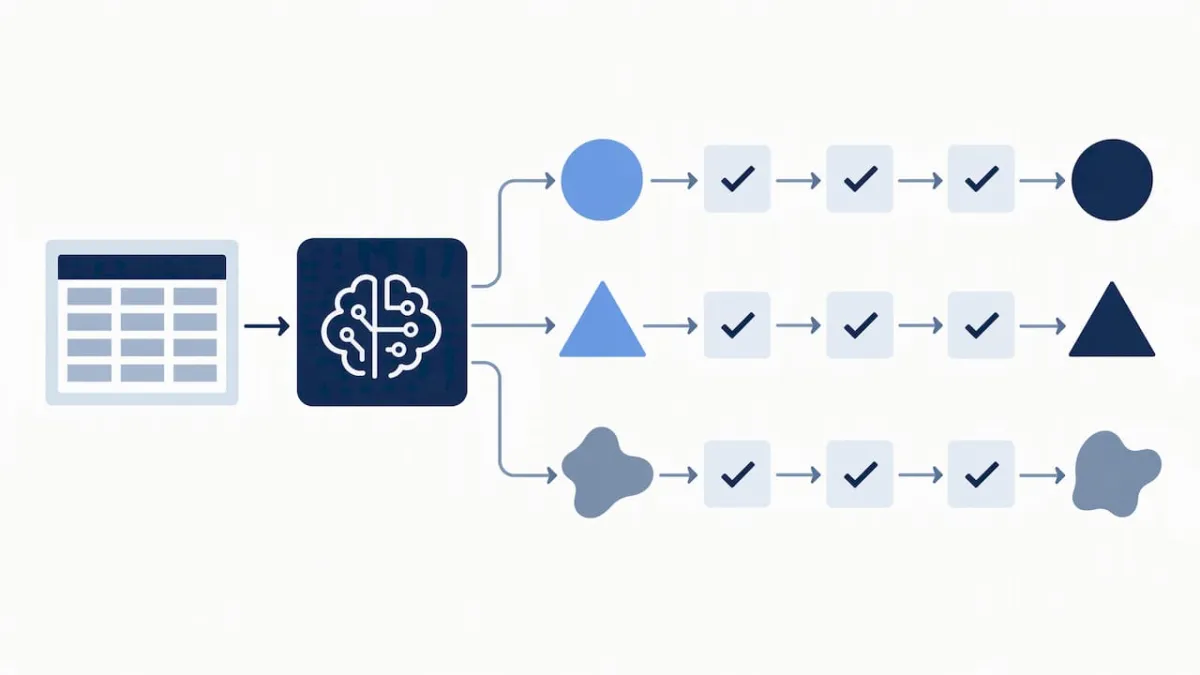
That last point is the one your security and compliance teams care about. It is also why an AI PM cannot work from a slide deck alone.
Skills an AI product manager needs
Forrester’s analysis of AI product managers lists AI-specific technical competence, data science skills in requirements, quality and bias, an understanding of how model performance iterates across accuracy, reliability, scalability, time and cost, regulatory and ethics awareness, and the ability to educate others. The classic duties stay: customer problems, vision, roadmaps and stakeholder management.
O’Reilly’s minimum viable skill set adds three areas: data lifecycle and pipeline management, experimentation and measurement (probability, A/B testing, model evaluation), and fluency in data science and ML development processes.
In practice, for an enterprise team, it comes down to five habits:
- Frame the product as behavior. Define guardrails and expected behavior, for example answering support questions at a target accuracy within a set response time, instead of fixed step-by-step flows. CRV makes this point about framing AI products.
- Decide acceptable error. Name the error rate you can live with and where a human must review.
- Translate in both directions. Executives want dates and certainty. Data science wants confidence bounds understood. The PM converts technical limits into business language, including what an extra point of accuracy costs in latency and spend.
- Work with risk functions early. BU lists product, engineering, data science, analytics, operations, legal, risk and executive teams among those an AI PM coordinates.
- Read raw outputs. An AI PM does not need to be an ML researcher, but must inspect what the system actually produces.
One regulatory example shows why working with risk functions early matters. A 2026 role guide notes that since 2 August 2026 the EU AI Act’s Article 50 requires telling people when they interact with an AI system and marking synthetic content, which turns disclosure into a product decision. If you sell to European customers, your PM owns that decision.
Assessing quality, risk and security
The APD Institute’s competency model defines AI evaluation as covering product quality, user experience, business impact, risk, reliability and cost over time. Its example measures are task success, groundedness, latency, safety and cost per interaction. The same document lists governance capabilities: risk classification, human oversight, privacy-by-design, fairness assessment, transparency, safety and security, auditability and post-launch incident response.
For a product team that ships AI-written code, the same list translates into a checklist you can run against your own pipeline:
- Risk classification: which changes touch authentication, payments or personal data, and need stricter review?
- Human oversight: which merges require a named approver? See how CODEOWNERS and merge gates combine AI review with human approval.
- Evaluation: how do you measure whether a review agent catches real defects? Precision, recall and noise are the metrics to track.
- Auditability: can you show an auditor who approved what, and why?
- Incident response: is there a documented path when an AI change breaks production? Our incident response playbook is a starting point.
- Readiness: does the release meet your bar? Use the production readiness checklist.
If your PM also needs to show value to finance, the six metrics for AI ROI and developer productivity give a common language with engineering leadership.
From product judgment to enforced controls
A product decision that lives only in a document is a suggestion. The AI PM’s guardrails, acceptable-error thresholds and review rules need to be enforced where code is written and merged. This is where AI product management meets AI governance, and where many teams find the gap: the tracker holds the spec, a separate AI reviewer comments on pull requests, and compliance evidence is assembled by hand before an audit.
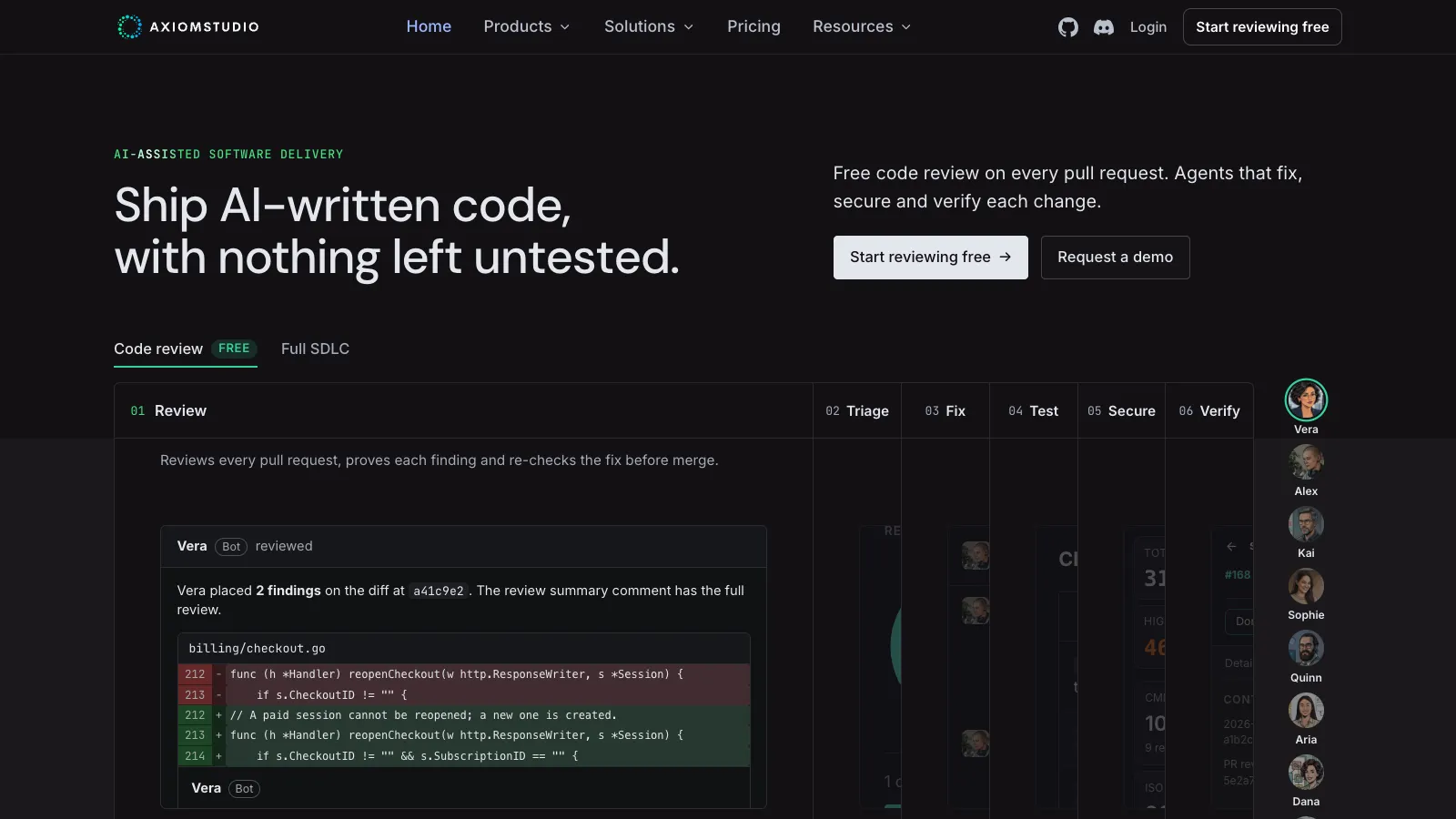
Our view is that the spec, the review and the evidence should sit in one system. That is how VibeFlow is built. It supplies an AI SDLC team: agent personas that take work from a ticket through planning, implementation and review. Work is tracked natively as features, todos and issues on a Kanban board, and it can sync with Jira, Linear, ClickUp or Azure DevOps. Vera, Axiom’s code review agent, reviews each pull request with evidence-backed findings, turns blockers into repair tickets and verifies every fix. The Security Lead persona reviews each finished work item and records compliance findings against seven frameworks, including SOC 2 and GDPR, and every agent action is kept in execution logs with commit attribution.
For a PM, the practical consequence is traceability. Every requirement can be followed to the change that implemented it and the review that approved it. The model for this is described in governed AI engineering from backlog to production code, and the review side in our guide to quality gates for AI-generated code.
The product manager persona in VibeFlow
VibeFlow’s agents work as personas, each playing a role. According to the VibeFlow glossary, nine ship by default: Developer (Alex), Architect (Morgan), Principal Engineer (Kai), Product Manager (Aria), Project Manager (Parker), UX Designer (Dana), QA Lead (Quinn), Security Lead (Sophie) and Customer (Casey). You launch one agent per persona, and each polls independently for work that matches its role.
The Product Manager persona is an advisory agent. Advisory agents write specs, reviews and comments, and they do not commit code. Code agents (Developer, Architect, Principal Engineer) write the source. That separation is useful for governance: the agent that shapes the requirement is not the agent that changes the repository.
The glossary also describes how work enters the flow. A work item created from chat lands in review, and a human or a PM agent decides whether to promote it. The status flow then moves through planning, ready to implement, implementing and done, followed by security review and QA review. For the full persona definitions, read the VibeFlow personas documentation.
How a human AI PM works alongside Aria
Your human AI PM keeps the judgment calls. The arXiv paper AI-Native Product Management: A Vision, by Ericsson’s Ricardo Britto, argues that AI can take part in sensing, exploration, decision preparation and realization, while humans retain responsibility for product judgment, consequential commitments and accountability. A workable split in a VibeFlow team looks like this:
- Human PM: sets scope, trade-offs, acceptable error and the approval rules.
- Aria: drafts and refines specs and comments on work items that match the Product Manager role.
- Security Lead and QA Lead personas: review work after it reaches done; the Security Lead records compliance findings.
- Vera: reviews the resulting pull requests and verifies each fix before merge.
- Human approvers: sign off where your rules require a person.
If you want the surrounding practices, our guides to AI software engineering and agentic coding explain roles and metrics for agent-driven development.
Where the role fits in your organization
In larger companies the AI PM often emerges to coordinate teams that grew separately. O’Reilly notes that AI PMs often appear out of the need to coordinate data platform, metrics, ML research and applied ML groups.
Two warning signs suggest the role is missing or under-resourced:
- Engineers are using AI tools nobody approved. Read the top signs of shadow AI in engineering teams.
- Compliance is treated as a form to fill in at the end. AI risk management beyond checkbox compliance covers the alternative.
Preparing for the role
If you are building toward the job, Udacity recommends product fundamentals, AI and ML literacy, applied work with data and technical teams, a portfolio of AI product artifacts, and framing adjacent experience in terms of outcomes and technical judgment. The APD Institute adds that capability should show up in observable behaviors, work outputs, portfolio evidence and case analysis. Governance literacy is a differentiator: a candidate who can explain risk classification, audit trails and human oversight stands out in an enterprise interview.
Put your AI PM’s decisions into the pipeline
If your team already uses AI coding agents, the fastest way to make product judgment stick is to run planning, review and compliance evidence in one place. VibeFlow gives you the work items and Kanban board, the persona agents and the review gates, and Vera reviews every pull request. The pricing page lists Starter (free), Pro at $20 per month, Team at $49 per seat per month with a three-seat minimum, and Enterprise.
If compliance is your starting point, read our overview of AI compliance, including the EU AI Act, SOC 2 and HIPAA.
Sources
- The Role of an AI Product Manager in Enterprise Organizations, Boston University
- Bringing an AI Product to Market, O’Reilly
- Practical Skills for the AI Product Manager, O’Reilly
- What is AI product management, really? Mind the Product
- AI Product Management: What It Is and How to Do It Well, CRV
- AI Product Manager Hiring Report 2026
- An AI Product Manager Now Manages the System That Does the Work, Matthew Mamet
- AI Product Managers, Forrester
- AI Product Manager: Role, Duties, Skills, JD, Specky
- AI-Native Product Manager Competency Model, APD Institute
- AI-Native Product Management: A Vision, arXiv
- The rise of AI product managers, Udacity
- VibeFlow glossary
- VibeFlow personas documentation
Frequently Asked Questions
What does an AI product manager do?
An AI product manager defines, launches and improves products whose value depends on a model. They decide acceptable error rates, where human review belongs, how quality is evaluated and how the product is monitored after launch. They coordinate data science, engineering, legal and risk teams.
Is using AI tools the same as being an AI product manager?
No. A PM who uses AI to summarize interviews or draft specs is using AI as a toolkit. An AI PM owns the behavior of an AI-powered product, including its guardrails, evaluation and drift after launch. The venture firm CRV draws this line between PMs who use AI tools and AI product management.
What skills does an AI product manager need?
The core skills are product strategy, data literacy, model and evaluation literacy, and responsible-AI judgment, according to sources such as Forrester and Udacity. An AI PM does not need to build models, but must understand their limits and read raw outputs. Communicating confidence and cost trade-offs to executives is just as important.
How does an AI PM handle governance and compliance?
They classify risk, define human oversight, plan for privacy and set up auditability and incident response, as the APD Institute competency model lists. In an engineering workflow, that means approval rules, review gates and an audit trail on every AI-generated change.
How do you measure the quality of an AI product?
The APD Institute competency model defines AI evaluation as covering product quality, user experience, business impact, risk, reliability and cost over time. Its example measures are task success, groundedness, latency, safety and cost per interaction.
Can an AI agent act as a product manager?
In VibeFlow, the Product Manager persona, Aria, is an advisory agent that writes specs, reviews and comments without committing code. Your human PM still sets scope, trade-offs and approval rules.
Written by
Axiom Studio