This Week in AI: Coding Agents Move to Live Systems
Cursor, Cognition, and Factory pushed coding agents closer to live systems. See what changed and what teams should test next.
 Axiom Studio November 6, 2026 6 min read
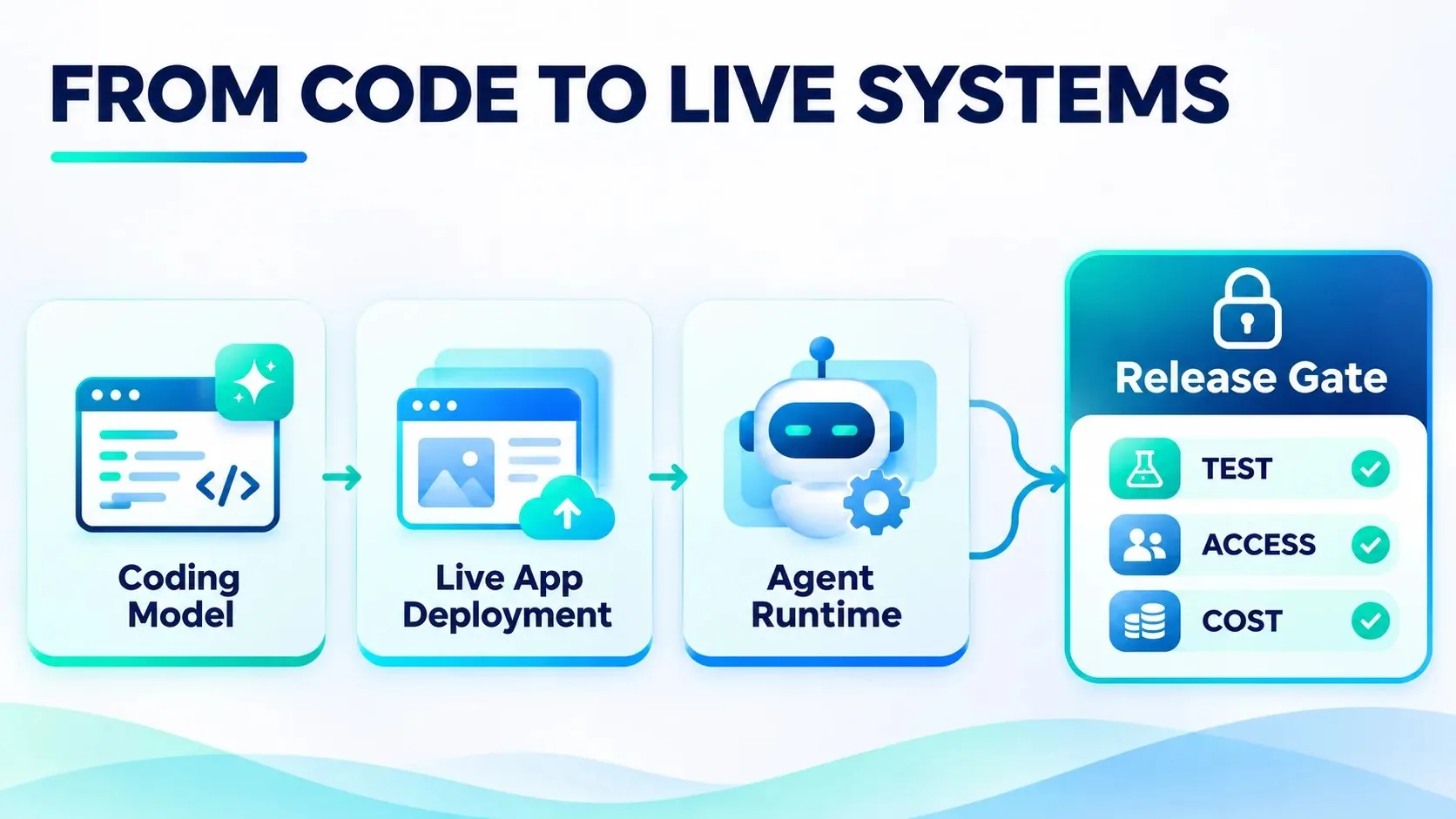
Short answer: coding agents are moving from editing code toward creating, deploying, and operating live systems. That makes release gates, access rules, cost records, and rollback as important as model speed.
Between November 4 and 6, three updates moved coding agents closer to real production work. Cursor announced live app building and publishing. Cognition launched SWE-2 Flash, a coding model built for speed and lower cost. HumanLayer announced it is joining Factory to help build autonomous software systems. The shared lesson is clear: faster code is only one part of the job. Teams also need access controls for agents, cost tracking, release gates, and a rollback plan.
Cursor can build and publish live apps
On November 5, Cursor announced that paid plans with cloud agents can build live apps. The agent can create the app, set up Postgres, add sign-in, provision hosting, and return a live link.
Cursor says publishing includes deterministic and agentic security checks. A failed check blocks the release until it is fixed or an authorized admin approves it. Team admins can view apps and secrets and can unpublish an app.
This can help teams ship small internal tools faster. It also joins code, data, secrets, hosting, and access in one agent flow.
What teams should test in Cursor
Start with a tool that uses fake data. Check who can publish, who can approve a blocked release, who can read each secret, and who can open the final app.
Test a secret placed in the wrong file. Test a user who should not see the app. Test an app that must be removed. Record build time, cloud-agent use, model cost, failed attempts, and review time.
Cursor says GitHub and Cursor Origin are supported now, while GitLab support is coming later. Confirm your repository path before planning a move.
Cognition launched SWE-2 Flash
On November 4, Cognition introduced SWE-2 Flash. Cognition describes it as a coding model focused on intelligence, low cost, and high speed.
A launch claim is a reason to test, not a reason to switch every task. Run the model on a fixed set of your own bugs, tests, and small features. Keep tool access, time limits, and review rules the same as the model you use today.
Track task success, serious errors, retries, wait time, token cost, and reviewer minutes. A fast answer is useful only when the finished change passes the same checks.
Factory added HumanLayer
HumanLayer announced on November 4 that it is joining Factory. HumanLayer says the goal is to speed work on autonomous, self-improving software for enterprises and developers.
This is a company update, not a new product benchmark. It still points to a wider change: agent systems are adding more runtime, context, and workflow parts around the model.
For engineering leaders, that raises ownership questions. Who owns the agent runtime? Where are approvals stored? Which events can start work? How does the team stop or roll back a bad run?
The common change: agents now reach the release path
The model is moving closer to databases, secrets, hosting, and long-running work. That can remove handoffs. It can also widen the effect of one wrong step.
Use four coding agent release gates:
- Test: Run fixed tasks and denied cases.
- Access: Give each agent only the tools and data it needs.
- Cost: Count tokens, hosted runtime, retries, and review time.
- Release: Require a clear owner, approval rule, and rollback step.
For a fuller list of checks, see quality gates for AI-generated code, and compare this issue with the October 24, 2026 AI systems update. For the broader model, read what agentic coding means.
A five-day team test
- Day 1: Pick one low-risk internal tool or coding task.
- Day 2: Record the current time, cost, errors, and review work.
- Day 3: Turn on one new model or agent feature in a test account.
- Day 4: Test normal use, denied access, a bad secret, a timeout, and a rollback.
- Day 5: Compare the finished task, not just model speed.
Do not send private customer data during the first test. Keep the old path ready until the new path passes.
What this means for AI teams
AI engineers need model tests that include tools and release steps. DevOps teams need logs across the full run. Engineering managers need cost per accepted result, not cost per token alone.
Use an LLM Gateway to record model routes and usage. For broader operational controls, read the AI operations guide, and review how to measure AI code review agents.
Takeaway
This week did not just bring a faster model or another agent feature. It moved AI work closer to live systems.
Pilot one change at a time. Test the full path from prompt to release. Keep access small, record total cost, and make rollback easy.
Want release gates around every coding agent run? See how VibeFlow tracks work items, approvals, and review gates, or request a demo to walk through your agent rollout.
Research notes
Checked November 6, 2026. Official sources include Cursor’s November 5 changelog, Cognition’s November 4 SWE-2 Flash announcement, and HumanLayer’s November 4 announcement that it is joining Factory. The company update is treated as a change in direction, not a product result. No benchmark or savings claim is repeated without a team test.
Frequently asked questions
What changed in AI coding agents this week?
During November 4–6, 2026, Cursor announced live app building and publishing, Cognition introduced SWE-2 Flash, and HumanLayer announced that it is joining Factory to work on autonomous software systems.
What should teams test before using coding agents in live systems?
Test a low-risk task with normal use, denied access, a misplaced secret, a timeout, and rollback. Verify the owner, approval rule, tool access, cost records, and final release checks.
How should teams measure a new coding model?
Run a fixed set of your own bugs, tests, and small features while keeping tool access and review rules constant. Track task success, serious errors, retries, wait time, token cost, and reviewer minutes.
Why do coding agents need release gates?
Agents can now reach databases, secrets, hosting, and long-running workflows. Release gates limit access, record cost and decisions, require an owner and approval, and make it possible to stop or roll back a bad run.
Frequently Asked Questions
What changed in AI coding agents this week?
During November 4–6, 2026, Cursor announced live app building and publishing, Cognition introduced SWE-2 Flash, and HumanLayer announced that it is joining Factory to work on autonomous software systems.
What should teams test before using coding agents in live systems?
Test a low-risk task with normal use, denied access, a misplaced secret, a timeout, and rollback. Verify the owner, approval rule, tool access, cost records, and final release checks.
How should teams measure a new coding model?
Run a fixed set of your own bugs, tests, and small features while keeping tool access and review rules constant. Track task success, serious errors, retries, wait time, token cost, and reviewer minutes.
Why do coding agents need release gates?
Agents can now reach databases, secrets, hosting, and long-running workflows. Release gates limit access, record cost and decisions, require an owner and approval, and make it possible to stop or roll back a bad run.
Written by
Axiom Studio