Agentic Software Development: A Guide for Enterprise Teams
Agentic software development for enterprise teams: what AI agents can build, the risks, the controls to require, and how to roll them out with audit trails.
 Axiom Studio November 17, 2026 12 min read
On this page
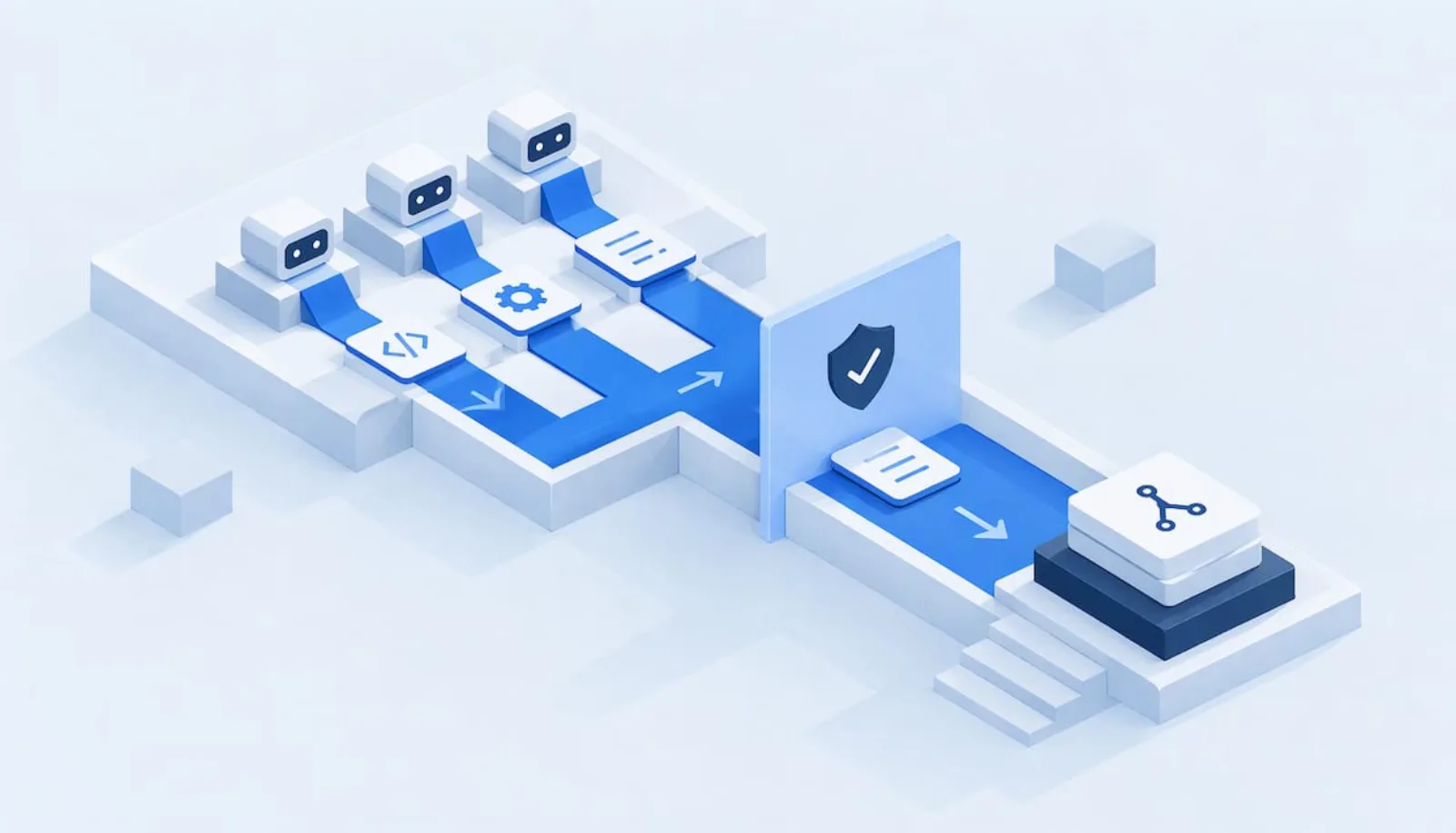
Agentic software development means AI agents plan, write, test and propose code changes toward a goal, while your team sets the limits and decides what ships. The speed is real, but so is the risk, and enterprises that get value from it treat agents like contributors who need scoped permissions, independent review and a recorded trail. Our VibeFlow AI SDLC team and Vera code review agent are built for that job: autonomous guardrails, audit trails, and tracking of every change against compliance frameworks such as SOC 2 and GDPR.
This guide covers what agents can do, how the workflow runs, what the evidence says about risk, and how to introduce agents in a way your security and compliance teams can sign off on.
TL;DR
- Agentic development differs from autocomplete-style assistance: the agent plans multi-step work, runs commands and tests, and prepares commits and pull requests.
- Research finds that unreviewed AI-built applications are often insecure. One study of 200 deployed vibe-coded apps found at least one vulnerability in 91.0% of them.
- Reliable agent use rests on four things: scoped permissions, written security requirements for the agent, independent review, and an audit trail of who approved what.
- Roll out in stages: pick bounded tasks, define autonomy levels, measure results, then widen scope.
- VibeFlow and Vera put the guardrails, review and compliance evidence in one platform for teams using AI coding agents.
What is agentic software development?
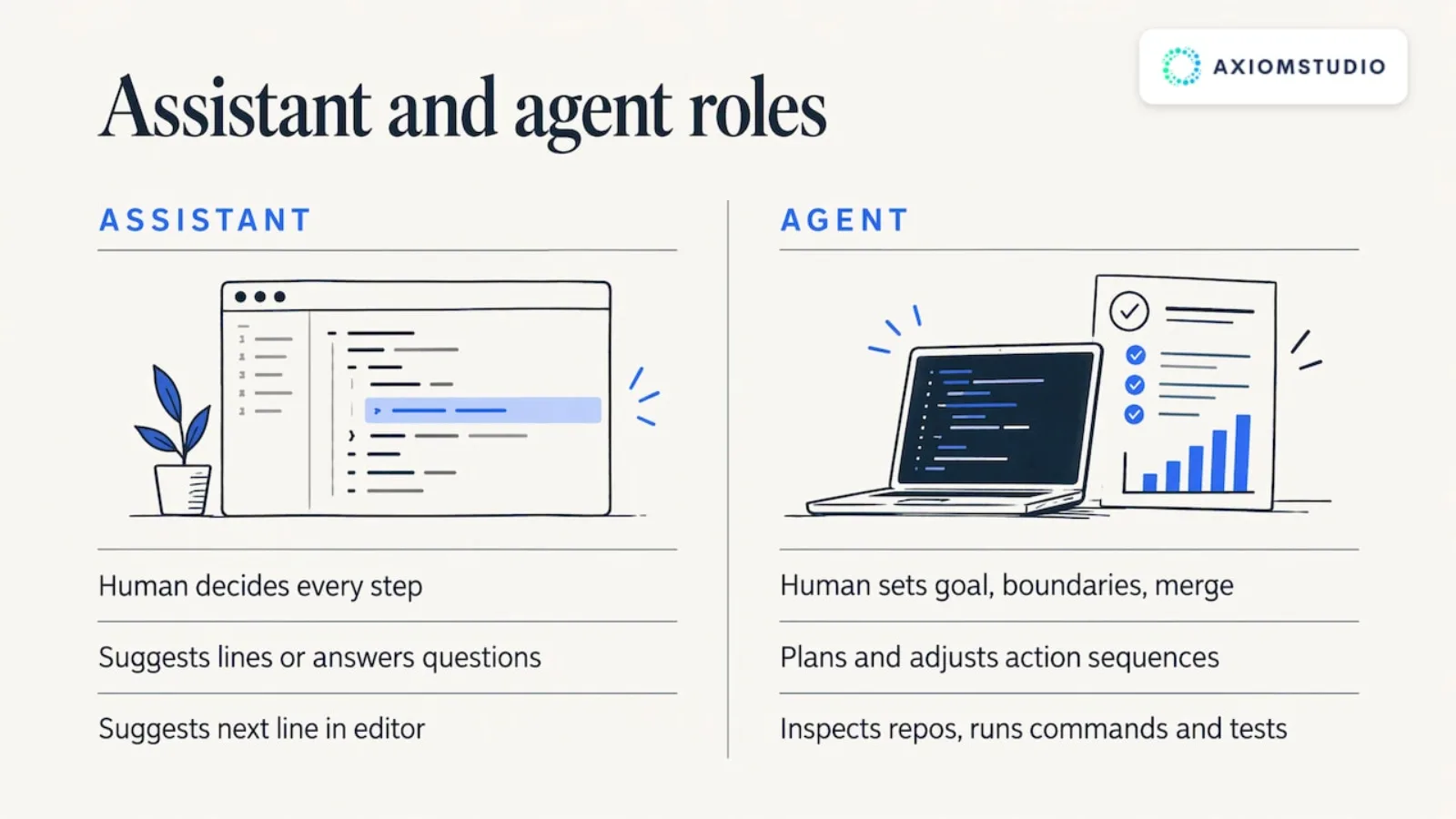
A coding assistant suggests the next line or answers a question in your editor. An agent takes a goal, breaks it into steps, acts, checks its own result and tries again. ENISA’s draft technical advisory on AI-assisted software development (September 2026) describes coding agents as working with higher autonomy: planning and adjusting action sequences, inspecting repositories, running commands and tests, installing dependencies, and preparing commits and pull requests. (ENISA is the European Union Agency for Cybersecurity.)
The practical difference is where the human sits. With an assistant, you decide every step. With an agent, you decide the goal, the boundaries and the final merge. That shift is what makes governance the central question, not a side concern. The same idea appears under several names: autonomous software development, AI software development agents, agentic coding. For a deeper definition, see our guide to agentic coding and our explainer on what agentic AI is.
What AI agents can do across the lifecycle
An academic survey of LLM-based agents for software engineering finds that agents can support work from requirements engineering and design through code generation and quality assurance (verification, static checking and testing). They also cover maintenance tasks such as fault localization, repair and feature changes. The same survey concludes that standalone language models are generally inadequate for these complex processes, which is why the agent wrapper around the model matters.
A separate 2025 survey of agentic programming reports that these tools can:
- generate programs or modules from natural-language specifications;
- diagnose and fix bugs using compiler or test feedback;
- write and run test cases;
- refactor code;
- orchestrate compilers, debuggers, profilers and version control systems.
This breadth is why a single narrow agent rarely covers an enterprise need. Our approach in VibeFlow is a team of specialized agents (product manager, architect, engineers, QA, security, DevOps and UX) that maps to the full software development lifecycle (SDLC), rather than one agent that only writes code. Our agent workflows for enterprise software development post shows how the stages connect.
How an agentic workflow runs
Teams that ship with agents converge on the same loop, whatever the tooling:
- Define the task. Write a bounded goal with acceptance criteria. Vague tasks produce vague patches.
- Explore and plan. The agent reads the relevant code without changing it, then proposes which files to change and in what order. A human can correct the approach here, before any code exists. This is the cheapest point to catch a wrong direction.
- Act in isolation. The agent works on a branch or isolated copy of the repository, implements the change and runs tests, fixing failures until the checks pass.
- Verify. Tests, linters, type checks and security scans run on the result.
- Review. A reviewer reads the diff. For riskier changes, a second agent reviews in a fresh context, so the agent that wrote the code is not the only one grading it.
- Merge. A human keeps merge authority and approves the pull request.
For design patterns and common mistakes in this loop, the guide on agentic workflow design patterns and pitfalls is a practical companion.
Where each step goes wrong
| Step | Typical failure | Control that addresses it |
|---|---|---|
| Define | Task too broad, agent invents scope | Written acceptance criteria and a scope limit |
| Plan | Wrong approach is discovered after code is written | Plan approval before execution |
| Act | Agent runs with the developer’s full permissions | Scoped tool access and an allowlist |
| Verify | Tests pass but access control is broken | Security scans in the pipeline |
| Review | Reviewer skims a very large diff | Small, bounded pull requests and independent review |
| Merge | No record of who approved what | Audit trail tied to the approver |
VibeFlow runs this lifecycle with agents assigned to each stage, and Vera handles the review stage as an autonomous code review agent. Your engineers keep the approval decisions; the platform takes on the repetitive checking and the record-keeping.
The risk: speed without review ships vulnerabilities
The case for governance is empirical. An academic study of 200 publicly deployed vibe-coded applications found 1,186 vulnerabilities in total. 91.0% of the audited applications contained at least one, and 65.77% of the vulnerabilities were rated Critical or High. Broken access control was the largest category: 339 vulnerabilities (28.58%), affecting 64% of applications. The authors report that better harnesses and prompting reduce these risks but do not eliminate them.
A March 2026 Cloud Security Alliance research note collects independent findings pointing the same way:
- AI-generated code introduced security vulnerabilities in 45% of development tasks.
- It produced 2.74 times more security issues per pull request than human-authored code.
- In one study, all 15 production applications tested failed basic controls such as CSRF protection.
- It names new attack surfaces, including Rules File Backdoor and slopsquatting (attackers registering package names that models tend to invent).
The exposure grows with autonomy. The OWASP Secure Coding with AI Cheat Sheet notes that in 2026 agentic tools execute shell commands, install packages, edit files, run tests, access networks and push branches on their own. Many developers run them with auto-accept enabled, which hands the agent the developer’s full permissions with minimal oversight.
For your security team, the question is not whether developers use agents. It is whether the use is visible, scoped and reviewed. Our CISO guide to AI agent security threat models walks through the threats in detail.
The controls to require
Official and professional guidance converges on a short list.
1. Write security requirements into the agent’s instructions
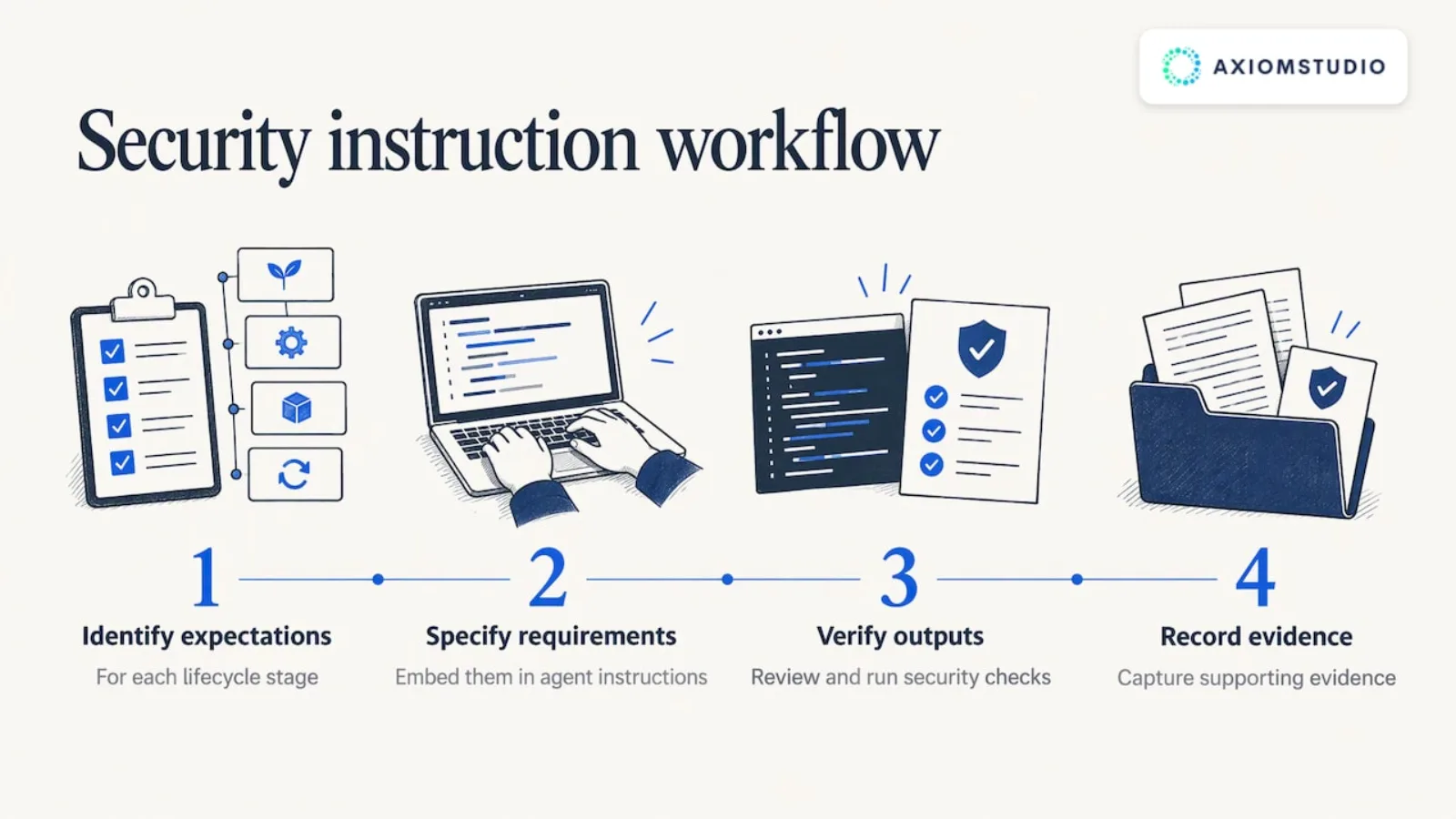
ENISA’s advisory prescribes four actions: identify the security expectations for each lifecycle stage, specify them for the agent, verify outputs through review and security checks, and record the supporting evidence. It argues that existing secure-development practices can be made explicit by embedding requirements and review expectations in agent instructions, with reusable “skills” keeping them consistent across teams.
2. Define what the agent is allowed to do, per task
The US Department of Defense’s AI for the SDLC play introduces a six-level framework for task-level autonomy, defining what an agent may do on a specific task. It pairs this with version-controlled “agent persona” files that set role, behavioral constraints, output format, escalation conditions and data handling rules. The authors also note that AI enters workflows in several places at once (in the IDE, in CI/CD pipelines and in multi-agent workflows), so each context needs its own oversight design.
In practice that means an allowlist of tools, scoped permissions, and approval rules that decide when an agent must stop and ask.
3. Keep a human accountable
OWASP states that AI tools do not accept responsibility for generated code. The developer who accepts and commits it does. It also says audit trails should record which developer approved which AI-generated changes, including the AI tool and model version used. For compliance teams preparing for an audit, this is the evidence trail to be able to produce on request.
4. Review independently and scan continuously
A second reviewer, human or agent, in a fresh context catches what the author misses. Compliance scans against the frameworks you answer to should run on every change, not once before an audit. Vera reviews every pull request, and VibeFlow tracks each change against your compliance frameworks, such as SOC 2 and GDPR. See Vera AI code review for details.
What changed in 2025 and 2026
Guidance has moved from general AI principles to specific coding-agent controls:
- OWASP published version 1.0 of its Securing Agentic Applications Guide on 28 July 2025, giving lifecycle security controls for agentic applications. It defers high-level governance to a separate guide.
- The Cyber Security Agency of Singapore released its Security Assessment Handbook for Agentic AI Coding Assistants on 15 October 2026. It maps threats to MITRE ATLAS tactics and gives tiered controls.
- ENISA published its draft advisory on AI-assisted software development in September 2026.
These are guidance documents, not a single binding rule, and the regimes that bind you depend on your sector and region. Your compliance team should map them to SOC 2, HIPAA, ISO 27001, GDPR or FedRAMP obligations. Our AI compliance guide covers the main frameworks.
How to introduce agents in an enterprise
A staged rollout gives security and engineering leaders something concrete to approve.
- Inventory current use. Find out which agents developers already run, with what permissions and on which repositories. Unmanaged auto-accept usage is the first thing to close.
- Choose bounded pilot work. Pick tasks that are defined, checkable and low in blast radius: test generation, dependency updates, small refactors, bug fixes with reproducing tests. Leave ambiguous, high-judgment work for later.
- Set autonomy levels. For each task type, decide whether the agent proposes only, acts on a branch, or acts and opens a pull request. Write it down as a version-controlled policy.
- Scope tools and data. Give agents an allowlist of tools, the least privilege they need and rules for what data they may see.
- Wire in verification. Tests, linters, type checks and security scans must pass before a human sees the pull request.
- Record everything. Capture the task, the agent, the model version, the approver and the scan results.
- Measure. Track merged pull requests, review time, defects found after merge, rework rate and cost per task. Compare against your baseline before widening scope.
- Expand deliberately. Raise autonomy only for task types where the measured results hold.
If you want outside help with broader AI integration, AI consulting for production-ready systems is one place to read about how automation fits into delivery.
Platform and engineering leaders can see how this maps to roles on our pages for platform engineers and engineering leaders. Where we fit at each step: VibeFlow records the audit trail for each agent task, the LLM Gateway adds policy-based access controls, cost tracking and multi-provider routing, and AI Studio offers a visual workflow canvas for designing agent pipelines, all deployable on Kubernetes with GitOps.
Getting started with VibeFlow and Vera
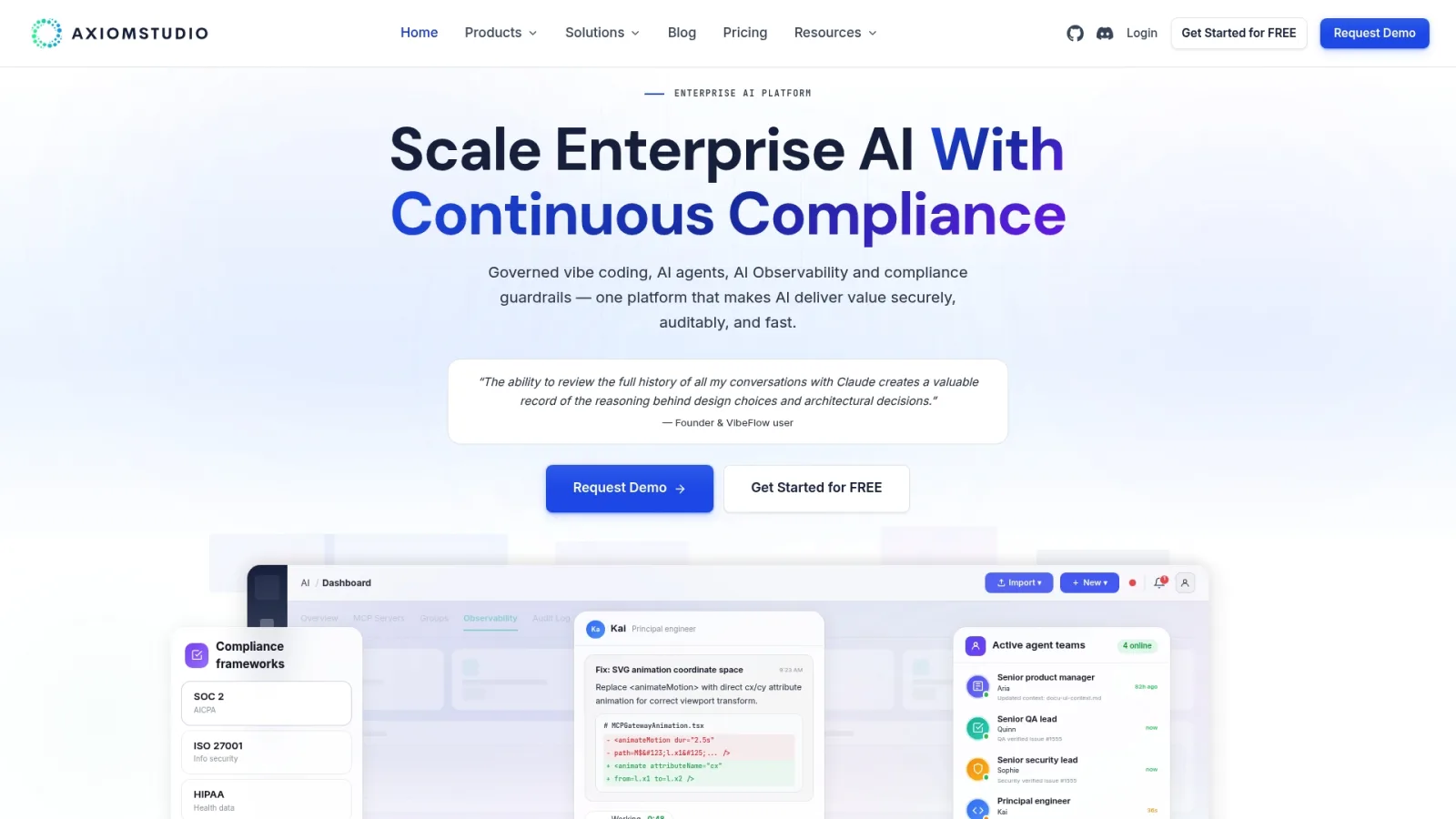
Axiom Studio is a unified platform for scaling enterprise AI with a governance layer that keeps compliance continuous. VibeFlow gives your team an AI agent team covering every stage of the lifecycle, and Vera reviews the code those agents produce. The goal is that teams using AI coding agents ship production-quality code rather than code full of security vulnerabilities and production-breaking gaps.
Plans are published on the pricing page: Starter (free), Pro at $20 per month, Team at $49 per seat per month with a three-seat minimum, and Enterprise. You can also explore Axiom Studio Cloud or read the docs before you decide.
Sources
- ENISA Technical Advisory on AI-assisted software development (draft, September 2026)
- Large Language Model-Based Agents for Software Engineering
- AI Agentic Programming: A Survey of Techniques, Challenges, and Opportunities
- Understanding the (In)Security of Vibe-Coded Applications
- Cloud Security Alliance research note on vibe coding security (March 2026)
- OWASP Secure Coding with AI Cheat Sheet
- AI for the SDLC: AI and Agentic Workflow Design and Governance
- OWASP Securing Agentic Applications Guide
- Security Assessment Handbook for Agentic AI Coding Assistants (Cyber Security Agency of Singapore)
Recommended
- Agent Workflows for Enterprise Software Development
- Agentic Coding: How AI Agents Write, Test & Ship Code Autonomously
- Top AI Coding Tools for Enterprise Teams
- AI Software Engineering: Practices, Roles & Metrics for Agent-Driven Development
Frequently Asked Questions
What is an agentic coding workflow?
It is a loop of explore, plan, act and review. The agent reads the code, proposes a plan, implements the change and runs checks, and a human reviews the diff before merge. Riskier changes add a second, independent reviewer.
Can AI develop software?
Agents can generate code from specifications, fix bugs from test feedback, write tests and refactor, according to the 2025 survey AI Agentic Programming: A Survey of Techniques, Challenges, and Opportunities. Production use still requires review, security scanning and human accountability for what ships.
How is agentic development different from AI-assisted coding?
An assistant suggests code while you drive each step. An agent pursues a goal across many steps, running commands and tests and preparing pull requests. The more autonomy it has, the more you need scoped permissions and an audit trail.
How do we keep agent-written code compliant?
Put security requirements in the agent's instructions, scan every change against your frameworks, and record who approved each AI-generated change along with the tool and model version. VibeFlow tracks each change against frameworks such as SOC 2 and GDPR, and Vera reviews the code before merge.
Where should an enterprise start?
Start with bounded, checkable tasks such as test generation or small bug fixes. Set autonomy levels, scope tool access, measure review time and defects after merge, and widen scope only where results hold.
Written by
Axiom Studio