Top 7 LLM Gateway Solutions for Enterprise AI Teams
Compare enterprise LLM gateway solutions across routing, observability, policy, cost controls, guardrails, provider abstraction, and production governance.
 AXIOM Team July 3, 2026 8 min read
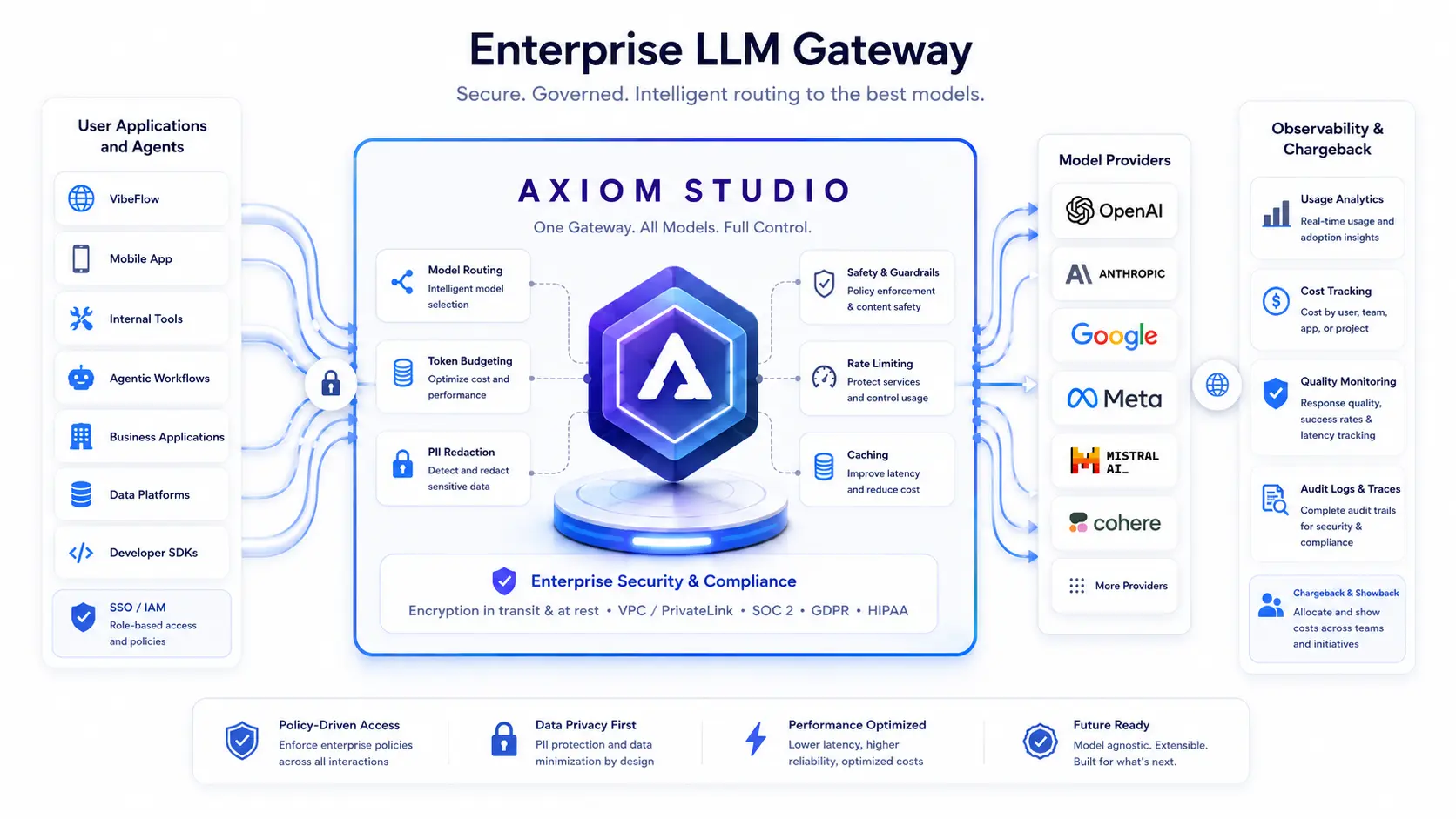
An LLM gateway becomes necessary the moment a team has more than one model, more than one application, or more than one policy.
At small scale, teams call model APIs directly. At enterprise scale, direct calls become a control problem. Every team names usage fields differently, handles retries differently, stores prompts differently, applies redaction differently, and bills tokens to a different spreadsheet.
The gateway is the control point between applications, agents, tools, and model providers. It handles routing, observability, cost controls, policy enforcement, fallback, and audit evidence.
This list compares seven gateway options and gateway-adjacent platforms. The order is not a universal ranking. It is a practical enterprise shortlist based on the job each solution is best suited to.
For background, read What Is an LLM Gateway, OpenTelemetry for LLM Gateways, and AI Tokenomics.
What an Enterprise LLM Gateway Should Do
Use this checklist before comparing vendors:
| Capability | Why it matters |
|---|---|
| Provider abstraction | Applications should not be rewritten every time the model strategy changes |
| Routing and fallback | Teams need model choice, latency control, failover, and cost-aware routing |
| Policy enforcement | Sensitive data, model allowlists, tool access, and use-case rules need a control point |
| Observability | Requests, latency, errors, token use, model choice, and spend need one telemetry view |
| Audit trail | High-risk workflows need evidence about prompts, context, outputs, tools, and approvals |
| Cost attribution | Finance needs spend by team, app, model, environment, and workflow |
| Governance integration | Model traffic should connect to SDLC, security, compliance, and incident processes |
If a gateway only solves routing, it is useful infrastructure. If it also solves policy, observability, evidence, and cost attribution, it becomes an AI governance layer.
1. Axiom Unified AI Gateway - Governance-First Gateway
The Unified AI Gateway is the strongest fit when the gateway must connect model routing to enterprise governance.
It is designed for teams that need model and tool traffic governed alongside AI-assisted SDLC work. That means routing, observability, provider controls, policy enforcement, and audit evidence should not live in a separate world from security review, QA, and work-item history.
Best for:
- Enterprises adopting multiple models, agents, and AI coding tools
- Teams that need model routing plus compliance evidence
- Organizations pairing gateway controls with VibeFlow
- Leaders who need cost, risk, and usage visibility across teams
Watch for:
- If your only need is a lightweight local proxy, a smaller open-source gateway may be enough.
- If governance and auditability are first-order requirements, evaluate the gateway together with SDLC controls, not as a standalone proxy.
Related reading: Building an AI Audit Trail, Enterprise AI Risk Management, and Building vs Buying Your AI Governance Layer.
2. LiteLLM - Developer-Friendly Multi-Provider Proxy
LiteLLM is often the first open-source gateway teams evaluate because it makes multi-provider access practical. It normalizes calls across many providers and can operate as a proxy for applications that need model optionality without rewriting every integration.
Best for:
- Engineering teams that want an open-source gateway layer
- Rapid multi-provider experimentation
- Internal platforms that need a common model API surface
- Teams comfortable owning operations, policy extensions, and production hardening
Watch for:
- Open-source flexibility comes with ownership: hosting, upgrades, observability, access control, and incident response stay with your team.
- Enterprise governance still requires surrounding controls for evidence, approvals, and compliance mapping.
LiteLLM can be a strong foundation when platform engineering wants to build gateway capability internally. The build-vs-buy question is how much governance you want to own above the proxy layer.
3. Portkey - Managed AI Gateway and Observability
Portkey is a managed gateway option focused on routing, observability, reliability controls, and governance features for production AI applications.
Best for:
- Product teams shipping AI applications across multiple providers
- Teams that want managed gateway operations rather than self-hosting
- Use cases where logs, analytics, rate limits, retries, and guardrails need to be available quickly
Watch for:
- Evaluate how deeply it integrates with your SDLC, compliance evidence, and internal approval process.
- Confirm data-retention, redaction, and enterprise administration requirements against your own policies.
Portkey is a good comparison point when the buyer wants a commercial gateway without building a proxy stack from scratch.
4. Helicone - LLM Observability and Gateway Controls
Helicone is frequently evaluated for LLM observability, request logging, usage analytics, and proxy-based visibility.
Best for:
- Teams whose first problem is visibility into model calls
- Developers who need request logs, latency, token usage, and cost views
- Smaller AI application teams that want a fast path from blind model calls to measurable traffic
Watch for:
- Observability is not the same as governance.
- If the enterprise needs review gates, compliance mapping, and model/tool policy across agent workflows, Helicone may need to be paired with additional controls.
Helicone is useful when the immediate question is “what is happening in our LLM traffic?” rather than “how do we govern every AI-assisted workflow?”
5. Langfuse - Observability, Tracing, and Evaluation
Langfuse is often used when teams need tracing, prompt management, evaluations, and observability for LLM applications.
Best for:
- AI product teams building prompt-heavy applications
- Evaluation workflows where traces, prompts, outputs, scores, and regressions matter
- Teams that need visibility into chains, agents, and application-level behavior
Watch for:
- Langfuse is strongest in the observability and evaluation layer.
- A separate gateway or governance layer may still be needed for provider routing, enterprise policy, and SDLC evidence.
Langfuse pairs well with gateway infrastructure when the organization wants both traffic control and application-level evaluation.
6. OpenRouter - Model Access and Routing Marketplace
OpenRouter is useful for teams that want a simple way to access many models through one API and route across providers.
Best for:
- Rapid model exploration
- Prototypes and applications that need broad model choice
- Teams that value one API for many hosted models
Watch for:
- Enterprise governance teams should evaluate data handling, provider routing transparency, administrative controls, and compliance requirements carefully.
- Model access breadth does not replace internal policy, audit, or SDLC controls.
OpenRouter can accelerate experimentation. For regulated production use, pair it with internal governance requirements and a clear approved-provider policy.
7. Cloudflare AI Gateway - Edge-Aligned Gateway Controls
Cloudflare AI Gateway is relevant for teams that want gateway capabilities close to the edge and already use the Cloudflare ecosystem.
Best for:
- Teams already operating on Cloudflare
- AI applications that benefit from edge-adjacent caching, analytics, rate limiting, and provider abstraction
- Engineering groups that want a lightweight gateway control point near existing web infrastructure
Watch for:
- Edge alignment is valuable, but the gateway still needs to fit your broader AI governance architecture.
- Confirm how audit evidence, prompt retention, team attribution, and compliance workflows map to your requirements.
This is a strong infrastructure option when the AI traffic path naturally belongs near Cloudflare’s network and developer platform.
Comparison Matrix
| Solution | Best fit | Primary strength | Governance depth |
|---|---|---|---|
| Axiom Unified AI Gateway | Enterprise AI governance | Routing plus policy, evidence, and SDLC alignment | High |
| LiteLLM | Internal platform teams | Open-source multi-provider proxy | Depends on what you build around it |
| Portkey | Managed production AI apps | Routing, reliability, logs, analytics | Medium to high |
| Helicone | LLM visibility | Observability and request analytics | Medium |
| Langfuse | Prompt/application evaluation | Tracing, evaluation, prompt management | Medium |
| OpenRouter | Model exploration | Broad model access through one API | Low to medium |
| Cloudflare AI Gateway | Edge-aligned teams | Gateway controls in Cloudflare ecosystem | Medium |
The matrix is deliberately capability-based. A startup building one AI feature may only need visibility and routing. A regulated enterprise needs a gateway that fits identity, audit, security review, cost attribution, and compliance evidence.
Buying Questions for Enterprise Teams
Ask these before standardizing:
- Can the gateway enforce model allowlists by team, app, environment, and data class?
- Can it redact or block sensitive context before provider calls?
- Can it attribute token spend to teams and workflows?
- Can it show latency, error rate, cache use, and model fallback behavior?
- Can it export audit evidence for SOC 2, HIPAA, or customer security reviews?
- Can it integrate with work-item, commit, security review, and QA evidence?
- Can it support both developer experimentation and production controls?
If the answer is no, the missing capability has to live somewhere else. Be explicit about where.
Final Recommendation
Choose a gateway based on the control problem you actually have.
If you need a developer proxy, LiteLLM may be enough. If you need observability, Helicone or Langfuse may be the first step. If you need broad model access, OpenRouter can accelerate exploration. If you need edge-aligned infrastructure, Cloudflare AI Gateway is worth evaluating.
If you need enterprise AI governance, the gateway has to connect model traffic to policy, evidence, cost, SDLC review, and compliance. That is the role of the Unified AI Gateway, especially when paired with VibeFlow for governed AI-assisted software delivery.
Written by
AXIOM Team