Build a Model Catalog Your Gateway Can Use
Create a model catalog with current IDs, prices, limits, tools, regions, data rules, owners and approved tasks for safe gateway routing.
 Axiom Studio November 18, 2026 5 min read
On this page
A gateway can route traffic only as well as the facts it has. Model IDs change. Prices move. Preview versions disappear. Tool support and data terms can differ by region or account.
A model catalog turns those moving facts into one small, reviewed record. The gateway reads it. Developers use stable names. Security and finance teams can see why a route is allowed.
Start with the models your apps use today. Do not try to catalog every model on the market.
What belongs in a model record
Store only the fields that help the gateway make a safe choice:
- Provider and exact model ID.
- Version or alias type.
- Lifecycle status: preview, available, deprecated or retired.
- Price source and date checked.
- Input and output limits.
- Supported inputs, outputs and tools.
- Allowed regions and data terms.
- Approved and blocked tasks.
- Owner, last reviewer and next review date.
- Replacement route and retirement date.
Do not copy a marketing label such as “fast” or “reasoning” and treat it as proof. The guide to reading LLM model metadata explains why teams still need their own task tests.
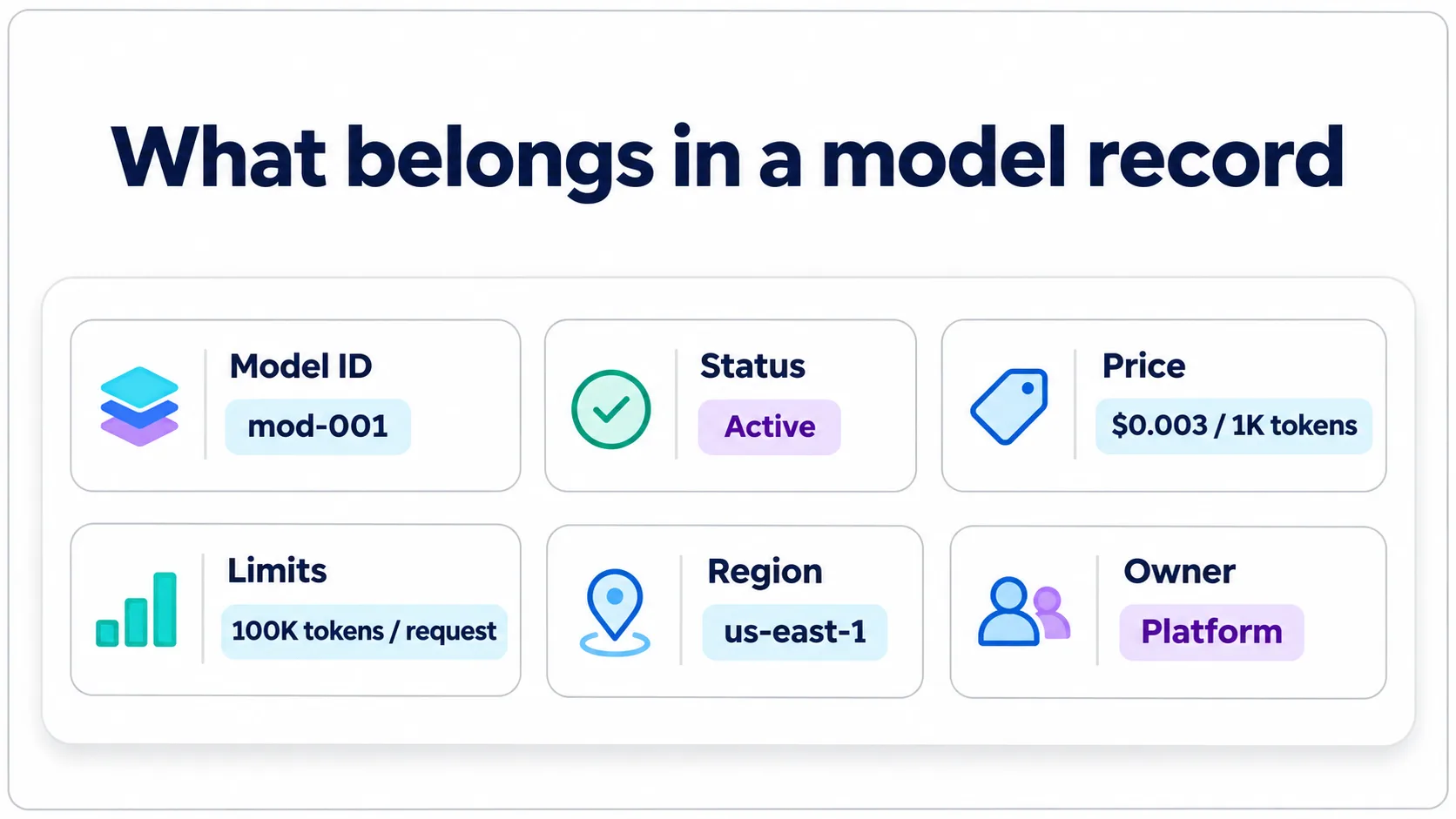
A useful catalog record combines provider facts with clear ownership, review dates and approved use.
Keep provider facts separate from team policy
A provider says what a model can do. Your team decides where it may run.
Provider facts include the model ID, limits, modalities, tool support, price and availability. Team policy includes approved tasks, allowed data class, region, owner, spend limit and fallback order.
Keep those parts separate. A provider update should not silently approve a model for sensitive work. A policy change should not rewrite the source facts.
id: support-fast
provider_model: provider/model-version
status: approved
price_checked: 2026-11-17
regions: [us]
tools: false
approved_tasks: [classification]
owner: ai-platform
review_after: 2027-02-01
This is a structure example, not a claim about a real model. Link every provider fact to a live source. OpenAI’s model catalog is one example of an official page that lists current model IDs and details.
Connect stable names to exact routes
Applications should ask for a stable catalog name such as support-fast or code-review-deep. The catalog maps that name to an exact provider model. The gateway enforces the route.
The LLM Gateway gives applications one OpenAI-compatible entry point across providers. Its documentation covers model-aware routing, centralized credentials, fallback, usage analytics and audit logs.
Before routing a request, check these questions in order:
- Is the model active and approved?
- Is it allowed for this task and data class?
- Does it support the required tools and output?
- Is it available in the required region?
- Is it inside the request’s cost and latency budget?
- Which approved fallback can handle the same task?
These checks are why one global “best model” route is not enough. Fallbacks are real traffic too, so see safe LLM retries for how to fall back without duplicate tool actions.
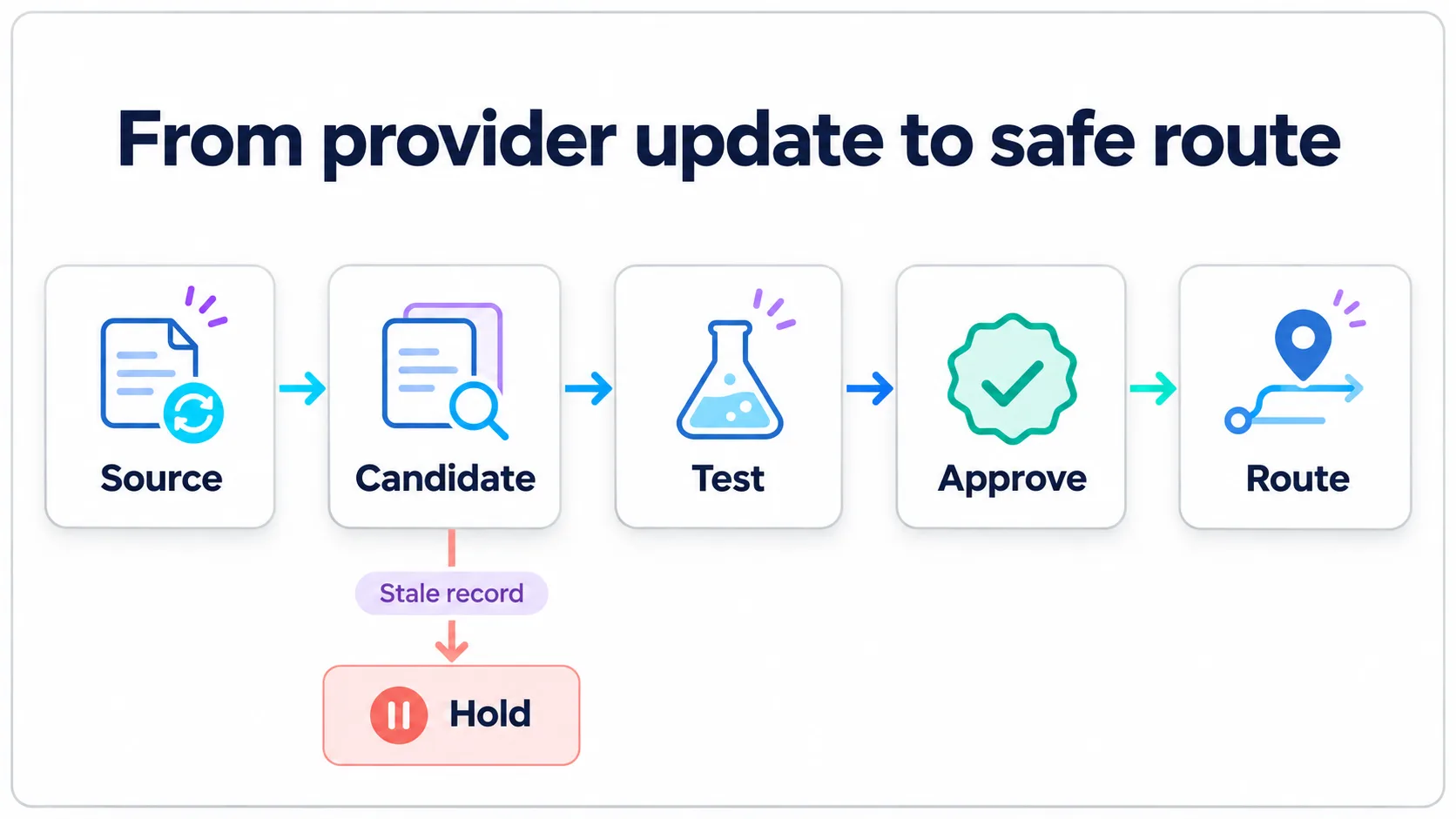
A model moves from an official source to a candidate record, task tests, approval and controlled gateway traffic. Stale records stop before routing.
Review changes before they reach traffic
Treat the catalog like code. A pull request keeps the changed facts, reviewer and approval together.
- Detect a new model, price, limit or deprecation.
- Update a candidate record with its source and check date.
- Run a small test set from real team work.
- Review quality, format, latency, failures and human effort.
- Approve, block or limit the model to named tasks.
- Publish the catalog change and watch the first routed traffic.
- Retire the old route only after the fallback is proven.
Prevent catalog drift
Run three simple checks in CI: reject past review dates, reject duplicate aliases or missing owners, and reject routes that point to retired models.
Also alert when live traffic uses a model that is not in the approved catalog. The catalog and gateway must agree. A clean spreadsheet that routing code ignores does not prevent risk.
Set a review rhythm that matches change risk
Not every field needs the same review speed. Check lifecycle and deprecation notices often because they can break traffic. Check price, limits, regions and data terms on a set schedule. Re-run task tests when the exact model version, system prompt, tool schema or output contract changes.
Give each record three dates: when the source was checked, when the team approved it and when it must be reviewed again. If the next review date passes, stop new traffic or route only low-risk work until an owner checks the record.
Use a small change report for every update. Show the old value, new value, official source, affected routes and test result. This makes review fast and keeps policy changes separate from provider facts.
Finally, keep a rollback route ready. A catalog update should be reversible without an app release. The gateway can switch a stable alias back to the last approved model while the team studies the change.
List the models used by current applications. Give each one an owner, one next-review date and one approved task. Connect those records to the gateway. Track the route, errors, tokens and cost.
When a provider changes a model, the team then has one place to review the change and one controlled path to roll it out. That is the real value of the catalog: fewer hidden model choices and safer changes without editing every application.
Frequently Asked Questions
What is a model catalog?
A model catalog is a reviewed record of the exact models a team can route to, including IDs, versions, limits, prices, tools, regions, data rules, owners and approved tasks.
Why should applications use stable model names?
Stable names such as support-fast let the gateway map applications to an exact approved provider model without requiring an app release when a route changes.
How often should a model catalog be reviewed?
Review lifecycle and deprecation changes frequently, and set a next-review date for every record covering price, limits, regions, data terms and task-test results.
How does a model catalog improve gateway routing?
It gives the gateway current, owned facts and explicit team policy so routing can check task, data class, tools, region, cost and latency before sending traffic.
Written by
Axiom Studio