Top 5 AI Governance Frameworks for Engineering Leaders in 2026
Compare NIST AI RMF, EU AI Act, ISO 42001, SOC 2, and HIPAA from an engineering execution perspective: what each framework requires and how to turn it into evidence.
 AXIOM Team July 3, 2026 9 min read
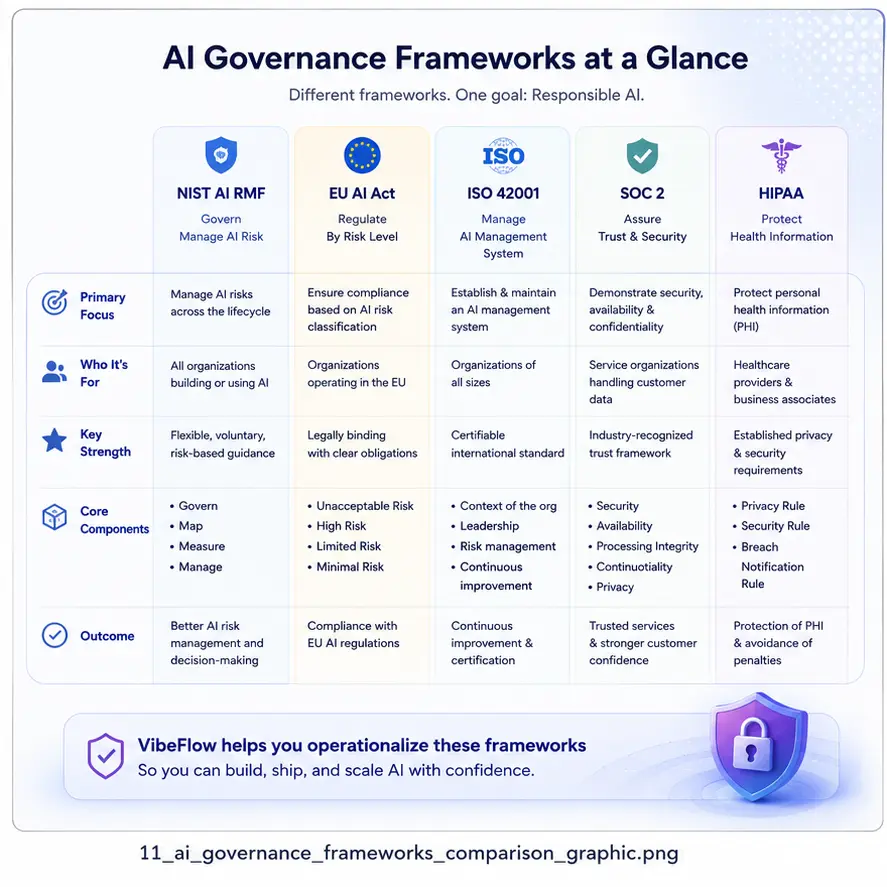
AI governance frameworks do not fail because the documents are unclear. They fail because engineering teams cannot turn the documents into repeatable evidence.
A policy says that AI systems must be inventoried. Who owns the inventory? A regulation says high-risk systems need oversight. Which workflow captures oversight? A security framework says access must be controlled. Which model calls, agent tools, and repositories does that include?
This guide compares five frameworks and compliance overlays that engineering leaders should understand in 2026:
- NIST AI RMF
- EU AI Act
- ISO/IEC 42001
- SOC 2
- HIPAA
SOC 2 and HIPAA are not AI-only frameworks. They still matter because enterprise AI programs usually inherit security, privacy, availability, and healthcare obligations from the systems around them.
For a deeper side-by-side view of NIST AI RMF, EU AI Act, and ISO 42001, read AI Governance Frameworks Compared. For the operating-model layer, read Enterprise AI Risk Management.
The Engineering View of AI Governance
Executives often ask, “Which framework should we follow?”
Engineering leaders should ask a different question: “Which evidence do we need to produce, and which workflows will produce it automatically?”
Most frameworks converge on a common set of engineering controls:
| Control area | Evidence engineering teams need |
|---|---|
| Inventory | AI systems, models, tools, agents, owners, data paths, and approved use cases |
| Risk classification | Which workflows are low, medium, high, regulated, customer-facing, or safety-sensitive |
| Access control | Who can use which model, tool, repository, and data class |
| Change control | Work items, approvals, implementation logs, tests, security review, QA, and commit linkage |
| Data governance | What context entered prompts, what was redacted, where outputs were stored |
| Monitoring | Usage, errors, latency, model changes, drift signals, cost, and incidents |
| Audit trail | Structured evidence that can be reviewed without reconstructing events from chat logs |
VibeFlow helps with SDLC evidence. The Unified AI Gateway helps with model and tool traffic evidence. Together, they make frameworks operational instead of aspirational.
1. NIST AI RMF - Best Starting Point for Risk-Based Governance
NIST AI RMF is the best starting point for organizations that want a flexible, risk-based AI governance program.
It is built around four functions:
- Govern
- Map
- Measure
- Manage
That structure is useful because it mirrors the practical lifecycle of an AI system: set accountability, understand the system, measure risk, and manage the risk over time.
Best for:
- US-based companies building an internal AI governance program
- Teams that want a common language before formal certification or regulation applies
- Organizations that need to align product, security, legal, and engineering around risk
Engineering evidence to capture:
- AI system inventory and ownership
- Use-case risk classification
- Model and tool selection rationale
- Prompt/context data flows
- Test and evaluation results
- Incident and change history
- Approval and exception records
Watch for:
- NIST AI RMF is flexible, which means your team must define how the controls become concrete workflows.
- A spreadsheet inventory is not enough once agents and gateways enter production.
Start here if your organization is early in AI governance and needs a practical operating model.
2. EU AI Act - Best for Regulatory Exposure and Risk Classification
The EU AI Act matters to any organization that places AI systems on the EU market or affects people in the EU.
Its most important engineering contribution is risk classification. Some AI systems are prohibited, some are high risk, some have transparency obligations, and many are minimal risk. Engineering teams need a way to classify each use case and prove the classification was handled correctly.
Best for:
- Organizations serving EU users or customers
- Companies building AI into products, hiring, education, healthcare, finance, or critical workflows
- Teams that need legal and engineering alignment on high-risk use cases
Engineering evidence to capture:
- System classification and rationale
- Data sources and data governance
- Human oversight workflow
- Testing, monitoring, and post-deployment controls
- Incident reporting process
- Technical documentation and change history
Watch for:
- AI-assisted engineering tools may not always be “AI systems placed on the market,” but their outputs can still affect regulated products.
- Do not wait until product launch to classify risk. Classification should happen before implementation.
Read EU AI Act compliance for a practical preparation path.
3. ISO/IEC 42001 - Best for Certifiable AI Management Systems
ISO/IEC 42001 is the most useful framework when the buyer, board, or customer wants a certifiable AI management system.
It is not only about individual models. It is about how the organization manages AI: roles, responsibilities, risk assessment, operational controls, performance evaluation, internal audits, management review, and continuous improvement.
Best for:
- Enterprises that need third-party assurance around AI governance
- Vendors selling AI-enabled products into enterprise customers
- Organizations that already operate ISO-style management systems
Engineering evidence to capture:
- AI management policy and scope
- Roles and responsibilities
- Risk assessment records
- Operational controls for development and deployment
- Evaluation and monitoring evidence
- Internal audit findings and remediation
- Management review inputs and outputs
Watch for:
- Certification is a management-system exercise, but weak engineering evidence will make the system feel hollow.
- The standard tells you what must be managed. Your delivery systems need to show how it was managed.
ISO 42001 is most powerful when paired with automated evidence capture from AI gateways, SDLC workflows, and audit logs.
4. SOC 2 - Best for Customer Trust and Operational Controls
SOC 2 is not an AI governance framework. It is still one of the frameworks your AI program will have to answer to because enterprise buyers care about security, availability, confidentiality, processing integrity, and privacy.
AI changes the SOC 2 conversation because model calls, prompts, generated code, agents, and tool access can all affect the control environment.
Best for:
- SaaS companies selling to enterprises
- Teams that need customer security-review readiness
- Organizations already maintaining SOC 2 evidence
Engineering evidence to capture:
- Access controls for AI tools and gateways
- Approval records for high-risk AI workflows
- Change-management evidence for AI-assisted code
- Logging and monitoring for model calls
- Vendor and provider risk records
- Incident response evidence involving AI systems
Watch for:
- Auditors may not ask for “AI governance” by name. Customers will still ask how AI tools touch code, data, and production systems.
- If AI-generated changes bypass normal controls, your SOC 2 story becomes harder to defend.
For the control-page layer, see SOC 2 compliance. For workflow evidence, see Quality Gates for AI-Generated Code.
5. HIPAA - Best for Healthcare AI Data Boundaries
HIPAA is not an AI framework either. It becomes central when AI workflows touch protected health information, healthcare operations, or systems that support covered entities and business associates.
The engineering problem is data boundary control. Teams need to know whether PHI entered a prompt, retrieval context, log, evaluation set, agent tool, or third-party model provider.
Best for:
- Healthcare SaaS vendors
- Health systems using AI-assisted development or operations
- Teams building AI workflows around clinical, claims, support, or patient data
Engineering evidence to capture:
- Data classification for PHI and adjacent sensitive data
- Approved AI tools and providers for healthcare workflows
- Redaction and de-identification controls
- Access logs and model-call logs
- Business associate and vendor controls
- Incident and breach-response evidence
Watch for:
- “We told developers not to paste PHI into AI tools” is not a control.
- Healthcare AI programs need enforcement, logging, and reviewable evidence at the point of use.
See HIPAA compliance for the compliance surface and The CISO Guide to AI Agent Security for threat-model context.
Which Framework Should You Start With?
Use this mapping:
| Situation | Start with |
|---|---|
| You need a flexible internal AI governance program | NIST AI RMF |
| You serve EU users or high-risk regulated use cases | EU AI Act |
| You need certifiable AI management-system assurance | ISO/IEC 42001 |
| You sell SaaS to enterprise buyers | SOC 2 plus AI-specific controls |
| You touch healthcare data or PHI | HIPAA plus AI data-boundary controls |
In practice, most enterprises need more than one. NIST AI RMF gives the risk-management language. EU AI Act shapes regulatory classification. ISO 42001 provides management-system discipline. SOC 2 and HIPAA turn AI governance into customer and sector-specific evidence.
The Evidence Stack
A workable evidence stack has three layers:
- Policy layer: approved use cases, risk appetite, data classifications, provider rules, and exception process.
- Enforcement layer: model routing, tool access, redaction, review gates, QA, and security approvals.
- Evidence layer: logs, work items, commits, tests, model calls, approvals, incidents, and reports.
The common failure mode is to write the policy layer and leave the enforcement/evidence layers manual.
That does not scale. Agents move too quickly, models change too often, and auditors do not accept “we think the team followed the process” as proof.
VibeFlow turns AI-assisted SDLC work into reviewable evidence. The Unified AI Gateway turns model and tool traffic into governed telemetry. Together, they give engineering teams the raw material needed to satisfy multiple frameworks without rebuilding the evidence trail after the fact.
Final Recommendation
Do not pick a framework as a paperwork exercise.
Pick the framework that matches your risk exposure, then design the engineering evidence path that proves the controls are real. If a requirement cannot be tied to a workflow, log, approval, test, commit, model call, or audit record, it is not operational yet.
That is the standard enterprise AI governance has to meet in 2026.
Written by
AXIOM Team