Why "AI Software Engineer" Is the Wrong Frame for Enterprise SDLC
The single-AI-engineer pitch demos beautifully and breaks at deploy. The framing assumes the buyer's organisation will silently absorb every role the agent doesn't do.
 AXIOM Team May 3, 2026 9 min read
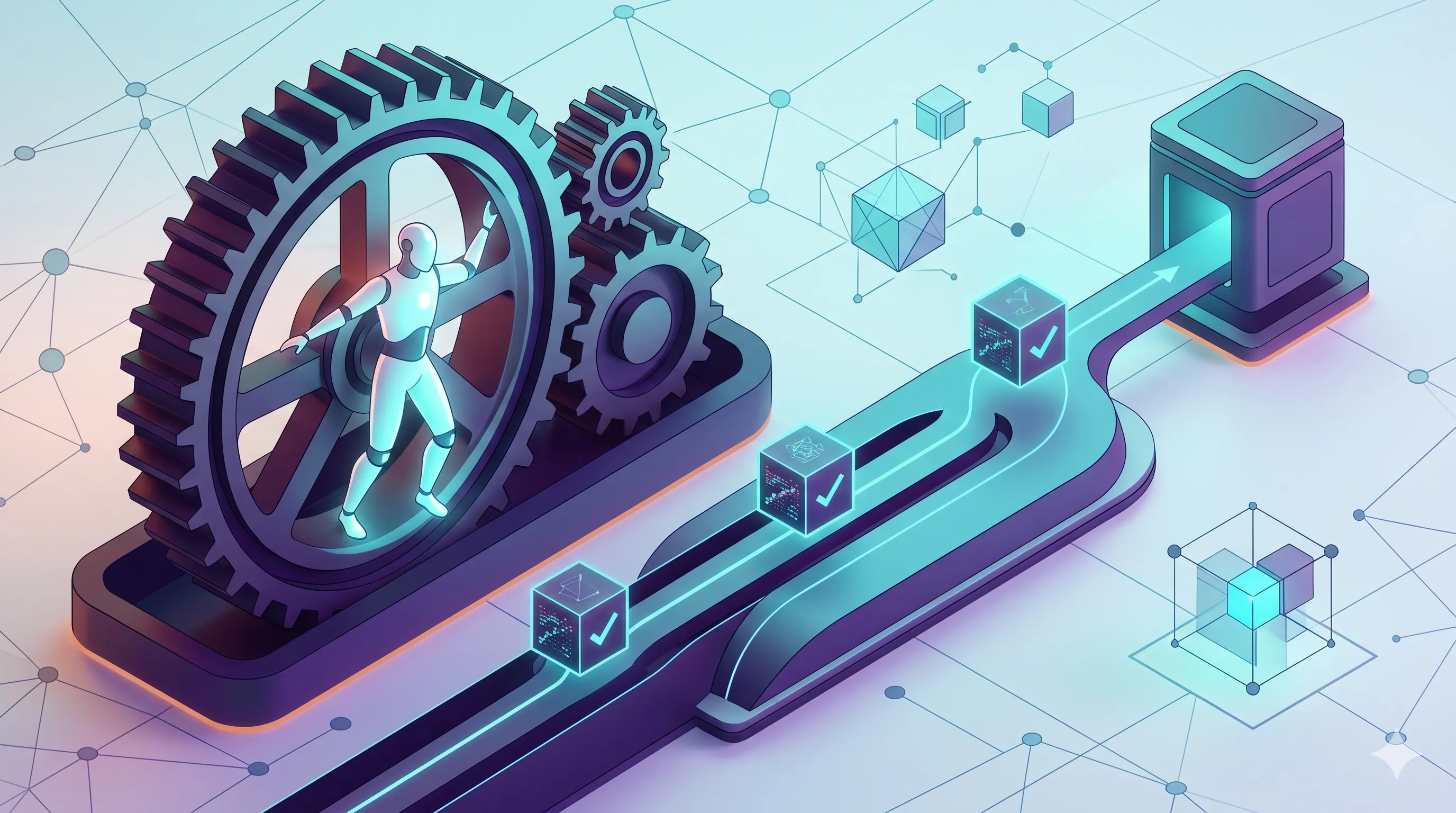
Every AI coding company eventually ships the same demo. A neutral-voiced narrator describes a feature request. An agent labelled “the AI software engineer” reads the request, opens an editor, writes some code, runs tests, commits, opens a PR. Two minutes. Cuts to applause. Procurement gets a pitch deck two days later.
The demo is real. The framing is the problem. “AI software engineer” is not a description of what the product does — it is a load-bearing piece of marketing that quietly relocates every responsibility a real software engineer doesn’t actually do alone. By the time the buyer has deployed it, scaled it, and tried to defend it to an auditor, the framing has produced a five-figure procurement decision and a five-figure month-one TCO surprise.
This is article 1 of 3 in a series on the framing question. Article 2A (you are reading it) makes the negative case. Article 2B introduces the agent-team alternative. Article 2C lays out the SDLC-discipline argument that should replace “whose AI engineer is best?” as the procurement question.
Where the Single-Engineer Frame Leaks
A real software engineer does not write code alone. They are inside a system of roles — PM, architect, peer reviewer, QA, security, on-call. The system absorbs the engineer’s mistakes; the engineer absorbs the system’s friction. The two are inseparable.
An “AI software engineer” product is sold as a swap-in for the engineer. But the system is what produces the actual outcome — not the engineer alone — and the system-shape is invisible in the demo. Specifically, every step that is not “code in editor → tests pass” is silently assumed to either (a) not exist, (b) be done elsewhere by someone else, or (c) not matter.
flowchart LR
    PM[PM scoping] --> A[Architecture] --> C[Coding] --> R[Adversarial review] --> Q[QA] --> S[Security] --> D[Deploy] --> O[On-call]
    style C fill:#dff,stroke:#080
    classDef gap fill:#fee,stroke:#a00,stroke-dasharray: 5 5
    class PM,A,R,Q,S,D,O gap
The single-engineer frame’s coverage is the green box (coding). The dashed pink boxes are the gaps the buyer’s organisation is expected to absorb without anyone saying so out loud.
Five Questions the Single-Engineer Frame Can’t Answer
When an enterprise buyer is told they’re getting “an AI software engineer,” the right pushback is five questions. None of them is leading; all of them are the unglamorous parts of the engineering job.
-
Who owns the design before code is written? Real engineers don’t start writing code on the first prompt. They check the design doc, talk to the architect, push back on requirements that are underspecified or contradictory. An AI software engineer that just opens a PR has implicitly decided that no design is needed — and silently embeds whatever assumptions the prompt didn’t pin down.
-
Who reviews adversarially? A pull request reviewed by the same agent that wrote it is not adversarially reviewed. The whole point of code review is independent eyes — different priors, different blind spots. Single-agent products typically have no answer to this beyond “the human reviewer.” That is correct; it is also exactly what the demo glossed over.
-
Who runs the security threat model? Threat modelling is a separate discipline — different mental model than coding, different toolset, different output (data flows, attack surfaces, mitigations). A coding agent that “thinks about security” inline is doing a watered-down version of the work, not the work. See The CISO’s Guide to AI Agent Security.
-
Who handles the post-deploy incident? When the AI-built code wakes someone up at 3am, who is on the page? Not the agent — agents do not have on-call rotations, runbooks, or accountability for incident postmortems. The buyer’s existing humans absorb that work, and the agent’s prompt history may or may not be useful for them.
-
Who attests to compliance evidence? For SOC 2, NIST AI RMF, EU AI Act, the audit trail asks who built it, who reviewed it, who approved it, and on what authority. A single agent’s commit + a human’s PR-approval click is a thin record. Whether that thinness is acceptable depends entirely on the buyer’s audit posture — see Building an AI Audit Trail and Quality Gates for AI-Generated Code for the bar.
The Unspoken Assumption — That the Buyer Will Absorb the Gaps
Every “AI software engineer” pitch silently assumes one thing: the buyer’s organisation already does the eight other things, and the only thing missing is more coding velocity. For a small subset of well-resourced enterprises with mature platform teams, well-staffed AppSec functions, mature on-call rotations, and a robust audit-evidence pipeline, that assumption holds. For most buyers it does not.
A common pattern: a CIO sees a single-AI-engineer demo, signs a six-figure annual contract, and three months in discovers that PR volume has doubled without QA capacity, without security capacity, and without compliance capacity to keep up. The agent isn’t broken; the assumption was wrong. The product was sold against a hypothetical fully-resourced organisation, and the actual buyer was somewhere in the long tail of “we have most of those things, mostly.” That gap, multiplied by agent throughput, is where rollouts stall — not at the demo, not at procurement, but six weeks after deploy when the volume of agent-authored PRs has overrun the team’s ability to inspect them.
The fix is not to staff up after-the-fact. The fix is to choose products whose framing matches the buyer’s actual capacity. If the buyer has the eight surrounding stages, an autonomous agent compresses the ninth. If they don’t, a multi-agent product that owns more of the stages is the better fit. Calling either product an “AI software engineer” obscures which one a given buyer actually needs.
What the Single-Engineer Frame Promises vs What Enterprise SDLC Requires
The same delta in tabular form, by SDLC stage:
| SDLC stage | “AI software engineer” frame promises | Enterprise SDLC requires | Gap absorbed by |
|---|---|---|---|
| Requirements clarification | Agent reads the prompt | PM with stakeholder context | Buyer’s PM |
| Design / architecture | Agent decides inline | Architect + design doc + review | Buyer’s architects |
| Implementation | Agent codes | Same | (Covered) |
| Adversarial review | Agent submits PR | Independent reviewer (human or distinct agent) | Buyer’s reviewers |
| QA / coverage | Agent runs existing tests | QA discipline + boundary cases + mutation | Buyer’s QA / pipeline |
| Security review | Agent considers security | Threat model + SAST + DAST + secrets + deps | Buyer’s AppSec / pipeline |
| Compliance evidence | Agent commits + human approves PR | Per-change audit + control mapping + attestation | Buyer’s GRC |
| Deploy gating | Out of scope | Risk-tiered gates + rollback authority | Buyer’s deploy pipeline |
| Post-deploy on-call | Out of scope | Rotation + runbooks + postmortems | Buyer’s on-call humans |
Eight of nine rows have the gap absorbed by the buyer. That is the actual product the buyer is signing up for: an agent that does one of the nine SDLC stages, and an organisation that absorbs eight more without explicit accounting. For an enterprise that already has all eight, this can be fine — the agent just compresses the ninth row’s wall-time. For an enterprise that does not, “AI software engineer” is buying a ninth row of velocity at the cost of eight rows of unbudgeted work.
The Total Cost of Ownership of an “AI Software Engineer”
The TCO of any tool is the licence fee plus the work the buyer must do to make it useful. For a single-AI-engineer product, the work-to-make-it-useful is the eight SDLC stages above. If the buyer hadn’t already invested in those, the AI engineer just made the gap more expensive — agent throughput compounds the volume problem in stages the buyer hasn’t staffed for. We’ve covered the volume failure mode in detail in AI Coding at Scale: Governance Challenges Solo Tools Can’t Solve.
Stanford’s research on developers using AI assistants is the most-cited piece of evidence that the work-to-make-it-useful in those gap stages is real and measurable: developers using AI assistants wrote less secure code AND rated their own insecure output as more secure. That is the gap making itself visible in production data. The platforms that fail to address those gaps explicitly are not bad products — they are products mis-priced against the enterprise buyer’s actual cost structure.
Where This Leaves Buyers
The single-AI-engineer framing isn’t dishonest; it’s just incomplete. Used by a team that already has the surrounding eight SDLC stages running, an autonomous coding agent is a velocity multiplier. Used by a team that doesn’t, it accelerates the volume of work in stages no one is staffed to absorb.
The procurement question, restated: not “whose AI software engineer is best?” but “which AI development product matches the SDLC coverage we actually have?” That is a different question, and the answer is rarely the loudest demo.
The two articles that follow this one make the constructive case. The Agent-Team Model (article 2B) lays out the alternative — specialised agents per role, with handoff contracts, instead of one autonomous engineer pretending to do everything. Article 2C (SDLC Discipline as the Real Differentiator) closes the argument: the unit of comparison should be the entire delivery process, not the cleverness of the developer agent.
For the operational angle on what the agent-team alternative looks like, see Agent Workflows in Enterprise Software Development, From Individual Copilots to Team-Wide AI Orchestration, and AI-Native SDLC: Automating Beyond CI/CD. Engineering leaders evaluating this trade-off can read the role-specific framings at /for/engineering-leaders, /for/ctos, and /for/cisos.
Stop buying the demo, start buying the SDLC fit. Or try VibeFlow for the agent-team alternative the next two articles in this series describe.
Written by
AXIOM Team