Claude Skills vs OpenClaw Skills: A Practical Comparison
How Claude Skills and OpenClaw Skills compare on SKILL.md format, locations, precedence, invocation, distribution, and security — and how to pick.
 AXIOM Team June 24, 2026 7 min read
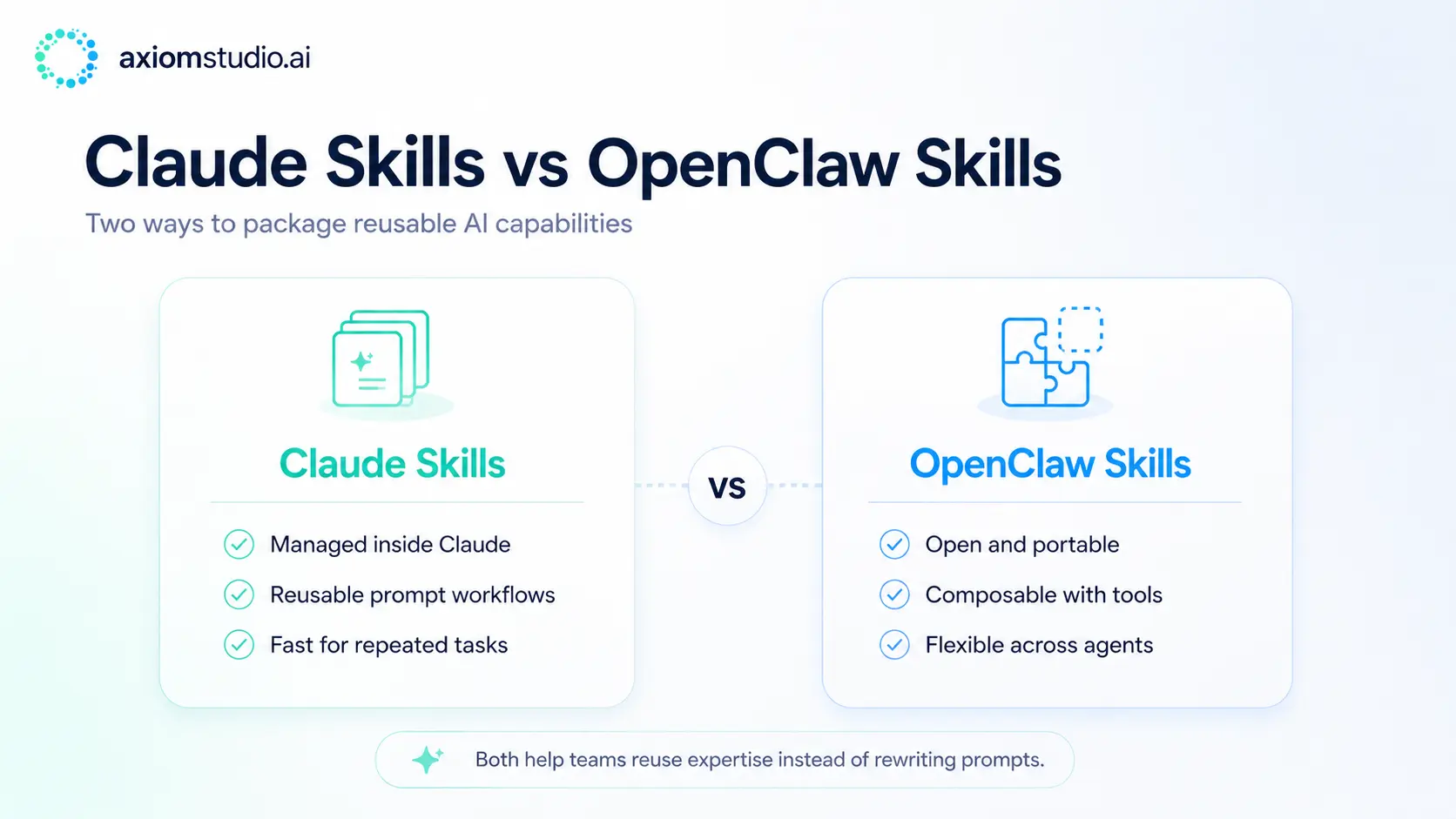
Claude Skills and OpenClaw Skills look almost identical on the surface. Both package reusable agent behavior into a folder built around a SKILL.md file. Both descend from the same idea: give an agent enough instruction, context, and supporting files to perform a repeatable job without inflating the system prompt.
Look closer and the two diverge in ways that matter. Where a skill lives, how it is discovered, what wins when names collide, how it is installed, and what it can touch at runtime are all different. Those differences decide how hard each platform is to secure and govern at enterprise scale.
This post compares the two head-to-head: the shared foundation, where each one stores and resolves skills, how they are invoked and distributed, the security model, and how to choose between them.
The Shared Foundation: SKILL.md
Both platforms build on the same primitive. A skill is a directory containing a SKILL.md file — frontmatter with a name and an activation description, plus an instruction body — and optional supporting files such as references, examples, templates, or scripts.
The activation description is routing metadata. It tells the runtime when the skill applies, so the agent can see enough to choose a skill and load the full instructions only when the task calls for it. That progressive-disclosure pattern keeps everyday context smaller than a single always-on instructions file.
Because both follow the AgentSkills-compatible layout, a well-written skill is broadly portable in shape. The real differences live in the platform behavior wrapped around that folder. If you are new to the underlying model, start with what agent skills are.
Claude Skills in Brief
Claude Skills are the first-party skill system in Claude Code. Project skills commonly live at .claude/skills/<skill-name>/SKILL.md and can be committed with the repository so a team shares them like code.
Claude documents four scopes — personal, project, enterprise, and plugin — each with its own precedence and sharing behavior. A skill loads either because the user explicitly invokes it with /skill-name or because its description matches the current task. Claude Code also treats existing .claude/commands files and skills as closely related, with skills adding richer folders, supporting resources, and invocation controls.
The headline architectural choice is progressive disclosure: Claude reads enough metadata to route, then opens the detailed SKILL.md only when needed.
OpenClaw Skills in Brief
OpenClaw Skills use AgentSkills-compatible folders too, but wrap them in a more elaborate loading model. OpenClaw resolves skills from three places: bundled skills that ship with the install, managed or local skills under ~/.openclaw/skills, and workspace skills under <workspace>/skills. Precedence runs workspace > managed/local > bundled, configured through ~/.openclaw/openclaw.json.
Two OpenClaw-specific behaviors stand out. First, ClawHub — a public registry for discovering, installing, updating, and syncing skills. Second, load-time gating: skills can be filtered by operating system, required binaries, environment variables, config values, and installer metadata, so a skill can appear or disappear depending on the host. OpenClaw also documents environment and API-key injection into the host process for an agent turn.
Head-to-Head: The Differences That Matter
| Dimension | Claude Skills | OpenClaw Skills |
|---|---|---|
| Skill format | SKILL.md folder |
SKILL.md folder (AgentSkills-compatible) |
| Primary home | .claude/skills/<name>/SKILL.md in the repo |
<workspace>/skills, ~/.openclaw/skills, bundled |
| Scopes / precedence | personal, project, enterprise, plugin | workspace > managed/local > bundled |
| Invocation | relevance match or /skill-name |
relevance plus load-time gates (OS, binaries, env, config) |
| Distribution | plugins, enterprise/managed scopes | ClawHub registry (install / update / sync) |
| Runtime surface | allowed tools via frontmatter | env / API-key injection into the host process |
| Config | .claude/ conventions |
~/.openclaw/openclaw.json |
| Security default | review allowed tools, scripts, dynamic context | treat third-party skills as untrusted code |
Three of these rows carry most of the practical weight.
Where skills resolve
Claude leans on named scopes that map cleanly to “who owns this”: personal, project, enterprise, plugin. OpenClaw leans on a precedence chain across bundled, managed/local, and workspace directories. The chain is powerful for team overrides, but it means two machines can resolve the same skill name differently unless the active source is logged. With OpenClaw, “which skill actually ran” is a question you must be able to answer.
How skills are distributed
Claude Skills travel with the repository, a plugin namespace, or an enterprise-managed scope. OpenClaw adds ClawHub, a registry that turns skills into installable, updatable packages. That convenience changes the supply-chain conversation: every installed skill now has a source, a version, a maintainer, and an update cadence you should track.
What a skill can touch at runtime
Claude skill frontmatter can influence which tools are available while a skill runs, so reviewing allowed tools and any dynamic-context commands is part of vetting a skill. OpenClaw documents environment and API-key injection into the host process and host-capability gating, which is flexible but widens what a skill can reach. On both platforms, reviewing a skill is a security activity, not just a documentation task.
Security: The Biggest Divergence
OpenClaw’s own documentation is blunt: third-party skills should be treated as untrusted code. That is the right default for any skill that can influence tools, inject environment values, or point an agent at scripts. OpenClaw also notes that sandboxed runs may need the same binaries installed inside the sandbox, not only on the host, and that injected secrets must never be copied into prompts, examples, transcripts, or skill output.
Claude Skills face the same class of risk from a different angle. A skill that pulls live diffs, runs shell helpers, or expands allowed tools changes what the model can see and do, so project skills should be code-reviewed, versioned, and tested for trigger phrases before they land. Either way, the controls that matter are provenance, permissions, secret hygiene, and approval. See agent skill security for the review checklist that applies to both.
Which Should You Pick?
- Choose Claude Skills if your team works inside Claude Code, wants skills versioned alongside the repository, and values progressive disclosure with clear personal/project/enterprise scopes.
- Choose OpenClaw Skills if you need a registry-driven library through ClawHub, per-workspace overrides, host-capability gating, and AgentSkills compatibility across agent tooling.
- Expect to run both. Because they share the
SKILL.mdformat, the content of a skill is broadly portable; the platform you pick is really a decision about distribution, precedence, and runtime trust.
The Governance Layer Both Share
Whichever platform you adopt, the enterprise question is identical: which skill ran, what tool access it had, who approved it, and what it produced. Skills move privilege closer to the model, so the audit trail around them is what makes either one safe to scale.
That is the layer VibeFlow is built for — tracked work items, code review, and audit evidence wrapped around agent actions, independent of whether the skill came from .claude/skills or ClawHub. The skill format is converging; the discipline around it still has to be deliberate.
Final Thoughts
The SKILL.md convergence is good news. Skills are becoming a portable packaging layer rather than a vendor lock-in. Claude Skills and OpenClaw Skills differ less in what a skill is and more in how it is stored, resolved, distributed, and trusted at runtime.
Pick the platform that matches how your team distributes and governs work, then keep the same review discipline regardless of which one you run. The format will keep converging; your security and audit posture is the part you own.
Written by
AXIOM Team