What Is an LLM Gateway? Proxy, Router, and Control Plane
Learn how an LLM gateway routes AI requests, protects provider keys, tracks cost, and gives teams one control point across model providers.
 Axiom Studio October 20, 2026 5 min read
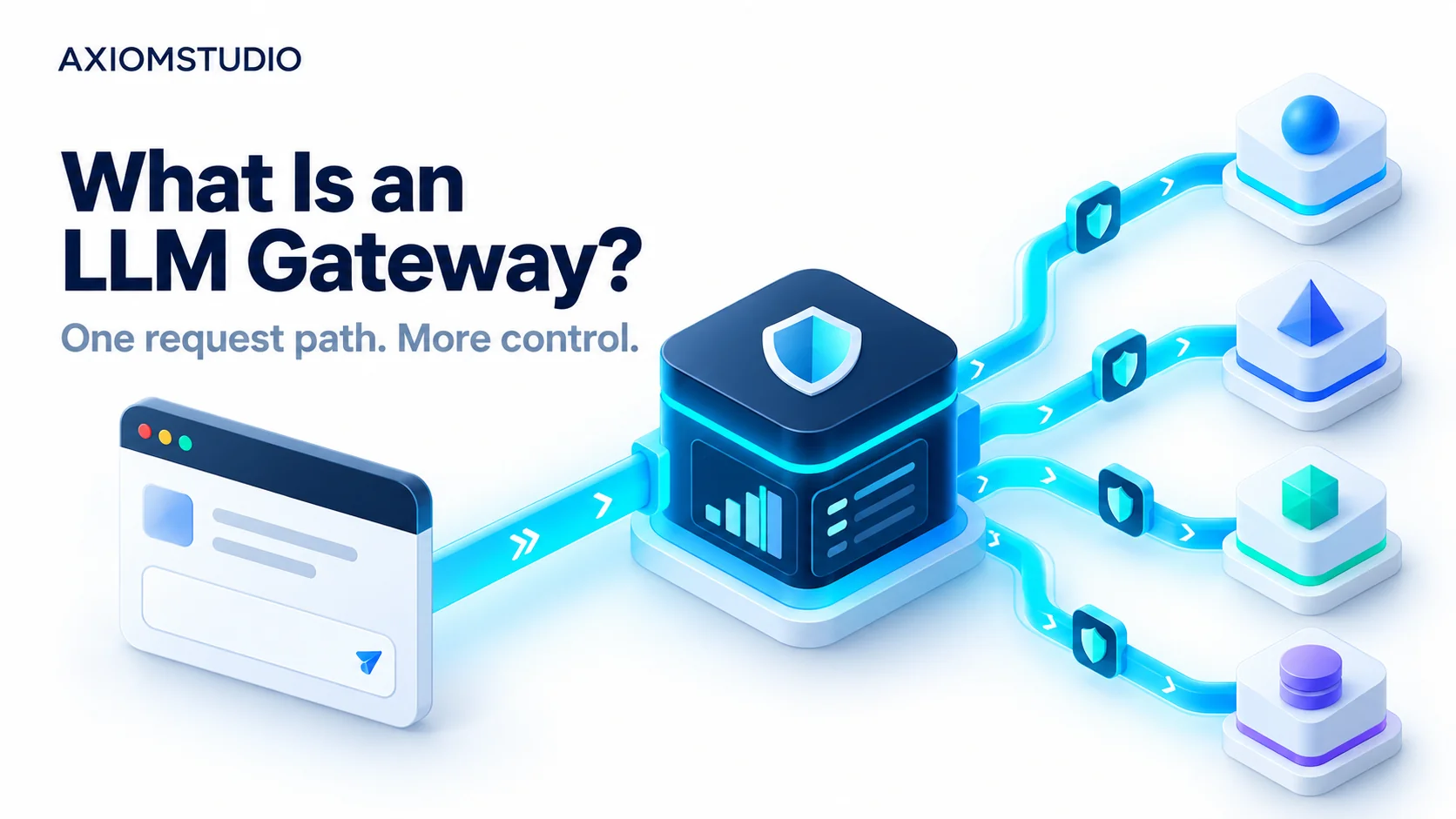
An AI app can start with one model and one API key. Then the team adds a second model. A backup provider comes next. Soon, each app has its own keys, retry rules, logs, and cost reports.
An LLM gateway gives those apps one path to AI models. The app sends a request to the gateway. The gateway checks the request, chooses a route, calls a provider, and returns the result.
This sounds like a proxy. It is more useful when it also acts as a router and control plane.
The short definition
An LLM gateway sits between your apps and model providers.
It can give the team:
- One API shape for many providers
- One place to store and rotate provider keys
- Rules for model routing and fallback
- Logs for latency, errors, tokens, and cost
- A place to add access rules and safety checks
A gateway does not make a weak model smarter. It does not remove the need to test each provider. It gives the team one place to manage how model traffic moves.
Follow one request
Picture a support app that needs to summarize a long ticket.
First, the app sends a request to the gateway. The request includes the model name, messages, and settings.
Next, the gateway checks who sent it. It can apply team, app, or environment rules. It can reject a request that uses a blocked model or a key without the right scope.
Then the gateway finds the right provider credential. It sends the request to the chosen model. If the primary route fails, a tested fallback rule may send it to another route.
Finally, the gateway returns the result. It can also record request time, provider time, token use, cost, errors, and fallback events.
Axiom’s LLM Gateway docs describe an OpenAI-compatible API, centralized credentials, model routing, weighted load balancing, fallback paths, streaming, usage analytics, audit logs, and Prometheus-compatible metrics.
Proxy, router, and control plane
Proxy
A proxy passes a request to another service. This keeps provider URLs and keys out of each app.
The proxy layer should be boring. It should preserve request and response fields that the app needs. Streaming, tool calls, embeddings, and errors still need tests because providers do not behave in exactly the same way.
Router
A router decides where a request goes.
A simple rule may route by model name. A stronger rule can also look at cost, latency, data class, or task type. Teams should start with clear rules that people can explain.
Fallbacks need care. A second call can raise cost. It may also give a different answer or use a provider with different data rules. Count fallback calls as real work.
Control plane
A control plane lets operators manage the system.
It may hold credentials, routes, budgets, audit events, and policy settings. This is where DevOps and security teams can review changes without editing every app.
The Axiom LLM Gateway product page explains this as one endpoint for several providers, with routing, failover, policy controls, and observability. Check the live product and documentation pages before publishing any provider count or feature list because these can change.
What the gateway sees and stores
A gateway may see prompts, tool inputs, model outputs, token counts, user IDs, and error data. That makes its data plan as important as its route plan.
Write down:
- Which request and response fields are logged
- Which values are removed or masked
- How long logs stay
- Who can search them
- Where provider keys are stored
- Which region handles the traffic
- How teams delete or export records
Use the least data needed for operations. Do not log secrets or sensitive user text by default.
The real cost
Provider token price is only one part of cost.
A fair cost check includes:
- Input and output tokens
- Retry and fallback calls
- Gateway hosting
- Log and metric storage
- Engineer time for setup and upkeep
- Human review when routes return different results
A gateway can help teams see these costs in one place. It cannot promise savings on its own. Savings depend on traffic, routes, cache use, model choice, and review work.
A practical rollout
- Map one current request from app to provider.
- List every field the app sends and needs back.
- Put one low-risk path behind the gateway.
- Compare output, errors, streaming, and latency.
- Test key rotation and provider failure.
- Check logs for secrets and sensitive data.
- Add more traffic only after the rollback path works.
Keep the old route ready during the first test. Set a clear rule for when to roll back.
Questions for engineering managers
Ask for a small scorecard:
- Request success rate
- Time to first token
- Total response time
- Token and retry cost
- Fallback rate
- Hours spent on gateway work
- Incidents tied to routing or credentials
These measures show whether the gateway helps the team. A provider count or feature list does not.
When a gateway is a good fit
A gateway is useful when several apps or teams use several model providers. It also helps when the company needs shared key control, audit records, cost tracking, or tested fallback routes.
A small prototype with one model may not need a full gateway yet. Start when shared control removes more work than it adds.
Explore the LLM Gateway, read the LLM Gateway documentation, review routing and reliability guidance, and check observability and FinOps guidance before planning a rollout. Use the OpenAI API reference to check the request shape your app already uses.
Research checked: 2026-10-20. Product claims use live Axiom pages. No cost savings, benchmark result, or deployment result is claimed.
Written by
Axiom Studio