NVIDIA Nemotron LLMs Explained: Models, Trade-Offs, and Gateway Routing
A practical guide to NVIDIA's Nemotron LLM family: Llama Nemotron, Nemotron 3, model sizes, licensing, self-hosting, API access, and where Nemotron fits in a multi-model gateway.
 AXIOM Team June 2, 2026 14 min read
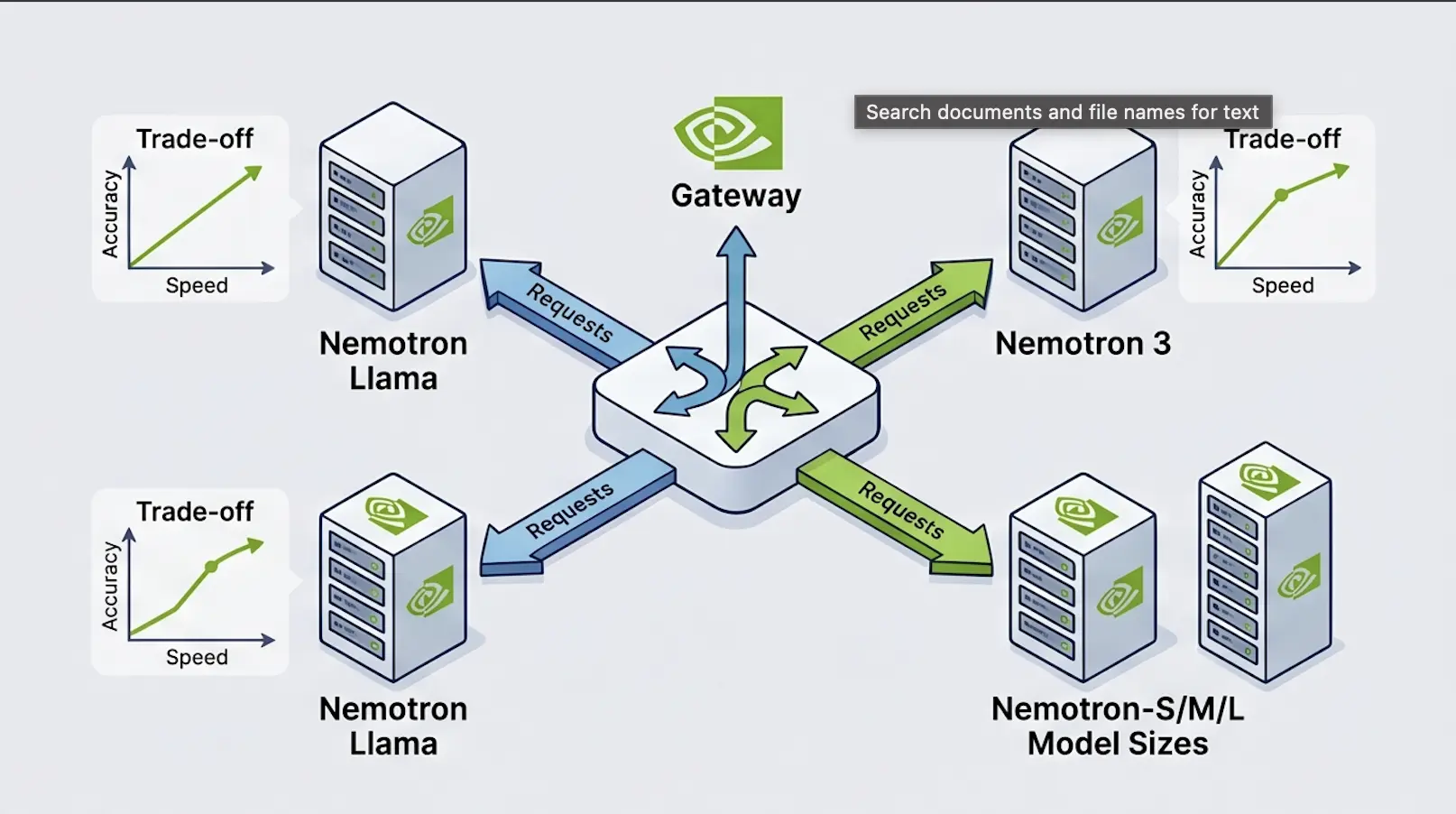
NVIDIA Nemotron is not one model. It is NVIDIA’s open model program for agentic AI: language models, model recipes, training data, deployment microservices, and optimization techniques aimed at making enterprise agents cheaper and easier to run on accelerated infrastructure.
That distinction matters because “Nemotron” now covers more than one lineage. There is the Llama Nemotron family, which NVIDIA describes as models derived from Meta’s Llama architecture and post-trained for reasoning, chat preferences, RAG, tool calling, and other agentic tasks. There is also the newer Nemotron 3 family, which NVIDIA describes as open models with hybrid Mamba-Transformer mixture-of-experts architecture, long context, and reasoning-budget controls.
In other words, Nemotron is NVIDIA’s bet that the next phase of enterprise AI will not be won by one giant closed model alone. It will be won by efficient, right-sized models that can be deployed, tuned, and routed as part of an agent system.
For teams building with an LLM gateway, that makes Nemotron interesting. It is not necessarily a drop-in replacement for Claude, GPT, Gemini, GLM, or Llama in every workload. It is another routing target with a very different cost, hosting, and governance shape.
This guide explains what Nemotron is, which variants NVIDIA has released, how the open/self-host path differs from API access, and when a gateway should route work to Nemotron instead of a closed frontier model.
For the broader model-selection landscape, see our coding LLM comparison and Best AI Coding Tools.
What Is Nemotron?
Nemotron is NVIDIA’s open AI model family and supporting ecosystem.
The simplest mental model is this:
- Llama Nemotron is the Llama-derived branch. NVIDIA starts with Meta Llama models, then post-trains and optimizes them for reasoning, instruction following, RAG, tool calling, coding, and math. NVIDIA’s Megatron Bridge docs list variants such as Nano, Super, 70B, and Ultra, with the Llama Nemotron family supporting context lengths up to 128K tokens.
- Nemotron 3 is NVIDIA’s newer native family. NVIDIA’s Nemotron 3 research page describes it as a Nano/Super/Ultra family of open models for agentic AI, using hybrid MoE, LatentMoE, multi-token prediction, NVFP4, long context up to 1M tokens, and inference-time reasoning budget control.
- NIM and NVIDIA AI Enterprise are the deployment path. NVIDIA makes these models available through build.nvidia.com, Hugging Face, and NIM microservices so enterprises can run them on accelerated infrastructure.
- Datasets and recipes are part of the pitch. NVIDIA has emphasized open data, post-training recipes, reinforcement-learning tooling, and agentic safety datasets as part of Nemotron, not just model checkpoints.
That is why Nemotron should be evaluated as both a model family and an infrastructure strategy. If your team already has NVIDIA GPUs, NeMo tooling, or an AI Enterprise procurement path, Nemotron is not just another Hugging Face model. It is a stack-aligned option.
Official NVIDIA sources worth checking before any production decision:
- NVIDIA’s January 2025 announcement of the Llama Nemotron and Cosmos Nemotron model families.
- NVIDIA’s March 2025 technical blog on Llama Nemotron reasoning models.
- NVIDIA’s Megatron Bridge documentation for supported Llama Nemotron variants.
- NVIDIA’s Nemotron 3 research page and Build/NIM model cards for current Nemotron 3 specifications.
Model details move quickly. Treat the table below as a map of the family, not as a substitute for pinning to the exact model card you deploy.
Nemotron Model Lineup
| Model line | Representative model | Parameters | Context window | Primary workload | License / access notes |
|---|---|---|---|---|---|
| Llama Nemotron Nano | Llama-3.1-Nemotron-Nano-4B / 8B | 4B / 8B | Up to 128K in the Llama Nemotron docs; NeMo Customizer entries may show smaller customization I/O limits | Edge, PC, efficient agents, customization | Built with Llama; NVIDIA model license plus applicable Llama terms depending on checkpoint |
| Llama Nemotron 70B | Llama-3.1-Nemotron-70B | 70B | Up to 128K | General reasoning, chat, RAG, tool calling | Open/downloadable model path; verify exact checkpoint terms |
| Llama Nemotron Super | Llama-3.3-Nemotron-Super-49B | 49B, NAS-optimized from 70B | 128K / 131,072 tokens on the model card | Reasoning, instruction following, coding, RAG, tool calling | NVIDIA Open Model License plus Llama 3.3 Community License terms |
| Llama Nemotron Ultra | Llama-3.1-Nemotron-Ultra-253B | 253B | Up to 128K | Large-scale reasoning | Open/downloadable model path; verify hardware and license terms before use |
| Nemotron 3 Nano | Nemotron 3 Nano 30B-A3B | 31.6B total, 3.2B active with embeddings | Up to 1M | Low-cost inference, software debugging, summarization, assistant workflows, retrieval | NVIDIA says weights, recipe, and redistributable data are released for Nano |
| Nemotron 3 Super | NVIDIA-Nemotron-3-Super-120B-A12B-BF16 | 120B total, 12B active | Long-context reasoning; check current model card for exact serving limits | Collaborative agents, high-volume workloads, tool use, RAG, IT-ticket automation | NVIDIA Nemotron Open Model License; available through Build/NIM and Hugging Face model card path |
| Nemotron 3 Ultra | Nemotron 3 Ultra | NVIDIA positions it as the largest model in the family | Up to 1M family target | Deep research, strategic planning, highest-accuracy reasoning | Track current release/model-card status before standardizing |
Two cautions:
- Context windows differ by source and deployment mode. The Llama Nemotron family docs describe up to 128K tokens. NeMo Customizer pages may show Max I/O Tokens for fine-tuning/customization workflows rather than full inference context. Nemotron 3 research material describes up to 1M context for the family. Always verify against the exact model card and serving endpoint you will use.
- License terms are checkpoint-specific. Some models are built with Llama and carry Llama community terms in addition to NVIDIA terms. The correct question is not “Is Nemotron open?” It is “Which Nemotron checkpoint are we deploying, under which terms, for which workload?”
NVIDIA’s Strategy: Open Models for Agent Systems
NVIDIA’s strategy is different from the closed-frontier-model strategy.
Closed model vendors optimize for the best API-served model experience: frontier reasoning, broad language capability, productized safety layers, managed capacity, and deep integration into their own cloud or developer ecosystem.
NVIDIA optimizes for a different stack:
- Models that run efficiently on NVIDIA hardware.
- Deployment through NIM microservices and NVIDIA AI Enterprise.
- Training and customization through NeMo tooling.
- Open weights, recipes, or datasets where NVIDIA has rights to release them.
- Agentic capabilities such as tool calling, RAG, instruction following, coding, math, long-context work, and safety evaluation.
That makes Nemotron especially relevant for enterprises that do not want all agent workloads to become a standing API bill to one closed vendor. If you already own GPU capacity, or if you need the ability to tune and operate models inside your own environment, Nemotron changes the economic equation.
It does not eliminate the need for closed models. It gives the gateway another tier.
Strengths and Weaknesses vs Other Model Cohorts
The right comparison is not “Nemotron vs everyone.” It is “which workload belongs on which cohort?”
| Cohort | Strengths | Weaknesses | Where Nemotron fits |
|---|---|---|---|
| Claude / GPT / Gemini closed models | Frontier general reasoning, mature APIs, strong managed safety and reliability, fast product iteration | Closed weights, limited self-hosting, vendor lock-in, list-price exposure at high volume | Nemotron can absorb repeatable agent workloads where self-host economics, customization, or deployment control matter more than absolute frontier quality |
| Base Llama derivatives | Broad open ecosystem, many fine-tunes, familiar tooling | Quality varies by checkpoint; enterprise support and deployment discipline are uneven | Llama Nemotron is a more enterprise-packaged Llama-derived option, optimized by NVIDIA for agentic tasks and NVIDIA infrastructure |
| GLM / other open-weight coding models | Sovereignty, permissive deployment patterns, strong cost control when self-hosted | Documentation and operational support can vary; quality is workload-specific | Nemotron competes on the same openness axis, but with stronger NVIDIA stack alignment and NIM deployment options |
| Specialist small models | Low latency, cheap routing for narrow tasks | Brittle outside their domain; usually need careful evaluation and fallback | Nemotron Nano / Nemotron 3 Nano can be candidates for narrow agent subtasks if your gateway has evals and fallback logic |
| Multimodal / vision-language cohorts | Perception, document/image/video understanding | Not every language workload needs multimodal capability | Cosmos Nemotron belongs here, but this article focuses on text LLM routing |
The biggest Nemotron advantage is not that it is always smarter. It is that it can be operationally closer to your enterprise stack. You can route more traffic through infrastructure you control, evaluate it with your own harness, and reserve closed frontier calls for the cases where they clearly win.
The biggest Nemotron risk is the same risk that applies to every open model: you inherit more operational responsibility. You need capacity planning, inference tuning, safety evaluation, upgrade management, and model-specific regression tests.
When To Route Workloads To Nemotron
An LLM gateway should make model selection explicit. Nemotron is a strong candidate when one of these conditions is true.
1. The workload is high volume and repeatable
High-volume internal tasks are often bad fits for premium closed models. Examples:
- Ticket classification.
- Support-agent summarization.
- RAG answer drafting over known knowledge bases.
- Tool-call planning for structured internal workflows.
- Routine code explanation or log summarization.
If the quality bar is measurable and the task repeats thousands of times, Nemotron becomes attractive because you can amortize infrastructure and tune the serving path.
2. The workload benefits from agentic post-training
NVIDIA positions Llama Nemotron for instruction following, RAG, tool calling, coding, math, chat, and reasoning. Those are exactly the building blocks behind agents. If your task is “read context, choose a tool, produce a structured answer, and explain the step,” Nemotron deserves a benchmark run.
Do not assume it wins. Put it in the gateway’s eval set next to the incumbent model and compare:
- Success rate.
- Tool-call validity.
- Hallucinated actions.
- Latency.
- Cost per completed task.
- Human rework rate.
3. You need self-host or cloud-controlled deployment
Some workloads are blocked from closed-model APIs because of data residency, customer commitments, regulated data, or internal policy. Nemotron gives teams a route to keep model execution closer to their own control plane.
This is where “open” is practically useful. It is not ideological. It means your security, platform, and compliance teams can reason about the model artifact, deployment location, logging, and network boundary.
4. You need a cheaper fallback tier
Nemotron can sit behind a policy such as:
- Route low-risk, high-volume summarization to Nemotron Nano.
- Route multi-agent workflow planning to Nemotron Super.
- Escalate ambiguous or high-risk tasks to a closed frontier model.
- Fall back to a second model if output confidence, schema validity, or eval score falls below threshold.
This keeps quality where it matters while reducing default spend.
5. You want to evaluate open model progress without changing application code
A gateway lets application teams call one normalized endpoint. Platform teams can swap model candidates behind the gateway, run shadow traffic, compare telemetry, and promote a Nemotron route only when the evidence supports it.
That is the right adoption path. Do not hand every app team a different model endpoint and hope governance survives.
When Not To Use Nemotron
Nemotron is not the right default for every task.
Avoid routing to Nemotron first when:
- You need the highest available frontier reasoning and have not proven Nemotron matches it on your workload.
- Your team lacks GPU operations, NIM, or managed inference capacity.
- You cannot maintain model-specific safety and regression evals.
- The task requires a provider feature only available in a closed platform.
- The workload is low-volume enough that self-hosting adds complexity without reducing meaningful cost.
- The legal team has not reviewed the exact model license and any inherited terms.
The mistake is to treat open weights as automatically cheaper or safer. They are only cheaper when utilization is high enough and operations are mature enough. They are only safer when governance is actually implemented.
Self-Host vs API Access
Nemotron can be consumed in more than one way.
Self-hosted or enterprise-controlled deployment
This is the path most people mean when they get excited about Nemotron. Download the model or deploy through NVIDIA’s enterprise stack, run inference on accelerated infrastructure, and integrate it into your gateway.
Benefits:
- Better control over data boundary and logging.
- Lower marginal cost at scale if GPU utilization is high.
- Ability to pin exact checkpoints and evaluate upgrades deliberately.
- Potential customization path through NeMo tooling.
Costs:
- GPU capacity planning.
- Serving optimization.
- Model-safety evaluation.
- Patch and upgrade management.
- On-call responsibility for inference incidents.
Hosted API / Build / NIM access
NVIDIA also exposes model access through build.nvidia.com and NIM microservice paths. This is usually the faster evaluation path. You can test Nemotron against your gateway harness before committing to self-host operations.
Benefits:
- Faster proof of concept.
- Less immediate infrastructure work.
- Easier model-card-driven experimentation.
Costs:
- Less control than self-hosting.
- Hosted pricing and availability constraints.
- Still requires license, data-handling, and retention review.
The pragmatic route is hosted evaluation first, then self-host only when the data, cost, or control case is strong.
A Gateway Routing Pattern For Nemotron
A mature gateway should treat Nemotron as one tier in a portfolio.
| Workload | First route | Escalation route | Gateway policy |
|---|---|---|---|
| Ticket classification | Nemotron Nano / small open model | Nemotron Super or closed model | Require schema-valid JSON and confidence threshold |
| RAG answer drafting | Nemotron Super | Claude / GPT / Gemini | Compare answer to retrieved evidence and block unsupported claims |
| Tool-call planning | Llama Nemotron Super or Nemotron 3 Super | Closed frontier model | Validate tool schema before execution |
| Code explanation | Nemotron Super | Coding-specialized closed model | Route by repo sensitivity and latency target |
| High-risk code generation | Closed frontier model or specialist coding route | Human review | Never execute changes without review gates |
| Regulated-data summarization | Self-hosted Nemotron | Human/manual fallback | Keep data inside approved boundary |
| Deep strategic reasoning | Nemotron 3 Ultra if available and validated | Frontier closed model | Require eval evidence before production route |
This is where Axiom’s LLM Gateway pattern becomes useful. The application should not know whether the response came from Nemotron, Claude, GPT, Gemini, GLM, or a specialist small model. The application should call the gateway. The gateway should enforce policy, capture telemetry, route by workload, and emit a normalized audit trail.
When model routing is only one part of a larger agent system, the Unified AI Gateway extends that pattern across MCP tools and A2A agent communication too. Nemotron can earn a seat in the model portfolio without forcing every team to rebuild routing, budget controls, or audit evidence in each application.
The gateway should also keep the model honest:
- Run route-level evals before rollout.
- Shadow new Nemotron checkpoints against production traffic.
- Track cost per completed task, not just token price.
- Compare latency at concurrency, not just single-request speed.
- Require output schemas for tool-use tasks.
- Escalate to a stronger model when risk or ambiguity crosses a threshold.
- Preserve model, prompt, tool, user, and trace metadata for audit.
That is how open models become enterprise infrastructure rather than side experiments.
The Practical Take
Nemotron is NVIDIA’s answer to a real enterprise problem: agents need more than one model, and not every call should go to a closed frontier API.
Llama Nemotron gives teams a Llama-derived, NVIDIA-optimized family for reasoning, RAG, tool calling, coding, math, and instruction following. Nemotron 3 pushes further into efficient open agent models, long context, hybrid MoE architecture, and reasoning-budget control. NIM and NVIDIA AI Enterprise provide the operational path for teams that want to run these models close to their infrastructure.
The right way to adopt Nemotron is not to declare it the winner. The right way is to put it behind a gateway, evaluate it on real workloads, and route the tasks where it wins on the combination of quality, latency, cost, data control, and governance.
Closed models will still matter. Open Llama-derived models will still matter. GLM and other open-weight coding models will still matter. Nemotron earns a seat in the routing table when your enterprise needs efficient agentic models that can live inside a more controlled NVIDIA-aligned stack.
The model market will keep moving. The gateway decision is what keeps the architecture stable.
If you are evaluating Nemotron alongside closed models and want routing, evals, and audit evidence in one place, request early access to see the gateway pattern on your own workloads.
Frequently Asked Questions
What is NVIDIA Nemotron?
Nemotron is NVIDIA's open model program for agentic AI, covering language models, model recipes, training data, deployment microservices, and optimization techniques. It includes the Llama-derived Llama Nemotron family and the newer native Nemotron 3 family.
What is the difference between Llama Nemotron and Nemotron 3?
Llama Nemotron models are derived from Meta Llama and post-trained by NVIDIA for reasoning, RAG, tool calling, coding, and math, with context lengths up to 128K tokens. Nemotron 3 is a Nano, Super, and Ultra family using hybrid Mamba-Transformer mixture-of-experts architecture, long context up to 1M tokens, and reasoning-budget control.
Are Nemotron models open source?
License terms are checkpoint-specific. Some models are built with Llama and carry Llama community terms in addition to NVIDIA terms, so teams should verify the exact checkpoint, its terms, and the intended workload before deployment.
When should a gateway route workloads to Nemotron?
Nemotron is a strong candidate for high-volume repeatable tasks, workloads that benefit from agentic post-training, self-hosted or cloud-controlled deployment, and cheaper fallback tiers. Ambiguous or high-risk tasks can still escalate to a closed frontier model.
Should you self-host Nemotron or use API access?
The pragmatic route is hosted evaluation first through build.nvidia.com or NIM, then self-hosting only when the data, cost, or control case is strong. Self-hosting brings more data and checkpoint control but adds GPU capacity planning, serving optimization, safety evaluation, and on-call responsibility.
Written by
AXIOM Team