Mellum2.1: When Does a Local Coding Agent Pay Off?
Compare the full cost of local and hosted coding agents, including GPU capacity, team time, failed fixes, review work, and data controls.
 Axiom Studio October 12, 2026 5 min read
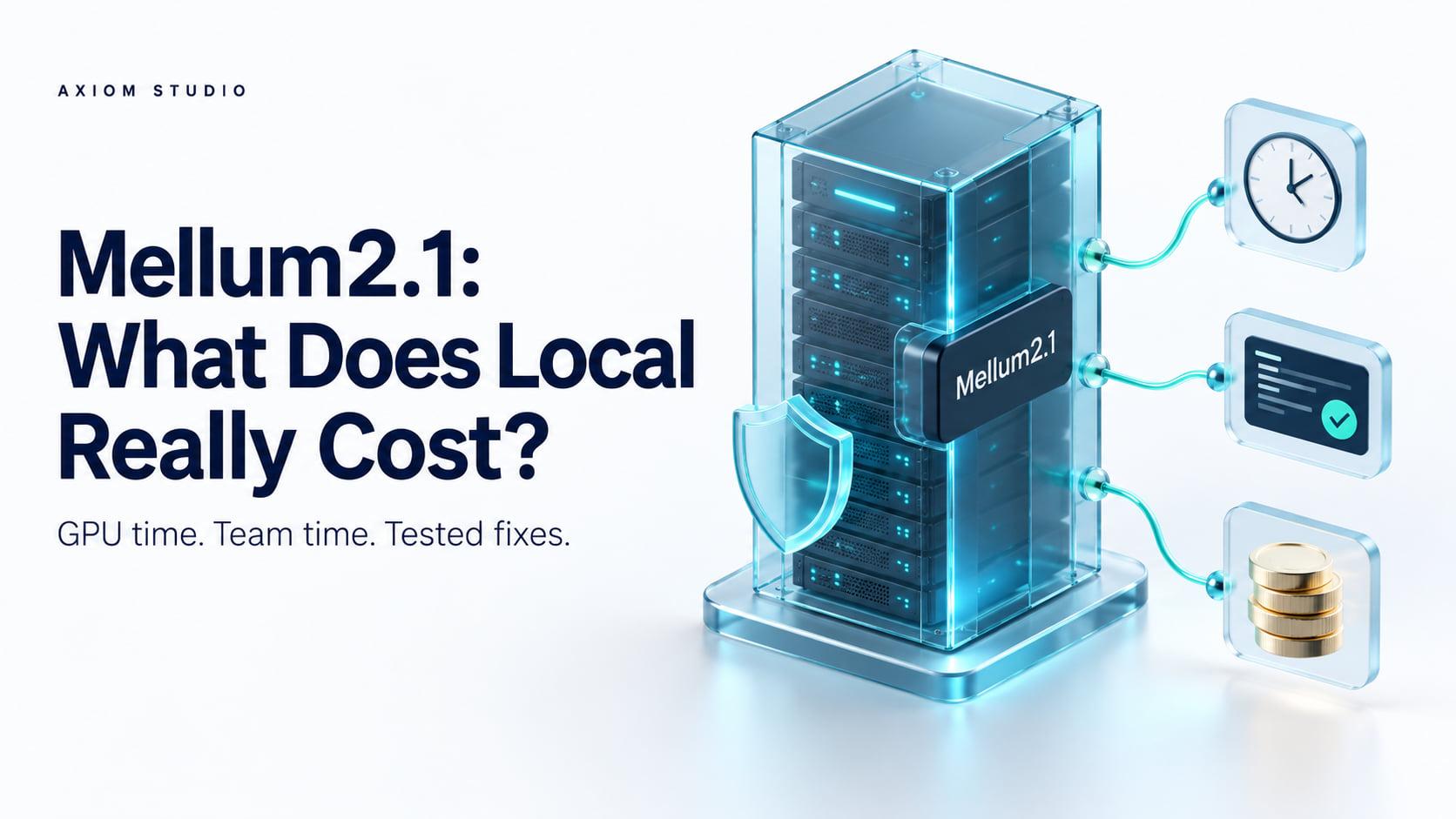
An open model can remove a model license bill. It does not remove the cost of running the service.
Someone still pays for the GPU, keeps it ready, fixes the setup, and checks the code. A quiet server can cost money even when no one sends it work.
Mellum2.1 gives platform teams a fresh reason to compare local coding agents with hosted APIs. The right test starts with the work your team needs done.
What Mellum2.1 offers
JetBrains released Mellum2.1 on October 8, 2026 for coding agents and smaller worker agents. It has 12 billion total parameters, with 2.5 billion active, and uses the Apache 2.0 license.
JetBrains describes tasks such as finding the cause of a failed test, drafting a fix, and checking it. The weights are available on Hugging Face. JetBrains now also lists GGUF files for local runtimes, though the launch post still says they are coming. The model card lists a 131,072-token context limit.
Read the JetBrains launch post before choosing a runtime. Check the current model files too. A model release does not mean every local tool supports it on day one.
Choose one job, then compare three routes
Start with a narrow task, such as fixing one kind of failed test in a private codebase. Use the same tests and review rules for each route.
Hosted API: the provider runs the model. Your team manages prompts, access, usage, and review. This can be a useful starting point for work that comes in bursts.
Local model: your team runs the model service. You gain control over where inference runs, but also own capacity, updates, uptime, and access.
Mixed route: local workers handle selected tasks. Approved hosted models handle other jobs. This adds a routing rule and another place to track costs.
These are design choices, not a ranking of model quality. A local setup may win for a steady workload. A hosted route may win when demand is low. A private-data rule may rule out a hosted route before cost enters the choice.
Use a break-even test with all the costs
Use this planning formula:
Monthly cost = fixed running costs + task costs + review and repair time.
Here is a made-up example. These figures are assumptions, not Mellum prices or measured results.
A local service costs $600 a month to keep ready. Staff work on updates and support adds $400. Each attempted task adds $0.02 in other costs.
A hosted route has no fixed charge in this example and costs $0.12 per attempted task. For now, assume both routes have the same pass rate and review time.
The local route has $1,000 in fixed costs. It saves $0.10 per task. It reaches break-even at 10,000 attempts a month.
At 2,000 attempts, local costs $1,040 and hosted costs $240. At 20,000 attempts, local costs $1,400 and hosted costs $2,400.
That result changes as soon as the assumptions change. Check whether one route needs more retries, longer reviews, or a paid backup service. Include those costs before making a choice.
Measure accepted fixes, not busy GPUs
A busy GPU is not proof that useful work is getting done. Count fixes that pass the agreed checks.
Suppose a trial costs $300 and produces 100 accepted fixes. Its cost per accepted fix is $3. If only 60 fixes pass, the same spend becomes $5 per accepted fix.
Keep failed attempts in the bill. Add review time for rejected patches too. Axiom’s AI operations guide can help frame who owns the service and how it is kept running.
Record the queue wait as well. A cheaper service that delays a release may be a poor fit for urgent tasks, even if it works well for overnight cleanup.
Local does not automatically mean private
The model may run on your server while an agent sends logs to another service. A tool may fetch a web page. A crash report may include file paths or snippets.
Map the full path of the data. Check the agent, tools, logs, backups, and network calls. Limit each worker to the files and actions its job needs.
Use fake secrets in a test workspace to check whether logs hide them. Do not use real credentials as test data. Axiom’s AI security guide covers controls to consider around the whole workflow.
For a bank’s internal code, the first pilot might use a cleaned copy of a test project. A factory software team might start with test generation away from live equipment. Choose a low-risk place to learn before granting wider access.
Run a one-week pilot
Pick a small set of recent tasks with known outcomes. Include easy fixes, unclear reports, and cases the agent should stop on.
Use the same tool access and time budget for each route where possible. Note any difference you cannot remove. A hosted model and a local model may need different prompts; record those changes.
Have a reviewer score each result without seeing which route made it. Track pass rate, serious errors, wait time, review minutes, and total cost.
Use AI observability to link each request to its task and final result. A pilot can guide a next step, but it cannot prove that rare failures will never happen.
Buy control with a clear owner
Choose a local route when it meets your data rules, quality bar, and full cost target. Choose a hosted route when it better fits your demand and staff time. Keep a mixed route only if the extra work is worth it.
For the steps around coding, explore VibeFlow, Axiom Studio’s workflow for AI agent teams. Confirm the model and deployment path you need before planning an integration.
A good local agent plan names an owner, a budget, a review rule, and a way to stop. The model is one part of that plan.
If your team is planning a coding agent pilot and wants review, cost, and ownership tracked in one workflow, request early access.
Frequently Asked Questions
What is Mellum2.1?
Mellum2.1 is an open model JetBrains released on October 8, 2026 for coding agents and smaller worker agents. It has 12 billion total parameters with 2.5 billion active, uses the Apache 2.0 license, and its model card lists a 131,072-token context limit.
When does a local coding agent become cheaper than a hosted API?
It depends on volume. In the post's made-up example, a local route with $1,000 in monthly fixed costs and $0.02 per task breaks even with a $0.12-per-task hosted route at 10,000 attempts a month; these figures are assumptions, not Mellum prices.
How should teams measure the cost of a coding agent?
Count accepted fixes, not busy GPUs. A $300 trial with 100 accepted fixes costs $3 per accepted fix, but only 60 passing fixes makes it $5, so keep failed attempts and review time for rejected patches in the bill.
Does running a coding model locally keep code private?
Not automatically. The agent may send logs to another service, a tool may fetch a web page, or a crash report may include file paths or snippets, so map the full data path including tools, logs, backups and network calls.
How do you run a fair pilot of local versus hosted coding agents?
Run a one-week pilot on recent tasks with known outcomes, give each route the same tool access and time budget where possible, and have a reviewer score results without knowing which route made them while tracking pass rate, serious errors, wait time, review minutes and total cost.
Written by
Axiom Studio