Hermes vs OpenClaw: Choosing the Right AI Orchestration Layer
Hermes and OpenClaw represent two distinct approaches to AI orchestration — a structured runtime vs a composable toolkit. A systems-design comparison and a guide to which fits your team.
 AXIOM Team May 18, 2026 6 min read
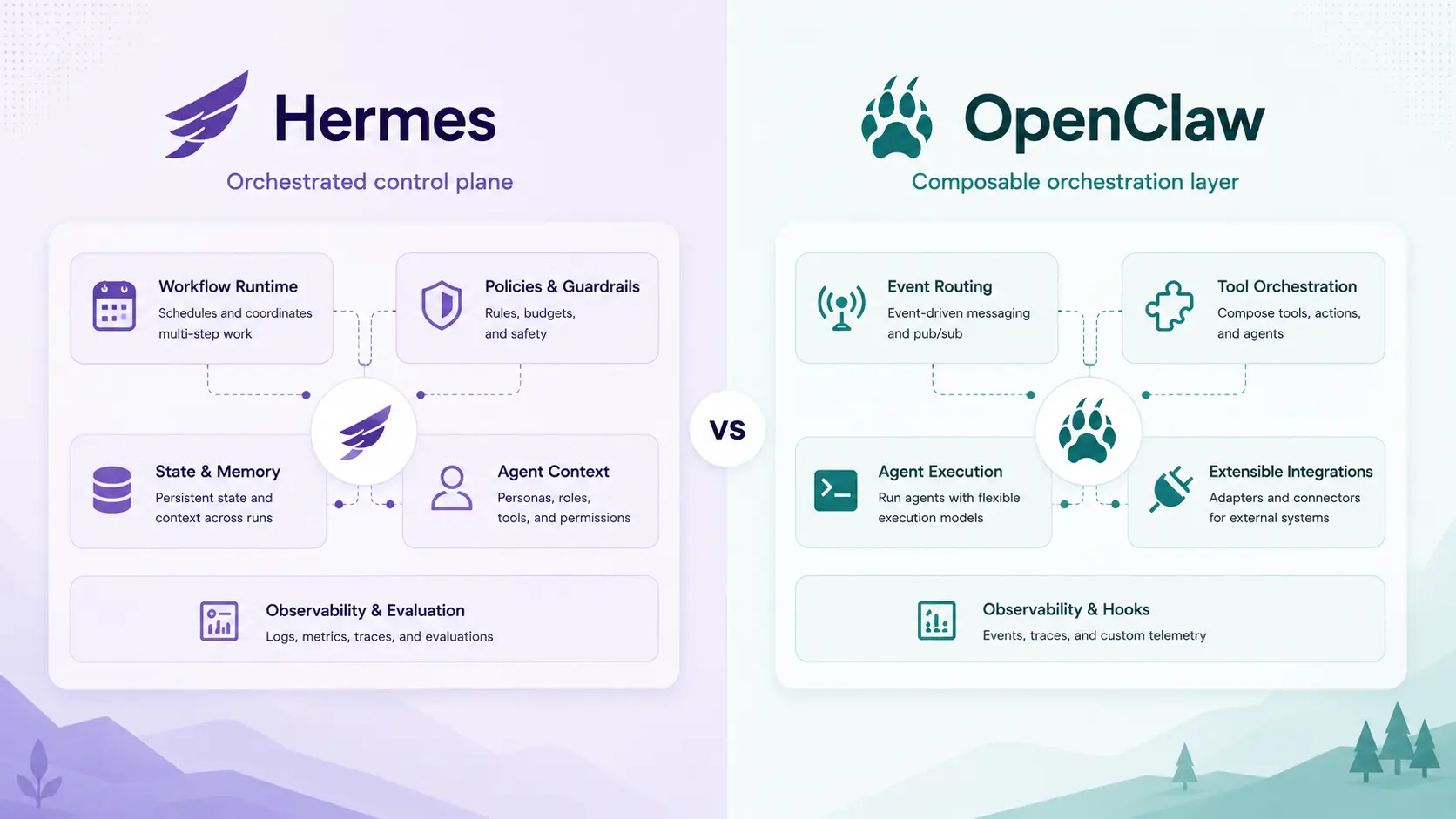
Modern AI systems are evolving from single-agent apps into distributed orchestration platforms. As teams scale beyond simple tool-calling workflows, orchestration frameworks become critical for reliability, observability, and long-running execution.
Two approaches that often come up in this space are Hermes and OpenClaw.
While both aim to coordinate AI-driven systems, they represent different philosophies:
- Hermes emphasizes structured orchestration, policies, and operational control.
- OpenClaw emphasizes composability, extensibility, and flexible execution.
This article compares the two at a systems-design level rather than a feature checklist.
The Core Difference
At a high level:
| Hermes | OpenClaw |
|---|---|
| Opinionated orchestration runtime | Composable orchestration layer |
| Strong workflow coordination | Flexible event-driven execution |
| Built-in policies and structure | Extensible integrations and adapters |
| Stateful operational control | Modular agent composition |
| Optimized for consistency | Optimized for flexibility |
Neither approach is universally “better.” The right choice depends on the shape of your system and the operational constraints of your team.
Hermes: Structured Orchestration
Hermes leans toward a centralized orchestration model.
The system is designed around:
- Workflow coordination
- State management
- Guardrails and policies
- Traceability
- Structured agent context
This style works especially well for:
- Enterprise workflows
- Long-running execution
- Compliance-heavy systems
- Multi-step deterministic pipelines
- Teams that value operational consistency
The major advantage is predictability.
Hermes-style orchestration tends to make:
- debugging easier,
- execution more traceable,
- and governance more enforceable.
The tradeoff is that highly opinionated orchestration can sometimes reduce flexibility for experimental or rapidly evolving systems.
OpenClaw: Composable Execution
OpenClaw takes a more modular approach.
Instead of tightly controlling orchestration, it focuses on:
- Event routing
- Tool orchestration
- Agent execution
- Extensible integrations
This architecture fits well when teams need:
- rapid experimentation,
- pluggable components,
- custom execution models,
- or heterogeneous agent systems.
The advantage is adaptability.
Teams can often move faster because components are loosely coupled and easier to swap or extend.
The tradeoff is operational complexity:
- observability may require more custom work,
- policies may be less centralized,
- and consistency can vary between implementations.
Architectural Philosophy
The biggest distinction is philosophical rather than technical.
Hermes optimizes for
- operational structure,
- governance,
- deterministic orchestration,
- and system-wide consistency.
OpenClaw optimizes for
- extensibility,
- composability,
- experimentation,
- and integration flexibility.
One behaves more like a managed runtime.
The other behaves more like a toolkit.
Comparing the Orchestration Models
Hermes Model
Hermes-style systems typically centralize:
- workflow execution,
- state propagation,
- evaluation,
- and policy enforcement.
This creates a unified operational layer where orchestration decisions are explicit and traceable.
That can be extremely valuable when:
- workflows become long-running,
- multiple agents interact,
- or production governance matters.
OpenClaw Model
OpenClaw-style systems tend to distribute orchestration responsibilities across composable components.
Rather than enforcing a strict runtime model, they provide:
- primitives,
- routing layers,
- adapters,
- and execution hooks.
This enables:
- rapid iteration,
- custom orchestration patterns,
- and flexible integrations.
The downside is that operational standards may need to be established by the engineering team instead of the framework itself.
Observability and Operations
Both systems recognize the importance of observability, but they approach it differently.
Hermes
Hermes tends to treat observability as part of the orchestration runtime itself:
- centralized tracing,
- policy visibility,
- workflow state,
- and execution history.
This can reduce operational ambiguity.
OpenClaw
OpenClaw often exposes observability primitives and hooks that teams integrate into their own telemetry stack.
That flexibility is powerful, especially for organizations with existing infrastructure, but may require more engineering effort to standardize. For teams who want a single audit-grade trace store across whichever orchestrator they pick, an LLM Gateway provides one normalized OTEL span per call regardless of which framework above it is making the request.
When Hermes Makes Sense
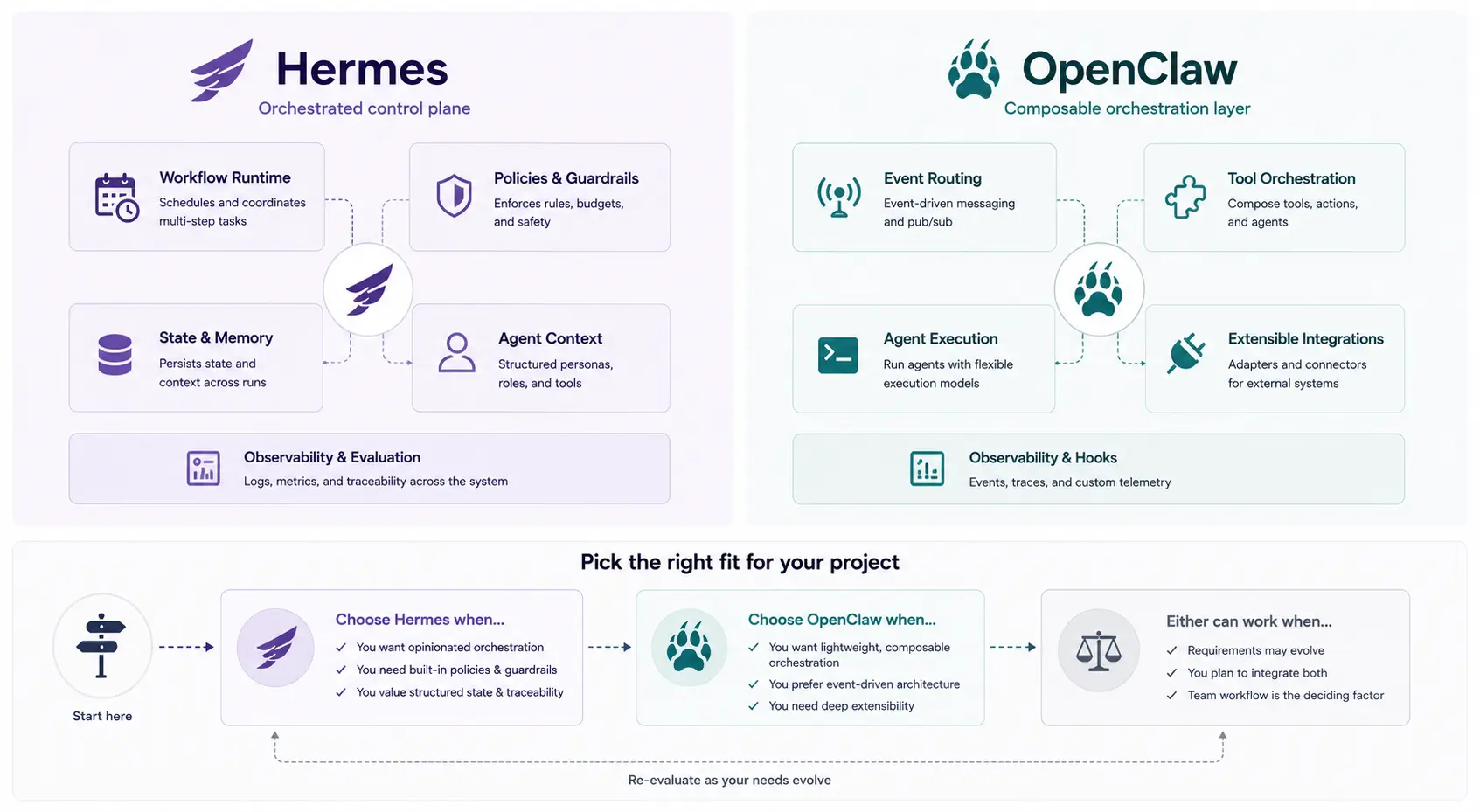
Choose Hermes when:
- workflows are long-running,
- execution needs governance,
- auditability matters,
- orchestration consistency is important,
- or operational traceability is a priority.
Typical environments:
- enterprise AI platforms,
- regulated systems,
- internal automation platforms,
- and multi-team orchestration environments.
When OpenClaw Makes Sense
Choose OpenClaw when:
- flexibility matters most,
- systems evolve rapidly,
- teams need composable execution,
- integrations change frequently,
- or experimentation velocity is critical.
Typical environments:
- startup platforms,
- research systems,
- modular agent ecosystems,
- and integration-heavy architectures.
The Real Decision
The choice between Hermes and OpenClaw is ultimately about operational philosophy.
If your priority is:
- structure,
- governance,
- repeatability,
- and centralized orchestration,
Hermes will likely feel more natural.
If your priority is:
- composability,
- modularity,
- flexibility,
- and rapid iteration,
OpenClaw may be the better fit.
In practice, many mature AI systems eventually incorporate ideas from both:
- structured orchestration where reliability matters,
- composable execution where flexibility matters.
The long-term trend is likely hybrid orchestration architectures rather than a single dominant model. That is the bet behind platforms like VibeFlow — a managed runtime for the work-item lifecycle that still lets teams compose their own evaluators, gateways, and integrations around it.
For teams evaluating Hermes or OpenClaw inside a broader platform, Axiom sits one layer above the runtime choice. AI Studio gives teams a place to declare and operate agent workflows, while the Unified AI Gateway governs model routes, MCP tool access, and A2A communication around those workflows. That keeps the orchestration decision portable: Hermes can be the structured runtime, OpenClaw can be the composable execution layer, and the enterprise still gets consistent routing, logs, costs, and approvals.
Final Thoughts
AI orchestration is quickly becoming infrastructure rather than application logic.
As systems become:
- multi-agent,
- stateful,
- event-driven,
- and operationally complex,
framework design choices increasingly affect:
- reliability,
- developer velocity,
- debugging,
- and governance.
Hermes and OpenClaw represent two distinct but valid approaches to that future.
The best choice depends less on features and more on how your team prefers to build and operate intelligent systems.
Written by
AXIOM Team