Agent Memory Architectures: Context Windows Are Not Enough
Production agents need more than a bigger prompt window. A field guide to the four memory layers — in-prompt, working, durable, organizational — and how each one composes with the LLM.
 AXIOM Team May 18, 2026 8 min read
Modern AI agents are no longer single-shot prompt systems.
As agents become:
- stateful,
- multi-step,
- collaborative,
- and long-running,
memory architecture becomes one of the most important system design decisions.
The challenge is not simply “adding memory.”
The challenge is deciding:
- what should persist,
- what should remain ephemeral,
- what should be injected into context,
- and what should stay outside the prompt entirely.
This article breaks agent memory into four practical layers used in modern AI systems.
The Four Layers of Agent Memory
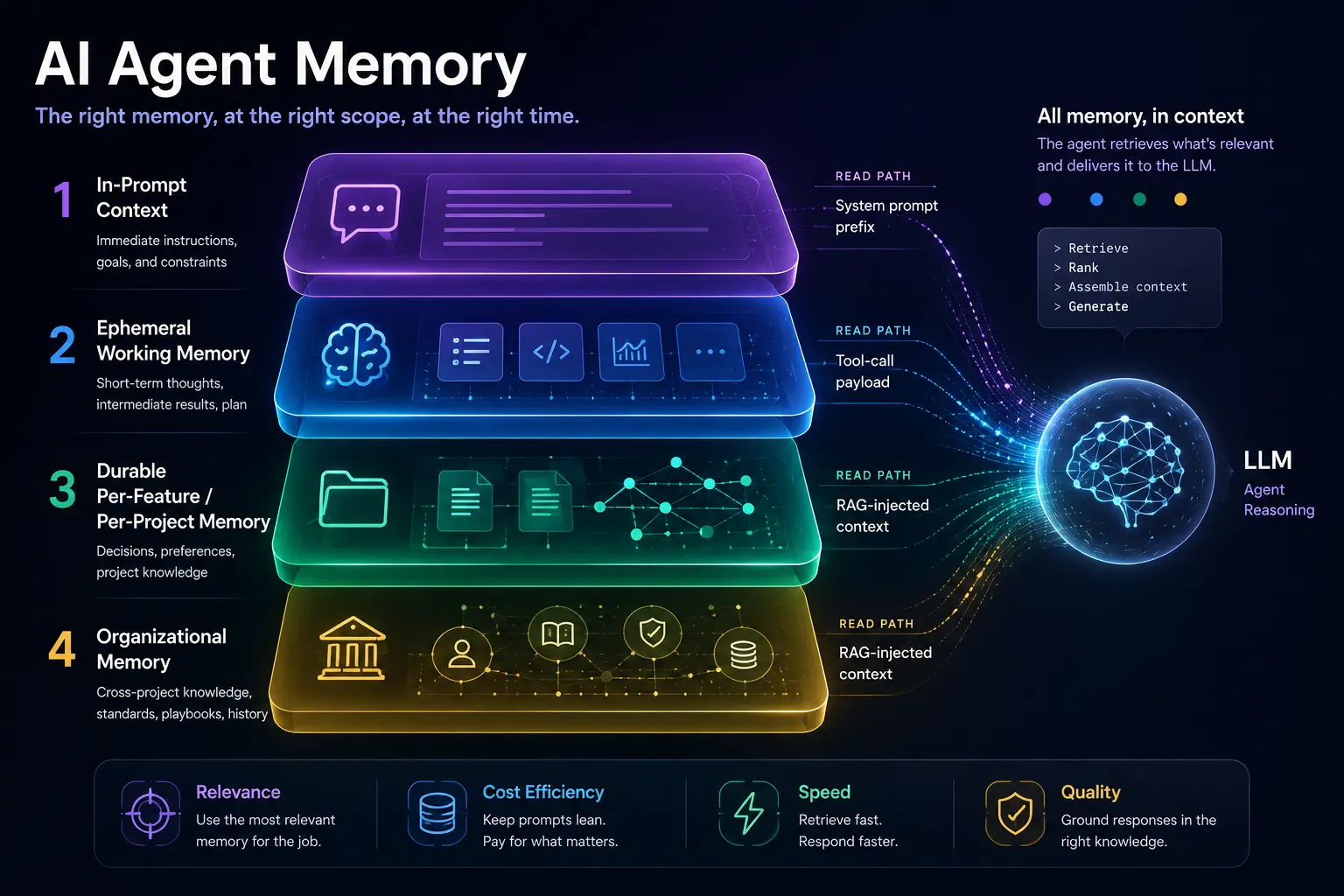
Most production-grade agent systems eventually evolve into four memory tiers:
- In-prompt context
- Ephemeral working memory
- Durable project or feature memory
- Organizational memory
Each layer optimizes for different tradeoffs:
- latency,
- quality,
- persistence,
- retrieval cost,
- and operational complexity.
The mistake many systems make is attempting to use a single memory mechanism for every problem.
That approach rarely scales.
Layer 1: In-Prompt Context
This is the simplest and most immediate form of memory.
It includes:
- the active conversation,
- current task instructions,
- temporary examples,
- and immediate reasoning context.
This memory is injected directly into the prompt window.
Typical read path:
- system prompt prefix,
- conversation history,
- or runtime prompt assembly.
Advantages
- Lowest latency
- Highest coherence
- Strong reasoning quality
- Immediate token availability
Limitations
- Expensive at scale
- Constrained by context windows
- Easily polluted
- Poor long-term persistence
In-prompt memory works best for:
- short-term reasoning,
- active task execution,
- and immediate conversational continuity.
Layer 2: Ephemeral Working Memory
Working memory sits outside the prompt but remains session-scoped.
This often includes:
- scratchpads,
- temporary state,
- active plans,
- tool outputs,
- execution traces,
- and short-lived summaries.
Unlike raw prompt context, working memory is dynamically fetched and assembled during execution.
Typical read path:
- tool-call payloads,
- execution middleware,
- runtime state injection.
Advantages
- Reduces prompt bloat
- Preserves execution state
- Improves multi-step workflows
- Enables agent planning loops
Limitations
- More orchestration complexity
- Requires synchronization
- Can drift from conversational context
This layer becomes essential once agents begin:
- tool chaining,
- long-running execution,
- or recursive planning.
Layer 3: Durable Project Memory
Durable memory introduces persistence beyond a single session.
This layer stores:
- project knowledge,
- user preferences,
- feature-level history,
- operational summaries,
- and reusable artifacts.
Typical implementations include:
- vector databases,
- structured stores,
- graph memory,
- or indexed document systems.
Typical read path:
- retrieval pipelines,
- RAG injection,
- semantic search.
Advantages
- Long-term continuity
- Persistent personalization
- Lower prompt costs
- Cross-session learning
Limitations
- Retrieval quality matters enormously
- Embedding drift can degrade relevance
- Poor ranking harms reasoning quality
- Increased infrastructure complexity
This is where most modern “memory-enabled” agents actually operate.
Layer 4: Organizational Memory
Organizational memory sits above individual users or projects.
This includes:
- institutional knowledge,
- shared workflows,
- policy systems,
- documentation,
- operational standards,
- and collective learning.
Rather than helping a single interaction, organizational memory helps entire systems behave consistently.
Typical read path:
- enterprise RAG,
- policy injection,
- organizational retrieval systems,
- centralized memory services.
Advantages
- Shared intelligence across teams
- Operational consistency
- Knowledge reuse
- Governance and policy alignment
Limitations
- Hardest layer to maintain
- Retrieval precision becomes critical
- Knowledge freshness matters
- Security boundaries become complex
This layer increasingly matters as agents become embedded into organizations rather than isolated applications — which is one of the bets behind VibeFlow: durable per-project and per-feature context that survives across sessions and personas, rather than treating each agent invocation as a fresh prompt.
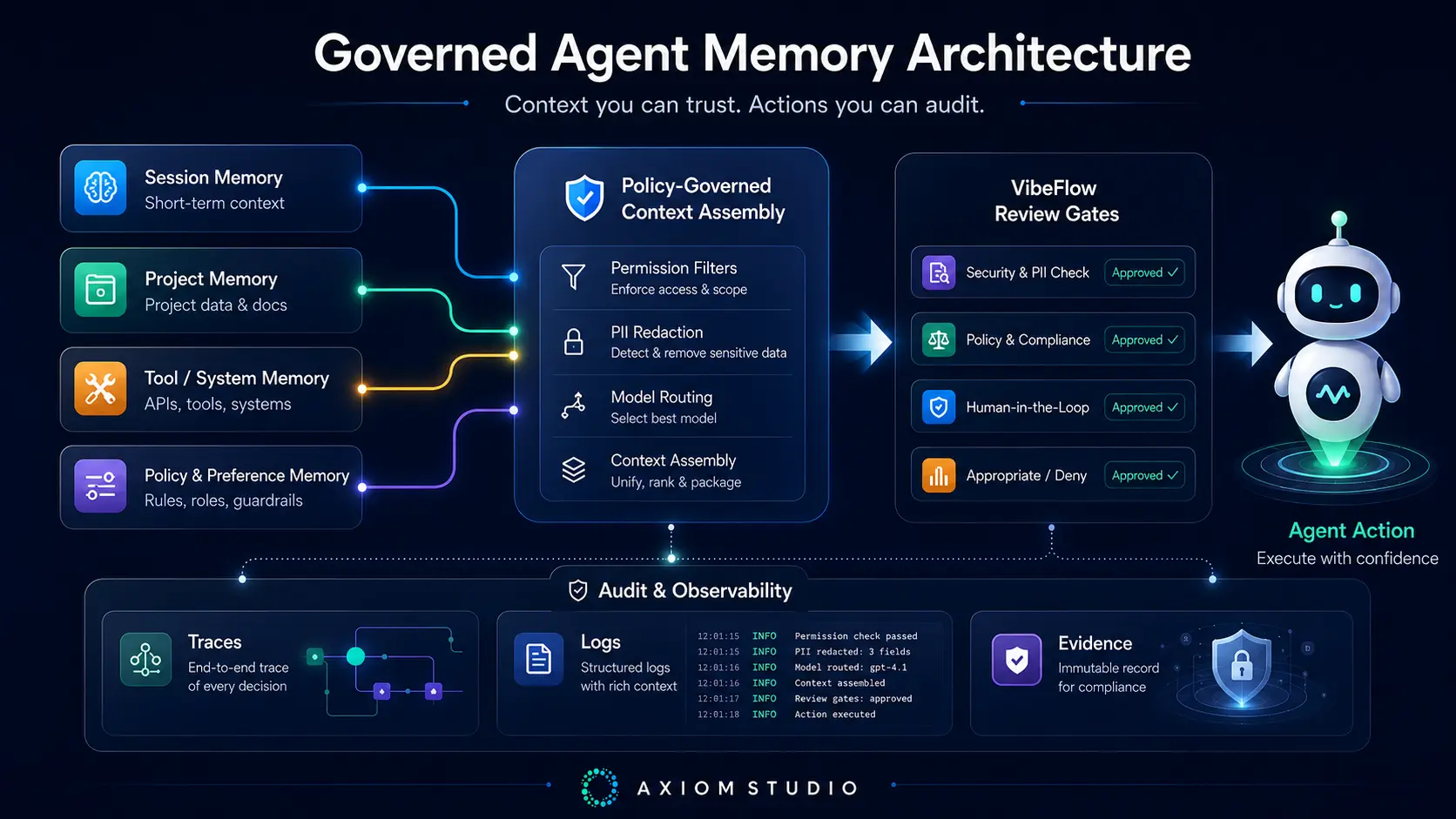
What Governed Agent Memory Looks Like in Production
In a prototype, memory is usually a convenience feature: store a summary, retrieve a few chunks, and hope the next model call uses them well. In production, memory becomes an operating boundary. The system has to know which context is allowed, which project it belongs to, who approved it, how stale it is, and whether the agent is using it to take an action that needs review.
That is why governed memory needs more than a vector database. It needs work-item context, role-specific handoffs, audit logs, and policy checks around every retrieval and write. A developer agent should not consume the same memory as a security reviewer without the boundary being explicit. A QA agent should be able to see the implementation evidence without inheriting the implementer’s assumptions. A platform team should be able to answer: what did the agent know, what did it retrieve, what did it do with that memory, and who approved the result?
This is the practical bridge between memory architecture and an enterprise AI platform. VibeFlow turns memory into part of the delivery workflow: requirements, implementation logs, security findings, QA verification, and commits are attached to the work item instead of disappearing into chat history. The Unified AI Gateway complements that by centralizing model access, routing, and policy enforcement, so the context an agent sees is governed at the infrastructure boundary as well as the workflow boundary.
Why Memory Layering Matters
Many early AI systems attempted to solve memory using only larger context windows.
That approach eventually breaks down because:
- context is expensive,
- retrieval quality degrades,
- latency increases,
- and reasoning becomes noisy.
Effective agent systems instead separate memory responsibilities.
For example:
| Memory Layer | Best For |
|---|---|
| In-prompt context | Immediate reasoning |
| Working memory | Active execution state |
| Durable memory | Cross-session continuity |
| Organizational memory | Shared institutional knowledge |
This separation creates cleaner orchestration boundaries and improves scalability.
The Real Tradeoff: Cost vs Quality vs Latency
Every memory layer introduces tradeoffs.
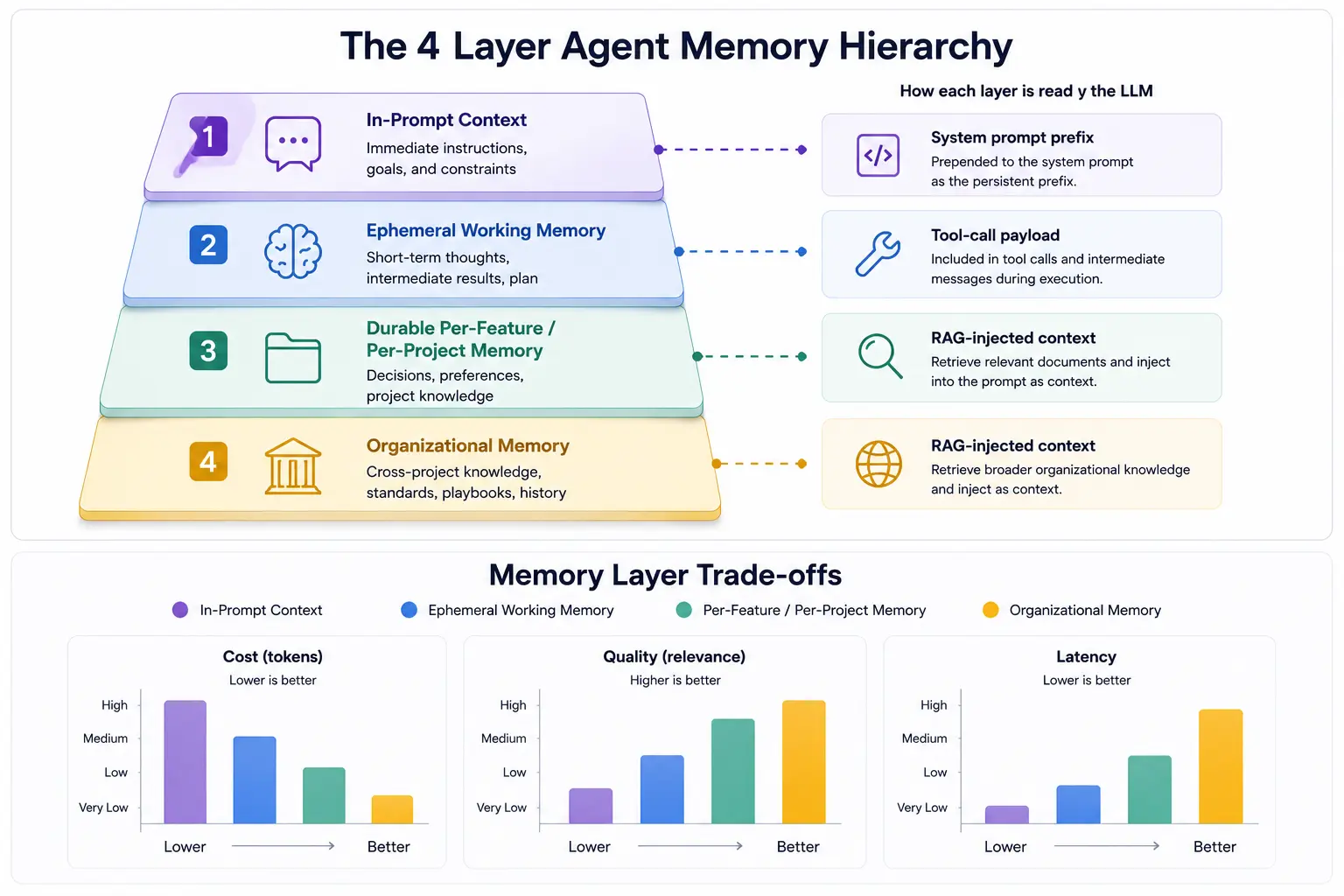
In-Prompt Context
- Highest reasoning quality
- Lowest retrieval latency
- Most expensive token-wise
Working Memory
- Fast operational state access
- Moderate orchestration overhead
- Better scalability than prompt stuffing
Durable Memory
- Lower token cost
- Better persistence
- Retrieval quality becomes critical
Organizational Memory
- Massive knowledge leverage
- Highest infrastructure complexity
- Most difficult ranking and governance problems
There is no universally optimal layer.
The right architecture depends on:
- workflow complexity,
- operational scale,
- cost tolerance,
- and retrieval quality requirements.
Emerging Architecture Patterns
Modern agent systems increasingly combine:
- short-term prompt memory,
- execution-scoped working memory,
- persistent retrieval systems,
- and organization-wide knowledge graphs.
This creates layered cognitive architectures rather than single-context agents.
The trend is moving toward:
- memory routers,
- adaptive retrieval,
- semantic caching,
- hierarchical summarization,
- and context budgeting systems.
In practice, the future of AI orchestration may look less like “chat history” and more like distributed operating systems for cognition.
For teams building that architecture, the LLM Gateway and MCP Gateway become part of the memory plane. The gateway layer controls which models receive which context, which tools can retrieve or mutate state, and how much the organization spends to move memory through the system.
Final Thoughts
Memory is rapidly becoming the core infrastructure problem in AI systems.
The hardest challenge is no longer generating text.
It is deciding:
- what the system should remember,
- when it should retrieve it,
- and how memory should influence reasoning.
The most effective agent systems will not rely on a single memory mechanism.
They will layer memory intentionally:
- immediate context for reasoning,
- working memory for execution,
- durable memory for continuity,
- and organizational memory for shared intelligence.
That layered approach is increasingly becoming the foundation of production-grade AI orchestration.
Related Reading
- Agent Workflows in Enterprise Software Development — shows how role-based agents pass work between planning, implementation, review, and verification instead of sharing one undifferentiated chat history.
- Building an AI Audit Trail from Model Selection to Production — explains the evidence chain needed when agent memory influences production decisions.
- Quality Gates for AI-Generated Code — maps the review gates that keep remembered context from turning into unreviewed output.
Ready to govern agent memory instead of just storing it? Explore VibeFlow for work-item memory, review gates, and audit trails, or request a demo to see how governed context works across an AI delivery workflow.
Written by
AXIOM Team