n8n vs Axiom AI Studio: Enterprise Workflow Comparison
A structured comparison for enterprise AI workflow buyers: where n8n is enough, where AI Studio governance matters, and how to combine both with an LLM gateway.
 AXIOM Team May 8, 2026 17 min read
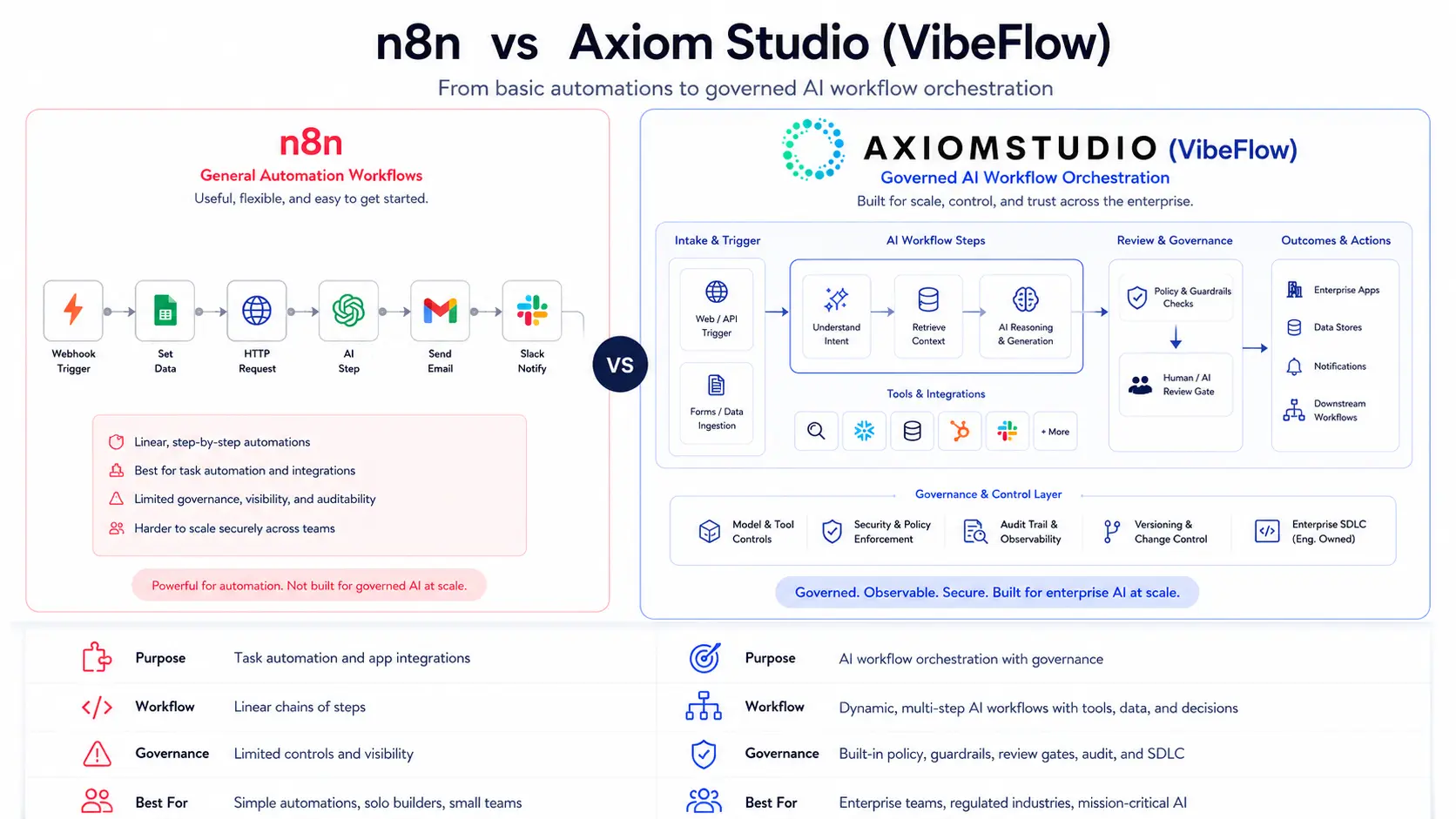
If you have a visual canvas, drag-and-drop nodes, and a workflow engine that runs the canvas, you might assume that two products in that category are interchangeable. Most of the time you would be wrong. The shape of what each platform optimizes for shows up the moment the demo ends and the production engineering starts — in versioning, observability, governance, and where the audit trail lives.
This post compares n8n and Axiom AI Studio along the axes that matter once an idea is past the prototype. We will not declare a universal winner because there is not one. There is, however, a real distinction in scope: n8n is workflow automation that grew an excellent AI surface; AI Studio is an AI agent platform that happens to do workflow automation as one capability among many. The right choice usually comes down to which axis — integration breadth or agent depth — is the dominant axis of your problem.
For background on n8n itself, n8n for AI: What It Is and Why It Suddenly Matters and the /learn/what-is-n8n explainer cover the platform in detail. For background on AI Studio, the /ai-studio product page walks through the agent builder, the visual canvas, and the CI/CD primitives.
The Short Version for Enterprise Buyers
If your team is asking “can we automate this internal business process quickly?”, n8n is usually the right first tool. It is fast, broad, self-hostable, and excellent at connecting SaaS systems, databases, queues, spreadsheets, and webhooks.
If your team is asking “can we run this AI agent in front of employees, customers, or regulated workflows and prove what happened?”, Axiom AI Studio is the stronger fit. It is built around governed agent execution: git-backed workflow versioning, model-call observability, prompt and output policies, gateway-mediated routing, deployment controls, and audit evidence.
The mature enterprise answer is often both. n8n handles integration breadth. AI Studio handles governed agent depth. The Axiom LLM Gateway and Unified AI Gateway sit in front of model traffic so both runtime paths share one policy, routing, cost, and audit layer.
What They Are, in One Paragraph Each
n8n is an open-source workflow automation platform built around a visual node-based canvas. It started in 2019 as a Zapier alternative and pivoted hard into AI orchestration during 2024-2025 with first-class LangChain integration, an AI Agent node, vector store nodes, and chat model nodes for every serious provider. It runs as a Node.js application; you self-host it or use n8n Cloud. The license is the Sustainable Use License (commonly called fair-code).
Axiom AI Studio is the agent-builder layer of the Axiom Studio platform. The same visual canvas idea, but every primitive is shaped for AI agents from the ground up: LLM nodes with provider-agnostic prompt schemas, vector store and retrieval nodes, MCP and A2A client nodes, Kubernetes action nodes, and built-in CI/CD with git-backed versioning, staged deployments, manual approval gates, and DORA metrics tracking. Workflows are treated as code, not as JSON in a database.
What the Buyer Is Actually Choosing
The procurement mistake is comparing screenshots of two canvases. The relevant comparison is the system of record around the canvas.
For workflow automation, the system of record is usually the workflow definition and its run history. That is enough when the workflow sends a Slack message, updates a CRM record, or moves data between SaaS apps.
For production AI agents, the system of record has to be deeper:
- Which model was called?
- Which prompt and retrieved context were used?
- Which tools was the agent allowed to call?
- Which policy checks ran before the response reached a user?
- Which version of the workflow was deployed?
- Who approved the deployment?
- What happened when the model call failed, timed out, or violated policy?
That is why n8n and AI Studio overlap on canvas UX but diverge on enterprise readiness. n8n starts from automation. AI Studio starts from governed agent operation.
Side-by-Side: The Honest Comparison
Twelve dimensions, no asterisks. Where one platform wins on a dimension, we say so plainly.
| Dimension | n8n | Axiom AI Studio |
|---|---|---|
| Origin | Workflow automation, since 2019 | AI agent platform, AI-native from day one |
| Best at | Connecting hundreds of SaaS apps, fast prototyping | Building governed agents, production AI workflows |
| Visual canvas | Mature, polished, large library of templates | Mature, agent-first node library |
| Connector breadth | Hundreds of SaaS integrations | Curated agent primitives (LLM, vector, MCP, K8s) |
| Agent depth | AI Agent node + LangChain primitives |
LLM, MCP, A2A, retriever, memory, K8s as first-class |
| Versioning | Workflow JSON in DB, optional git sync | Git-native, PR review, rollback, semantic diffs |
| Deployment | Docker, self-host, n8n Cloud, embedded | Kubernetes-native with built-in CI/CD |
| Observability | Workflow-level execution logs | Per-LLM-call traces, DORA metrics, cost attribution |
| Governance | Role-based access on workflows | Policy enforcement on prompts/outputs, audit trail per call |
| Compliance evidence | Reconstructed after the fact | Generated as a side-effect of execution |
| License | Sustainable Use (fair-code) | Commercial |
| Pricing model | Free self-host, paid Cloud | Commercial; see vendor page |
Two patterns emerge from the table. n8n wins anywhere the dominant constraint is “reach the long tail of SaaS apps.” AI Studio wins anywhere the dominant constraint is “produce evidence that an agent did the right thing for the right reason.” A surprisingly large number of enterprise AI programs need both, which is why the coexistence pattern at the end of this post exists.
Enterprise Evaluation Criteria
Use these questions before choosing a starting platform:
- Is the workflow mostly deterministic? If the workflow is trigger, transform, route, notify, and update, n8n is usually enough.
- Does the workflow expose an LLM to a user or customer? If yes, model-call observability, policy enforcement, and response auditability become first-order requirements.
- Does the agent call sensitive tools? If an agent can query customer data, update production systems, or send external messages, tool authorization has to be explicit.
- Does the workflow need release discipline? If prompt changes require PR review, staged deploys, rollback, and environment promotion, AI Studio fits better.
- Will compliance ask for evidence? If the answer is yes, decide where prompt, response, context, cost, user, and policy evidence will live before the first workflow ships.
- How many SaaS connectors are required? If the answer is dozens, n8n should probably stay in the architecture even if AI Studio owns the governed agent surface.
The right answer is not ideological. It is operational. Put each platform on the axis where it is strongest.
Same Workflow, Different Solutions
The clearest way to feel the difference is to look at how each platform implements the same task. Imagine you are building a RAG-backed support assistant: a Slack message asks a question, the assistant retrieves from a vector index of internal docs, an LLM answers with citations, the answer goes back to Slack.
---
title: n8n
---
flowchart LR
    A[Slack Trigger] --> B[Format Query]
    B --> C[AI Agent]
    C --> D[Vector Retriever]
    D -.-> E[(Pinecone)]
    C --> F[OpenAI Chat Model]
    C --> G[Format Citation]
    G --> H[Slack Reply]
---
title: Axiom AI Studio
---
flowchart LR
A[Slack Trigger] --> B[LLM Gateway Call]
B --> C[Retriever Node]
C -.-> D[(Pgvector)]
B --> E[Policy Gate]
E --> F[Citation Builder]
F --> G[Slack Reply]
H[/Audit log/] -.->|each step| B
H -.->|each step| C
H -.->|each step| EBoth diagrams describe the same product behavior. The structure is different in two specific places.
In the n8n version, the AI Agent node owns the orchestration: it decides when to call the retriever, when to call the chat model, and how to assemble the response. That is fast to build. It also means the audit trail you get at the end of the run is workflow-shaped — you can see the workflow ran, but the per-call evidence (which chunks were retrieved, what prompt the model saw, what response it produced) lives inside the agent node's opaque output.
In the AI Studio version, the LLM call goes through a gateway node that emits a normalized OpenTelemetry span for every model call, retrieval is a separate first-class node with its own logged inputs and outputs, and a policy gate runs between retrieval and final response. The audit log is not an afterthought of the workflow — it is a parallel artifact produced as a side-effect of every step. That is slower to build the first time. It is also what compliance reviewers ask for.
Neither approach is wrong. The first is the right shape for “is this idea worth pursuing?” The second is the right shape for “does this run in front of regulated users?”
Where n8n Genuinely Wins
Connector breadth. When the AI part of an idea needs to read from Salesforce, write to Notion, post to Slack, file a Jira ticket, and update a spreadsheet, the hard part is rarely the LLM call — it is the SaaS plumbing around it. n8n turns that plumbing into a few node configurations because hundreds of SaaS connectors already exist. AI Studio focuses its node library on agent primitives; for breadth-of-SaaS work, you would either bridge over n8n or write HTTP nodes by hand.
Speed to first prototype. A working RAG demo over your docs is a 30-minute exercise on n8n once credentials are configured. AI Studio is faster than hand-rolled code, but the “30 minutes to a Slack demo” experience is n8n's sweet spot. If you are validating an idea before investing in production engineering, n8n is the right floor.
Open-source self-hosting. n8n is genuinely operable as a self-hosted system. Real Docker image, real Kubernetes Helm chart, real queue-mode for horizontal scaling. AI Studio is also self-hostable but is a commercial product; for teams whose first constraint is “must be open-source under our control,” n8n is the better fit.
Where Axiom AI Studio Genuinely Wins
Versioning as code, not as DB rows. AI Studio workflows live in your git repository. PR reviews on prompt changes; semantic diffs that show what changed in a workflow between versions; rollback by reverting a commit. That is the SDLC discipline production AI needs and is the area where general-purpose automation tools, n8n included, are weakest.
LLM-call-level observability. Every LLM call produced by an AI Studio workflow flows through the LLM Gateway and emits a normalized OpenTelemetry span with gen_ai.* attributes. Token counts, latency, cost, model, prompt, response — all queryable in one trace store. Across all workflows, all teams, all providers. n8n records that a workflow ran; AI Studio records what every model call inside it did.
Policy enforcement at the call boundary. AI Studio runs prompt-and-output policies on every LLM call: PII redaction before the prompt leaves your network, content filtering before responses reach users, allowlists on which tools an agent can call. Those policies are configured declaratively, not embedded in workflow logic. n8n can do equivalents with Code nodes and external services, but the platform itself does not opinionate on them.
Audit-grade compliance evidence. SOC 2 CC7.2, ISO 27001 A.12.4, and EU AI Act technical documentation all expect model-call-level evidence, not workflow-level rollups. AI Studio produces that evidence as a side-effect of execution. With n8n, you build it.
Kubernetes-native deployment with CI/CD. Workflows deploy through your Kubernetes pipeline with staged environments, manual approval gates for production, and automatic rollback on failure. DORA metrics — deployment frequency, change failure rate, lead time, MTTR — are tracked automatically. For platform teams treating AI workflows as production software, this is the daylight.
Governance, Auditability, and Model Controls
The governance split is the most important part of this comparison.
n8n can participate in governed AI workflows, but its native abstraction is the workflow run. You can see that a workflow executed, inspect node output, and build logging around it. For many internal automations, that is enough.
AI Studio is designed for the model-call and agent-action layer. The platform treats each LLM call, retrieval step, policy decision, tool call, and deployment transition as evidence. That matters when teams need to answer questions such as:
- Which model answered this customer?
- Which retrieval chunks influenced the response?
- Did PII redaction run before the prompt left the network?
- Which tool calls were allowed or blocked?
- Which workflow version was live at the time?
- Which approval gate allowed this version into production?
That is also where the gateway layer matters. The Unified AI Gateway provides the control plane around model routing, MCP tool access, agent-to-agent communication, observability, and cost management. The LLM Gateway is the model-call layer that can normalize traces and enforce policies even when the workflow runtime is n8n.
In practice, this means n8n can stay valuable without becoming the governance platform. Route n8n model calls through the gateway, and use AI Studio for the workflows where the agent behavior itself has to be governed, versioned, and deployed like software.
Routing, Model Choice, and Tool Control
Enterprise AI workflows rarely stay on one model or one provider. Teams start with one OpenAI or Anthropic node, then quickly need provider fallback, cheaper models for low-risk tasks, higher-quality models for reasoning, self-hosted models for sensitive data, and per-team quotas so a runaway workflow does not become a finance incident.
n8n can call many model providers. The harder question is whether every workflow follows the same routing and policy rules. If each workflow stores provider credentials and routing choices locally, governance spreads across dozens of canvases.
AI Studio and the gateway layer centralize those decisions:
- Model routing policies can live outside the workflow.
- Fallback chains can be configured without rewriting every agent.
- Token cost can be attributed across teams and workflows.
- Prompt and output filters can run at the call boundary.
- MCP and A2A tool access can be scoped by agent, user, team, or environment.
That distinction is why a workflow can start in n8n and still benefit from Axiom infrastructure. The runtime can be n8n; the model governance layer can be the gateway.
Enterprise Production Readiness Checklist
Before putting either platform in front of real users, walk through this checklist:
- Workflow ownership: One team owns the workflow, its credentials, its deployment path, and its failure modes.
- Version control: Prompt, retrieval, tool, and policy changes are reviewable before production.
- Model routing: Provider choice, fallback, quotas, and cost attribution are centrally governed.
- Tool authorization: Agents can only call tools appropriate for the user, tenant, and environment.
- Audit evidence: Prompts, responses, retrieved context, model IDs, token usage, policy decisions, and tool calls are queryable.
- Incident path: There is a clear rollback or disable path when an agent behaves incorrectly.
- Human approval: High-risk actions have approval gates before external effects happen.
- Monitoring: Latency, errors, cost, output quality, and policy violations are visible in one place.
n8n can satisfy pieces of this checklist with additional engineering. AI Studio and the gateway layer are designed so more of the checklist is native.
A Decision Framework
Most teams over-think this. The choice is rarely binary, but if you have to pick one starting point, the question to ask first is whether your workload is dominated by integration breadth or agent depth.
flowchart TD
    A[New AI workflow?] --> B{Dominant axis?}
    B -->|Integration breadth| C{Regulated users?}
    B -->|Agent depth and governance| D[Axiom AI Studio]
    C -->|No| E[n8n]
    C -->|Yes| F[n8n + LLM Gateway in front]
    D --> G{Need 50+ SaaS connectors?}
    G -->|No| H[AI Studio only]
    G -->|Yes| I[AI Studio + n8n bridge]
Use the decision tree as a starting point, not a verdict. The points below frame the trade-offs we see most often:
- Use n8n if your dominant constraint is “wire AI into a long tail of SaaS apps,” you are still validating the use case, and the audience is internal or non-regulated.
- Use AI Studio if your dominant constraint is “ship a governed agent that runs in front of paying or regulated users,” you need git-native versioning and call-level observability, and the workload is bounded enough that hundreds of SaaS connectors are not the differentiator.
- Use both if the program is mature: n8n for the operational integration backbone, AI Studio for the agent surface that needs governance, with webhook calls between them. This is the pattern most enterprise AI programs converge on.
The Coexistence Pattern
The two platforms talk over HTTP. n8n exposes any workflow as a webhook; AI Studio exposes any agent as an endpoint. That single primitive lets you treat each platform as a service the other consumes.
The shape that works in practice: n8n stays in charge of the SaaS plumbing — the integrations, the data sync, the “a deal moved to Closed Won, kick off seven follow-up actions” logic. AI Studio stays in charge of the agent surface — the customer-facing assistant, the policy-gated tool calls, the workflows that need an audit trail. Where they meet, n8n calls AI Studio agents over HTTP for the AI-heavy steps, and AI Studio calls n8n workflows over HTTP for the integration-heavy steps. Each platform owns the part of the stack it is good at.
For the audit story, run all model traffic from both platforms through the Axiom LLM Gateway. One environment-variable change on n8n's chat model nodes points them at the gateway URL instead of the provider URL, and every prompt-and-response from every n8n workflow lands in the same OpenTelemetry trace store as the AI Studio activity. The audit trail is unified even though the runtimes are not.
The deeper version of this pattern is an enterprise AI operating model:
- n8n owns integration-heavy background automation.
- AI Studio owns governed agent workflows.
- VibeFlow governs SDLC changes to the agents and workflows that need engineering review.
- The Unified AI Gateway owns model, tool, agent communication, policy, observability, and cost controls.
That model lets teams adopt n8n without pretending it is a compliance platform, and adopt AI Studio without recreating every SaaS connector n8n already handles well.
The Take
n8n and AI Studio are not the same product, and the people who position them as substitutes are usually selling one of them. n8n is the right floor for AI prototyping and integration plumbing. AI Studio is the right ceiling for governed AI agents that need to satisfy a real audit. The interesting question is not which one to pick — it is how to structure your AI program so each one does what it is best at.
Pick n8n for breadth. Pick AI Studio for depth. Pick both when the program is real. And whichever path you start on, route the model traffic through a gateway from day one — because by the time compliance asks, the cheapest evidence is the evidence you have been collecting all along.
For a product-level walkthrough, start with AI Studio, the Unified AI Gateway, and the LLM Gateway. For the broader n8n background, read n8n for AI and the /learn/what-is-n8n explainer. If your team is deciding where the governance line belongs, request a demo with one real workflow and one real audit question.
Written by
AXIOM Team