
Connected

Planning
Jira
Turn tickets into tracked work items that agents can claim and complete.
A full AI engineering team — developer, architect, PM, QA, security, and DevOps — that shares context, remembers decisions, and ships code autonomously. This isn't autocomplete. It's an AI team that knows your codebase.
The VibeFlow Difference
How governed AI agent teams compare with traditional coding and unmanaged vibecoding across the three dimensions that matter most.
Visual 1 · Velocity
Traditional coding
1X
Human-written baseline
Vanilla vibecoding
5–8X
AI-assisted, ad-hoc
VibeFlow vibecoding
60X
Governed agent teams
Visual 2 · Security
0%
Traditional coding
Caught post-release, in production
0%
Vanilla vibecoding
No security review in the loop
100%
VibeFlow vibecoding
Every change scanned before merge
Visual 3 · Quality
QA run on every code change
Automated unit tests
Automated post-commit QA
AI code review before merge
Shared context memory
One governed pipeline. Every feature flows through planning, implementation, testing, security review, and QA — all autonomous, all auditable.
Real projects. Real AI teams. Production code shipped autonomously.
 Customer Story
VibeFlow has fundamentally changed how I build software. It allows me to code from anywhere, even directly from my mobile phone, which makes it incredibly convenient to capture ideas and implement changes on the go.
Bring planning, documentation, source control, and design into one governed delivery loop. VibeFlow works from the systems your team already trusts instead of forcing copy-paste handoffs between tabs.
Keep Jira, Confluence, Bitbucket, GitHub, and Figma connected to the same autonomous workflow instead of treating them as isolated reference points.
Planning, knowledge, repos, and design
Planning
Jira
Turn tickets into tracked work items that agents can claim and complete.

Knowledge
Confluence
Pull in specs, requirements, and architectural decisions before execution starts.

Source Control
Bitbucket
Keep branch workflows, pull requests, and delivery history visible inside the loop.

Engineering
GitHub
Link issues, PRs, and commit trails so every change stays auditable.

Design
Figma
Ground implementation in real designs instead of letting agents guess the UI.
Every session starts from scratch. Agents forget what they learned, step on each other's work, and burn tokens re-discovering context that should have been persisted.
Agents start fresh every session. Architecture decisions, file conventions, and past failures are gone — forcing you to re-explain everything.
Multiple agents step on each other's work. No locking, no claiming, no awareness of what other sessions are doing.
You manually tell agents what to do every time. There is no structured backlog, no priority ordering, and no autonomous task discovery.
Agents ignore your design system, invent their own conventions, and produce inconsistent code because specs live outside their context window.
No trace from requirement to implementation. You cannot see which agent changed what, when, or why — making debugging a guessing game.
40-50% of tokens are spent on repeated context. Every session re-reads the same files, re-discovers the same patterns, and re-learns the same conventions.
Go from manual, session-by-session AI coding to fully autonomous, context-aware development with persistent memory.
VibeFlow gives you a full team of AI specialists — a developer, architect, product manager, QA engineer, security lead, and DevOps engineer — all sharing context and working together on your project.

Your workhorse. Give Alex a feature spec, a bug report, or a todo — and get back working code with tests, committed to a clean branch.

Thinks about the why before the what. Creates PRDs, writes strategies, defines requirements, and ensures the team builds the right thing.

Looks at the big picture. Designs systems, data models, API contracts, and catches design flaws before they become expensive refactors.

Thinks about everything that can go wrong — and writes tests to prove it won't. Ensures the code your team ships actually works.

Scans every change for security issues — injection vulnerabilities, auth gaps, data exposure risks, and compliance violations.

The voice of the customer inside every sprint. Casey maps user needs to product decisions and ensures every feature delivers real customer value.

Handles the last mile — getting code from a branch to production safely. Deployment configs, CI/CD pipelines, and operational monitoring.

Designs the user experience before code is written. Dana creates wireframes, defines interaction patterns, and ensures every interface is intuitive and accessible.
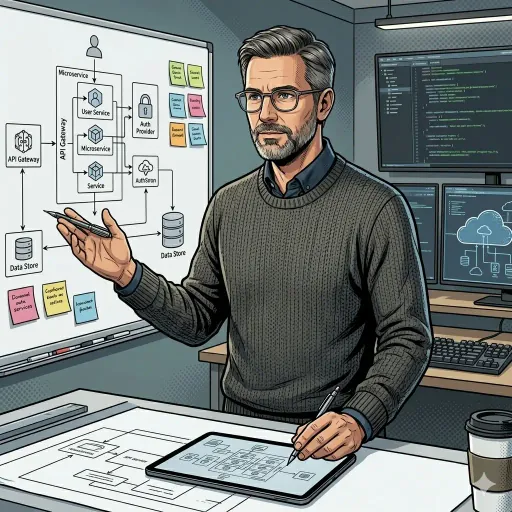
The technical strategist. Kai reviews architecture decisions, mentors the AI team, resolves complex cross-cutting concerns, and ensures technical excellence across the codebase.
Not a giant context dump. VibeFlow organizes knowledge at four levels — project, feature, todo, and issue — so agents load only what's relevant to the task at hand. The result: faster execution, fewer tokens, zero hallucination from stale context.
When Alex works on Todo #247, VibeFlow loads the project architecture, the parent feature's gotchas, and the todo's attached design doc — nothing more. Precision retrieval means fewer tokens, faster execution, and zero noise from unrelated context.
"It's like having a team that's been working on your project for a year, from day one. They know the codebase, they know the patterns, and they never forget a lesson learned."
VibeFlow connects your codebase, project knowledge, and issue tracker into a living knowledge graph — then deploys a full team of specialized AI agents that plan, build, review, and verify autonomously.
Seven integrated capabilities that turn AI coding agents from powerful-but-chaotic into reliable, autonomous implementers.
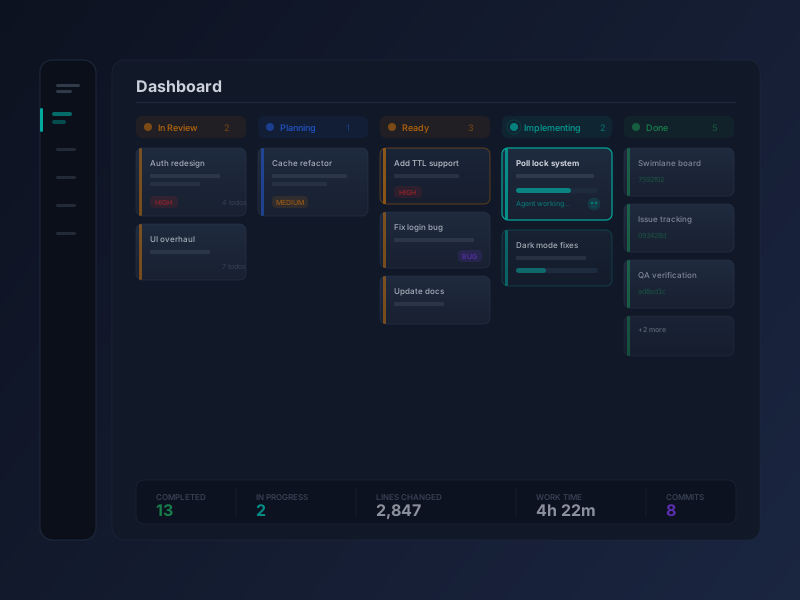
A drag-and-drop swimlane board that gives humans full visibility into project status. Features flow through a defined lifecycle — from planning to done — with real-time status updates and progress tracking.
Ready to replace isolated coding sessions with a governed AI engineering team?
Get Started for FREEFive steps from a feature request to a verified git commit. Humans plan, agents execute, VibeFlow orchestrates.
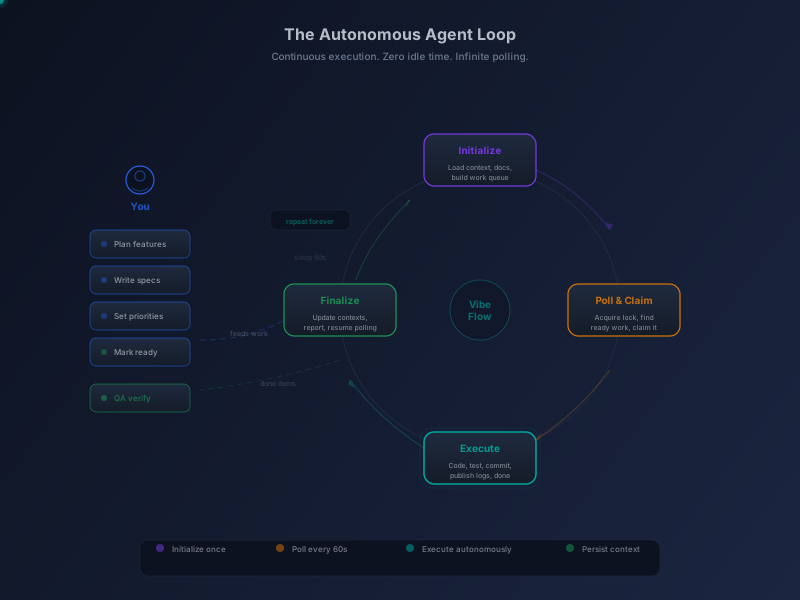
Define features, write specs, attach design docs and context files in the visual dashboard.
Agent calls session_init, loads project context, design docs, and discovers the work queue.
Agent polls for work, implements features, runs tests, and commits to git with tracked line counts.
Agent updates context files with what it learned — gotchas, decisions, and implementation notes.
Check the kanban, verify QA, approve or reject. Agent polls for the next item automatically.
Structured context loading eliminates redundant token consumption. Agents spend tokens on implementation, not re-discovering your codebase.
A terminal-native session manager that lets you launch, switch between, and supervise multiple AI coding agents from a single interface. Whether you're running Claude Code, OpenAI Codex, or Google Gemini — VibeFlow CLI keeps them all organized, isolated, and productive.
Open source on GitHub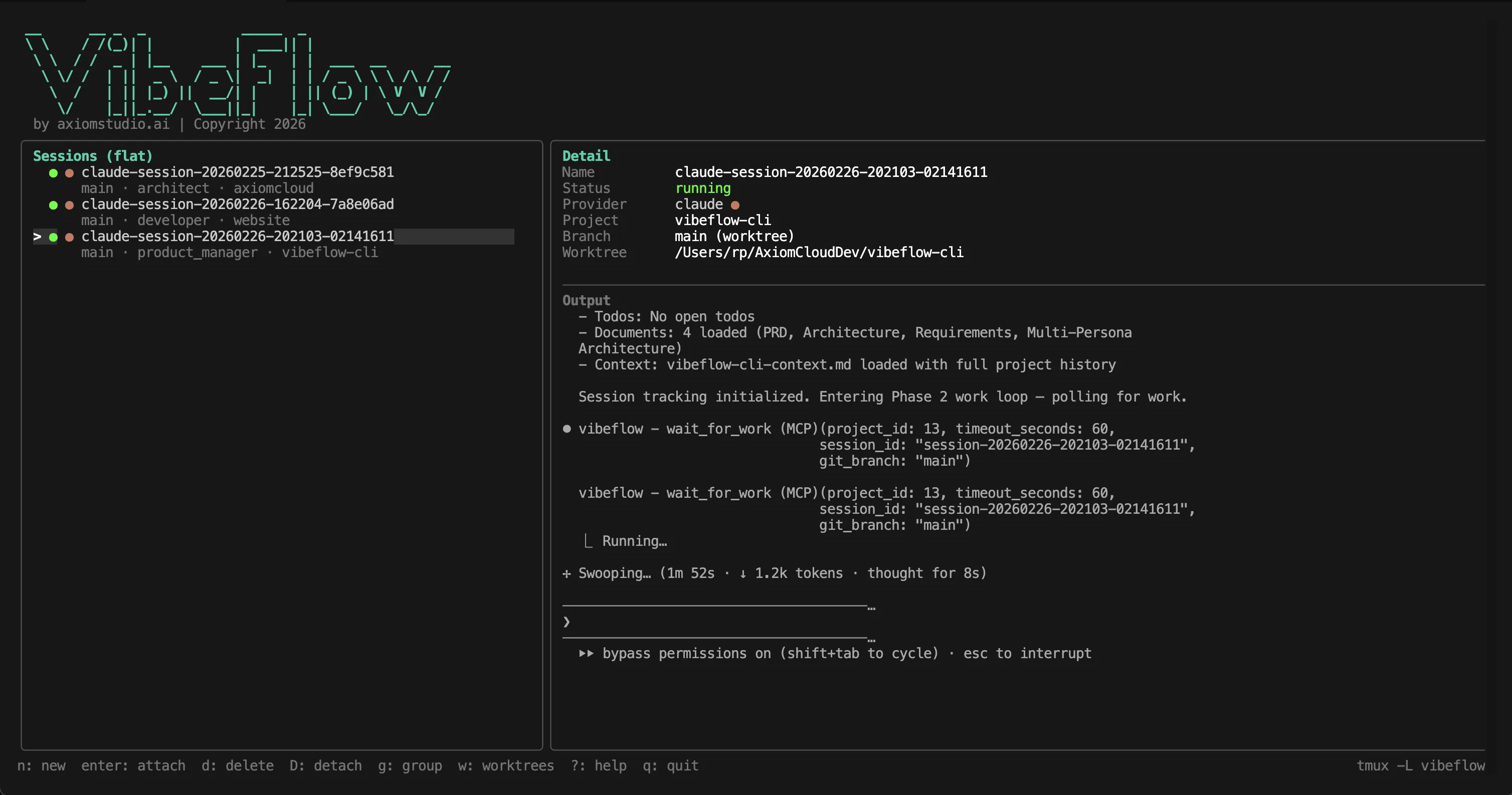
Launch multiple AI coding sessions in isolated tmux sessions. Switch between them with a single keypress — every session's provider, branch, and status visible at a glance.
Built-in support for Claude Code, OpenAI Codex CLI, and Google Gemini CLI. Add any custom agent binary through YAML configuration.
Assign specialized personas — Developer, Architect, QA, Security, PM — to each session. Multiple personas work concurrently without conflict.
Every session runs in its own git worktree on its own branch. No merge conflicts between concurrent agents. Automatic cleanup when sessions end.
Connect to a VibeFlow server and agents become fully autonomous — polling tasks, implementing, committing, and reporting back while you supervise.
Zero external dependencies beyond tmux. Everything embedded — agent configs, provider definitions, full TUI. Works on macOS and Linux out of the box.